Five model jobs sit behind one server
SGLang covers 5 model families: language, vision-language, embedding, reward, and diffusion. It exposes OpenAI-compatible chat, completion, embedding, and Responses APIs, plus native endpoints with more control. Underneath, it schedules concurrent work, caches reusable prefixes, supports structured output, and spreads models across devices or nodes. The README also covers reward models, video and image generation, and rollout work for reinforcement learning.
That range can replace several separate serving systems. It can also make SGLang too much for a small product. A developer who wants one local chatbot still has to choose weights, launch a server, expose an endpoint, and supply the UI. The 107.5 MB checkout makes more sense for a platform team that already owns model storage, accelerators, observability, and capacity planning.
The 580-test Rust result covers one part of a huge repository
The checkout at commit bede6bc had 8,408 files and roughly 2,194,546 lines of source. Our lab targeted the Rust project in ./rust/, rather than every Python kernel, model implementation, accelerator backend, or distributed configuration elsewhere in the monorepo. That scope matters when interpreting a clean result. SGLang contains far more than the component our generic sandbox could compile and test.
The repository has 103 CI workflow files and an active hardware test matrix. GitHub recorded 35,514 stars, 5,140 combined issues and pull requests, and a push on September 6, 2026. Release v0.5.19 arrived the previous day after 786 merged pull requests. The activity is current, and the volume of open work makes careful version selection important.
What happened when we ran it
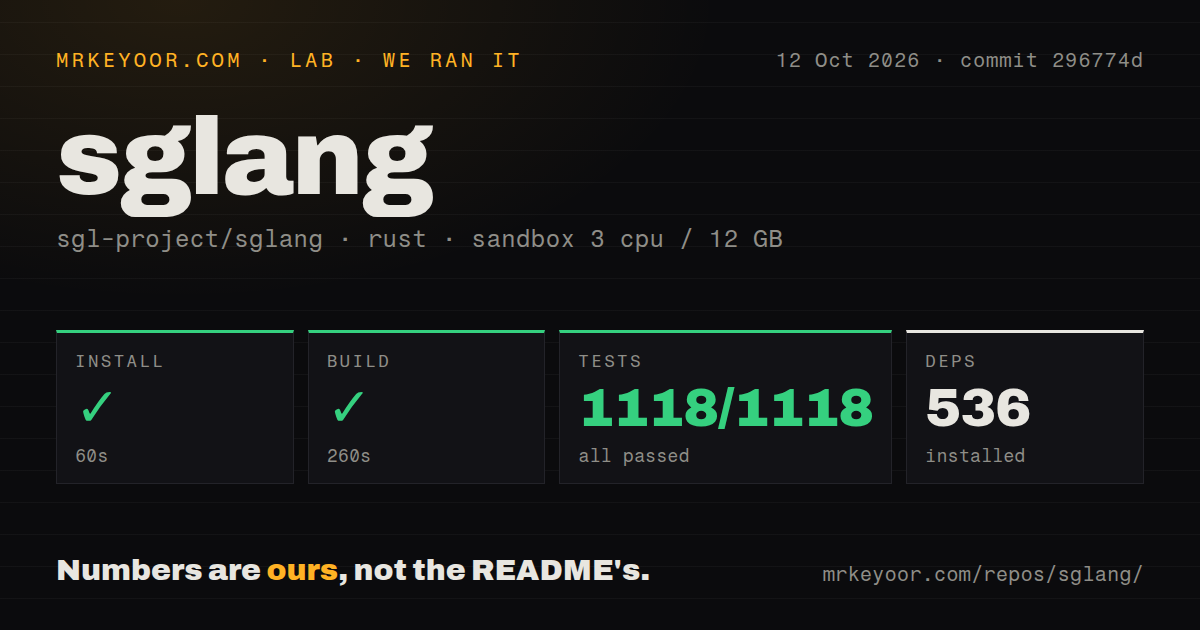
Our sandbox installed 504 Rust packages in 76 seconds. Compilation succeeded in 178 seconds, and cargo test completed in 33 seconds with 580 passed and 0 failed. The unprivileged container had 3 CPUs and 12 GB of RAM, used no secrets, and had no serving accelerator. This result covers commit bede6bc and the Rust project under ./rust/.
The checkout measured 107.5 MB, with 8,408 files and about 2,194,546 source lines. Our scan found 103 CI workflow files, no Dockerfile, and a tests directory. We did not load a model or measure inference. The clean 580-test result says the Rust subproject built and passed in that sandbox; it does not test the Python server, accelerator kernels, or a distributed deployment.
CUDA 13 is the default, and model fit decides the rest
The install guide requires Python 3.10 or newer and primarily addresses NVIDIA systems. CUDA 13 is the default path. CUDA 12 users replace Torch, the SGLang kernel, and DeepGEMM from specific wheel indexes. The guide warns that uv older than 0.12.0 may silently select SGLang 0.5.9 unless prereleases are allowed, because some dependencies publish only prerelease builds. Pin the server and wheel sources.
Containers reduce compilation work but retain the hardware decisions. The example grants all GPUs, sets 32 GB of shared memory, mounts the Hugging Face cache, uses host IPC, and passes a Hugging Face token for gated weights. The docs warn that latest and dev tags move, and recommend an immutable release tag. CUDA 12 images have separate suffixes. A successful docker run still depends on driver compatibility and enough memory for the model.
Eight nondefault hardware paths need separate setup
The install guide links 8 dedicated routes beyond its common NVIDIA GPU instructions: AMD, Apple Metal, Intel Xeon CPU, Google TPU, DGX Spark, Jetson, Ascend NPU, and Intel XPU. Our 3-CPU sandbox tested only the Rust project. Even the default FlashInfer attention backend requires NVIDIA sm75 or newer; the troubleshooting note directs affected users to Triton and PyTorch backends.
Distributed serving adds tensor, pipeline, expert, and data parallel choices, along with prefill and decode separation. Kubernetes examples cover a single-node service and a multi-node stateful set, while SkyPilot and SageMaker have their own routes. For a product group without an inference specialist, each option is another place to mis-size memory, networking, or cache persistence. The 3-CPU lab result cannot answer those operating questions.
Three API references are built in, but session reconnects need testing
The running server exposes 3 API documentation endpoints: Swagger, ReDoc, and an OpenAPI document. Clients can use curl, Python requests, or the OpenAI Python client against /v1/chat/completions; a native /generate endpoint offers SGLang-specific parameters. Streaming is documented for both API styles. Existing OpenAI client code therefore has a short migration path.
Compatibility at the HTTP layer does not settle output accuracy, latency, memory fit, or failure recovery. Open issue 36475 reports that an immediate request after a client disconnect can lose streaming-session state and crash the scheduler. The report concerns an optional session mode on v0.5.18, so it does not establish a failure in ordinary stateless chat. Teams using sessions should reproduce that sequence against the exact release and client behavior they plan to ship.
The September 5 release includes breaking changes
v0.5.19 was released on September 5, 2026, after 786 merged pull requests; GitHub recorded another push on September 6. The release makes the unified radix tree the default, requires FlashInfer 0.6.18 for certain paths, and lists several renamed or removed settings. Frequent releases are useful only if the team budgets time for version selection and upgrade testing.
Choose SGLang when you need its model range, accelerator coverage, caching, or distributed controls and can test them on production-like hardware. Compare throughput, first-token delay, memory use, and recovery using your own prompts and concurrency. For a 1-model, 1-GPU text deployment, vLLM or a vendor runtime may give the team a smaller surface to own.