The weights need about 315 GB before inference overhead
Naive-N0.5-Flash's README says its FP8 weights occupy approximately 315 GB and require compatible NVIDIA GPUs. That is the first adoption decision. If your available machine cannot accommodate the weights plus inference memory, the short Python example will not help. This project targets people evaluating a large coding and AI research model, with hardware planning already part of their job.
The repository itself occupied just 12.5 MB in our sandbox and contained about 400 source lines. That small footprint makes the code approachable, but it describes the model implementation and accompanying assets rather than everything needed to answer a prompt. Downloading the repository gets you a way to inspect the design. It does not put the trained model on your machine or establish that your serving stack supports it.
What happened when we ran it
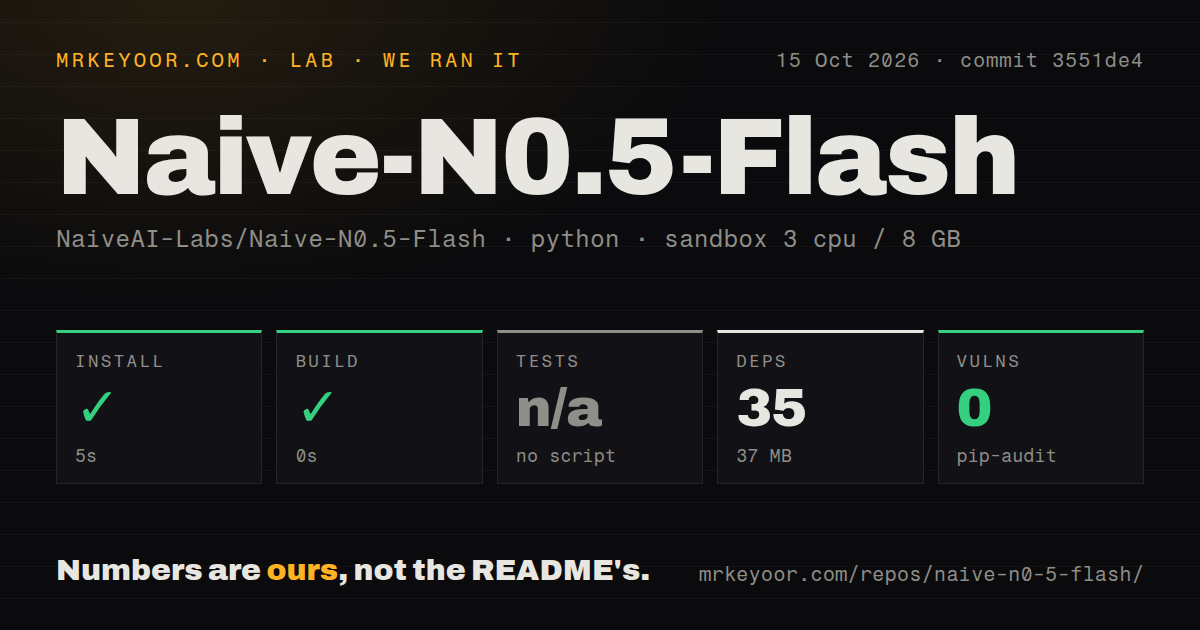
Our run installed commit 3551de4 in 5 seconds, adding 35 packages and using 37 MB on disk. The build step succeeded in 0 seconds as recorded by the harness. We used an unprivileged Debian container with Python 3.12, 3 CPUs, 8 GB of RAM, and no secrets on October 15, 2026. These measurements describe the repository setup that the harness exercised.
Tests were skipped because the project had no test script or target. Pip-audit reported 0 known vulnerabilities. Our scan found 21 files, no CI workflow files, no Dockerfile, and no tests directory. A successful setup therefore gives limited assurance: it shows that the selected dependency and build steps completed, without supplying a test result for tokenization, attention behavior, or model generation.
The 37 MB installed environment is particularly easy to misread beside the hardware requirements. Our measurement did not validate loading the published weights, producing an answer, or serving a long conversation. There is no measured inference speed or coding accuracy here. Anyone comparing this model against a hosted assistant needs a separate evaluation on representative tasks and the intended GPU hardware.
Sparse attention still retains the full history cache
The architecture description lists 309 billion total parameters and 15.5 billion active parameters. Mixture-of-experts models select part of their network for each token, which reduces the computation used on that token. The smaller active count does not mean the remaining weights disappear. Treating it as the memory requirement would lead to buying the wrong hardware.
NaiveAI builds on MiMo-V2.5 and replaces its global-attention layers with sparse attention. Most layers read a nearby window, while a smaller group selects relevant positions from the broader history. The README explicitly says the indexer still scans the full history and retains the full key-value cache. That qualification matters more for capacity planning than the word sparse on its own.
The documented attention window is 128 tokens, and the sparse layers select 2,048 positions for backbone attention. Those are design specifications, rather than results from our run. They explain why this model is interesting to researchers working on long context: it changes which history receives expensive attention. Whether your coding agent retrieves the right distant detail still needs a workload that can expose missed information.
The quick start executes custom model code
The deployment example calls Transformers with trust_remote_code=True for the tokenizer and model. It names the FP8 checkpoint separately from the general model link. Before treating that example as a deployment recipe, choose the exact checkpoint and inspect the custom implementation you will execute. Pinning both code and weights is a sensible requirement for repeating an evaluation or investigating a changed answer later.
Our 35-package sandbox install does not establish that the README's GPU route is ready. The README asks for Transformers with Torch and kernel extras, along with FP8-capable NVIDIA hardware. It provides a generation example rather than a full service configuration. You still need a request-serving process and operating policies if other people will depend on it. An interactive model call leaves those decisions with you.
The advertised API is described as future access
The README says API access will be provided, while the concrete deployment instructions describe loading open weights. That wording does not establish that a hosted endpoint is available to use today. If your project needs an API credential and a working endpoint before development can begin, verify access directly rather than planning around the advertised service. The MIT license makes local experimentation possible without waiting for that offer.
With only 21 files in our checkout and no test target, I would judge this release as a model handoff for experienced evaluators. The documentation explains the attention change and links evaluation notes, but published benchmark charts cannot answer whether a particular repository's build conventions confuse the model. Try it on work you understand well enough to grade, including failures that a plausible explanation could conceal.
September activity offers little issue-history evidence
GitHub recorded the last push on September 27, 2026, with 177 stars and 0 open issues and PRs in the fetched metadata. The recent issue endpoint returned no entries, and the latest-release endpoint returned no release. Those facts leave little public support history to assess. They do not prove abandonment, especially when the repository has been pushed recently.
Our 5-second installation makes inspecting Naive-N0.5-Flash easy. Adoption starts with the much harder question of accommodating its documented weights and proving useful answers on your own tasks. Qwen3 is a better comparison when you want a family with smaller model choices, while DeepSeek-V3 is relevant for another large mixture-of-experts deployment. Choose this model for its specific attention design only after your hardware and evaluation can support that decision.