
vLLM is a serving engine, not a model manager
vLLM turns model weights into an inference process or network service. Its job is scheduling requests, handling the attention cache, batching work, and keeping accelerators busy. The same project supports offline Python inference and servers shaped like familiar hosted APIs. That makes it a good foundation for an internal model endpoint, but it does not choose a model, obtain weights, or decide how much hardware your workload needs.
The scope is large. The README lists more than 200 model architectures, including decoder-only, mixture-of-experts, multimodal, embedding, classification, and reward models. It also covers NVIDIA, AMD, and Intel GPUs, Google TPUs, CPUs, and additional hardware plugins. That breadth is valuable when a platform team must serve several model families. It also means installation advice depends heavily on the device and model path you select.
PagedAttention matters because serving is mostly resource management
The project grew out of work on PagedAttention, an approach to managing the key-value cache used during generation. For an operator, the useful outcome is the ability to combine continuous batching, prefix caching, chunked prefill, and several parallel execution modes in one engine. vLLM also offers quantized formats and speculative decoding options, which gives experienced teams many ways to trade memory, latency, and output behavior.
None of those switches supplies a universal performance result. Our lab did not benchmark token throughput or compare GPUs, so we will not turn the README's speed claims into numbers. Hardware, model architecture, prompt length, concurrency, quantization, and kernel support all affect the result. A sensible evaluation uses your model and traffic shape, then records memory use and request behavior under that exact configuration.
The API can reduce migration work, with compatibility limits
vLLM includes an OpenAI-compatible server, an Anthropic Messages API, and gRPC support. It can stream output, return structured results, run tool-calling parsers, and serve several LoRA adapters. Applications already written against a common chat or completion shape can often point at the new endpoint with fewer client changes than a custom inference wrapper would require.
Compatibility should still be tested parameter by parameter. Issue 50767, updated August 25, reports that presence_penalty and frequency_penalty supplied as server defaults can be silently ignored while other generation defaults work. The report concerns a specific configuration path, not every request. It is still a useful warning: capture the effective sampling settings and verify output-critical defaults instead of assuming that matching endpoint names guarantee matching semantics.
What happened when we ran it
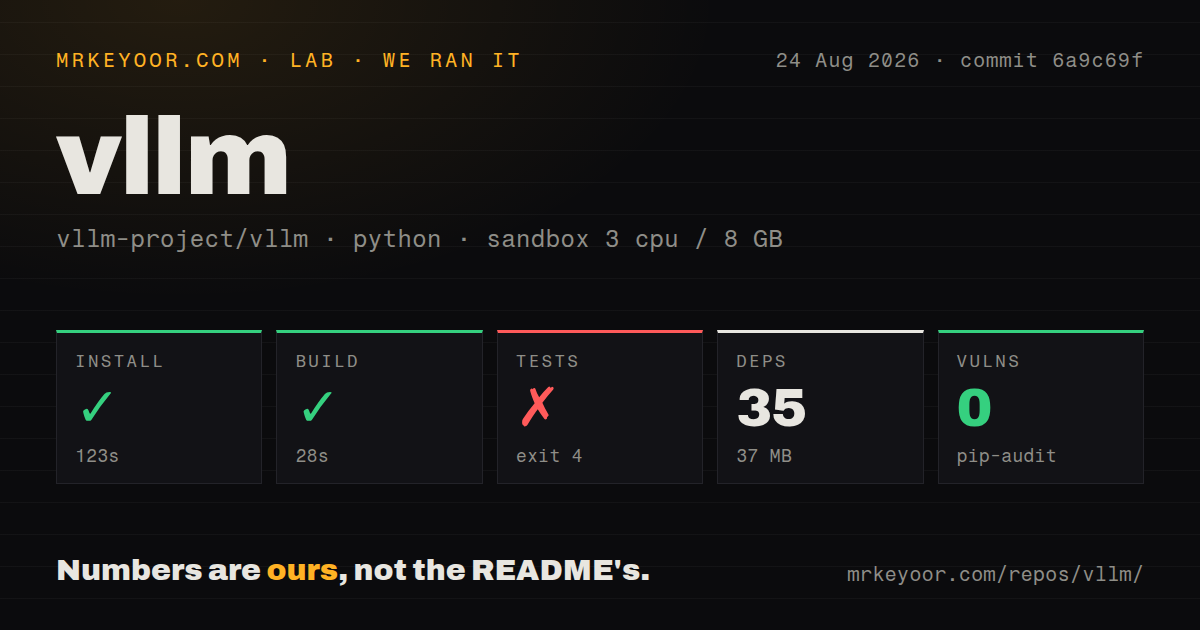
Our sandbox cloned commit 6a9c69f into an unprivileged Debian container with 3 CPUs, 8 GB of RAM, and no secrets. The checkout held 6,707 files, about 1,646,028 lines of source, and occupied 107.1 MB. It had 10 CI workflow files and a tests directory, but no Dockerfile at the repository root.
Installation succeeded in 123 seconds. The environment added 35 packages and used 37 MB on disk. The build succeeded in another 28 seconds. A dependency audit reported 0 known vulnerabilities, which describes the packages present in this run rather than a guarantee about every optional hardware extra or future release.
Tests did not reach any cases. After 12 seconds, pytest exited with code 4 while loading tests/conftest.py; Python could not find the tblib module. The log establishes the missing import and nothing more. It does not show a failing vLLM behavior, nor does it prove that the full suite would pass after adding that package. Contributors following the same path should expect to reconcile the development dependencies before they get a useful test result.
Hardware breadth creates an operations job
The one-line uv pip install vllm command is a starting point for a supported wheel. Running a useful server also means obtaining a model, confirming its license and access terms, fitting its weights and cache into available memory, and choosing server arguments. Quantization can reduce memory demands, while tensor, pipeline, data, expert, or context parallelism can spread work. Each choice adds hardware and networking assumptions.
The documentation separates installation by GPU, CPU, and TPU, then branches again for hardware and deployment patterns. That is the right structure for a project with 10 CI workflow files and many backends. It also rules out treating one successful CPU-oriented package build as proof that a CUDA, ROCm, TPU, or distributed deployment is ready. Test the exact image, driver, model, and kernel combination you will operate.
Current activity supports production use, not careless upgrades
The repository was pushed on August 25, 2026, one day after the commit in our run. GitHub showed 7,018 open issues and pull requests combined, and multiple pull requests were being updated within minutes of our check. The latest release, v0.27.1, arrived August 11 with a focused addition for quantized DSpark Markov heads. Those dates show active maintenance alongside a very large review queue.
Frequent changes are useful for new models and accelerators, but they make pinning important. Validate generation defaults, structured outputs, tool calls, and memory behavior before changing versions. vLLM is the stronger choice when inference is shared infrastructure and a team can own that validation. For a developer who wants to download one model and chat locally, Ollama's smaller operating surface is easier to justify.