A local coding model asks for most of your PC
Strata's installer asks you to choose a model size, context length, and image support before it opens a local chat page. The point is to run Qwen3.8-Flash-Next on consumer hardware by spreading work across graphics memory, system RAM, and the processor. For a developer who wants a large local model behind an existing coding assistant, that is a useful proposition. The hardware commitment comes first.
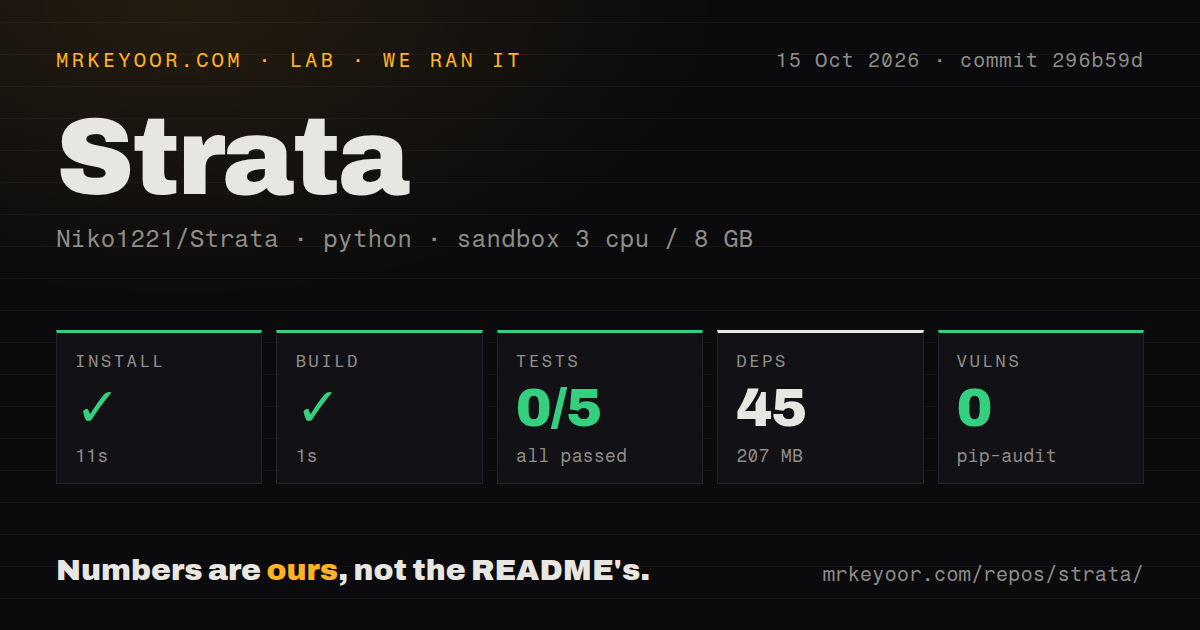
Our checkout occupied 51.3 MB, and the installed Python environment reached 207 MB. Neither number describes a ready-to-chat machine. The README calls for at least 12 GB of graphics memory, 32 GB of RAM, and about 80 GB of free disk. Model files account for a much larger commitment than the repository. Check your available memory with the browser and editor open before picking a model size.
What happened when we ran it
Our run installed Strata commit 296b59d in 11 seconds, adding 45 packages, and the build step passed in 1 second. We used a fresh Debian container on 2026-10-15 with 3 CPUs, 8 GB of RAM, Python 3.12, no secrets, and no elevated privileges. These are repository setup measurements. They establish neither GPU inference speed nor the quality of a generated answer.
Pytest exited with code 3 after 4 seconds. The supplied result was 0 passed, 0 failed, and 5 collection/setup errors. During collection, tools/test_iq_pack.py called add_gguf_py(), which exited because llama.cpp's gguf-py could not be found. The message directs users to run setup.py, which clones llama.cpp into third_party/, or set STRATA_GGUF_PY. Collection stopped before a passing test result could tell us anything about model behavior.
Pip-audit reported 0 known vulnerabilities. The repository scan found a Dockerfile and a tests directory, with 0 CI workflow files. That audit result concerns known dependency advisories in the measured environment. It doesn't certify the native engine, downloaded weights, or network configuration. The missing gguf-py path is the concrete setup failure to resolve before treating this checkout as a working development environment.
Default requests queue behind each other
The README's usage instructions say Strata handles one request at a time by default. Additional callers wait. You can enable parallel processing, but the documentation warns that answers slow down on a small graphics card. That makes a single developer's local assistant a clearer fit than a shared team endpoint. We haven't measured throughput under either configuration.
The 3 CPUs and 8 GB of RAM in our sandbox were below the README's stated RAM requirement. A successful package install therefore cannot support a recommendation about gaming-PC performance. Strata keeps frequently used model experts on the GPU and other experts in system RAM. If your machine cannot hold the selected size, the documentation warns about disk activity, poor responsiveness, and engine exits. Those are reasons to choose a smaller model before changing tuning flags.
Existing clients connect through local API routes
Strata exposes OpenAI-compatible requests at http://127.0.0.1:8080/v1, an Anthropic-compatible messages route, and a Responses route. Its browser interface includes chat and a hardware monitor. You can point a compatible coding client at the server instead of replacing your editor. Local requests accept any API key and model name according to the README. Network sharing requires deliberately setting a secret.
An 11-second package install says little about how well those clients work with a particular model. Tool calling, reasoning settings, and image inputs still need checks in the application you use. Strata's MIT code license also doesn't settle the licenses of every component or model: the README explicitly separates them. A company evaluating local coding should review the chosen weights alongside the server configuration.
AMD image support has a Windows boundary
The README says AMD cards process pictures through the CPU on Linux, while AMD image input on Windows is unavailable. Apple Silicon and Intel Arc appear among experimental community-supported routes. Those distinctions matter more than a generic claim of hardware support. If Windows image input on an AMD card is the requirement, the documented route currently fails the selection test before performance enters the discussion.
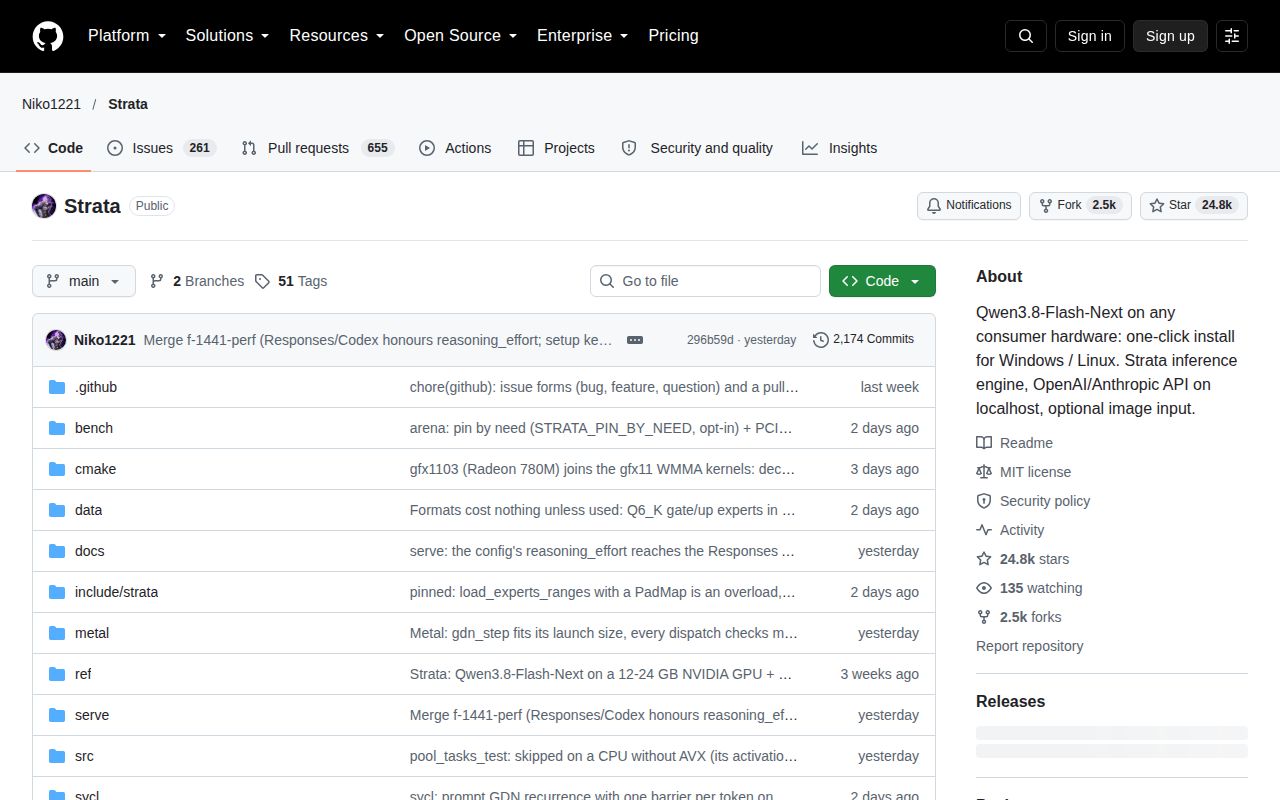
Our 3,177-file checkout contained about 350,952 source lines. The project includes a native engine as well as Python setup and serving tools, which helps explain why the lab's Python classification differs from GitHub's C++ language label. The MCP management server can let Claude Code and other assistants inspect hardware, install models, and manage the process. Its installation tool first returns a plan and requires confirmation before proceeding.
October maintenance includes specific hardware fixes
The last push was 2026-10-14, and GitHub showed 916 open issues and PRs. Recent activity included work on Intel graphics and shared model memory. Release v0.1.44.1, published that day, documents fixes for older processors and Apple Metal behavior. That is evidence of active maintenance, with hardware compatibility still changing. A busy tracker should prompt you to check your exact platform rather than count every open item as a bug.
I would choose Strata for a dedicated local coding machine whose owner accepts model downloads and platform-specific troubleshooting. Our 207 MB Python environment is an encouragingly small part of that commitment, but the failed collection step prevents a clean setup recommendation. Choose llama.cpp when you want direct control over a general inference engine, or Ollama when a general local model workflow matters more than Strata's particular model and memory strategy. Before relying on Strata, get past the missing gguf-py dependency and verify an answer through your own client.