Ollama turns a model file into a familiar local service
The shortest explanation of Ollama is also the useful one: install it, choose a model, and talk to that model through a terminal or HTTP request. The server listens on a local API, with official Python and JavaScript libraries for applications that do not want to assemble raw requests. The README also documents direct launch paths for Claude Code, Codex, Copilot CLI, OpenCode, and OpenClaw. That makes Ollama a practical adapter between downloadable models and software already built around conversational APIs.
Its convenience sits above a substantial codebase. Our checkout had 1,315 files and roughly 351,641 lines of source, even though it occupied only 54.2 MB. Ollama manages model acquisition, local storage, prompting through Modelfiles, imports, runtime selection, and a resident server. Those choices save time for one developer. They also mean the tool makes decisions that an inference engineer may prefer to control directly through llama.cpp or another lower-level runtime.
The packaged install hides a native build toolchain
The README gives macOS, Windows, and Linux users a one-line installer, alongside manual downloads and an official Docker image. Running ollama then prompts the user to select a model or connect an integration. No hosted credential is required for the basic local route. The model itself must still be downloaded, and its size and memory needs are separate from the 177 packages our source install obtained.
Building commit fb30760 exposed more machinery. Ollama includes native code compiled with CGO, and its development guide requires Go, CMake 3.24 or newer, plus a platform compiler. A clean native build uses CMake and places runtime files under build/lib/ollama. The guide warns that Go and CGO data structures can fall out of sync during development, in which case a full native rebuild may be needed. This is ordinary systems work, but it is more involved than the front-page install command suggests.
What happened when we ran it
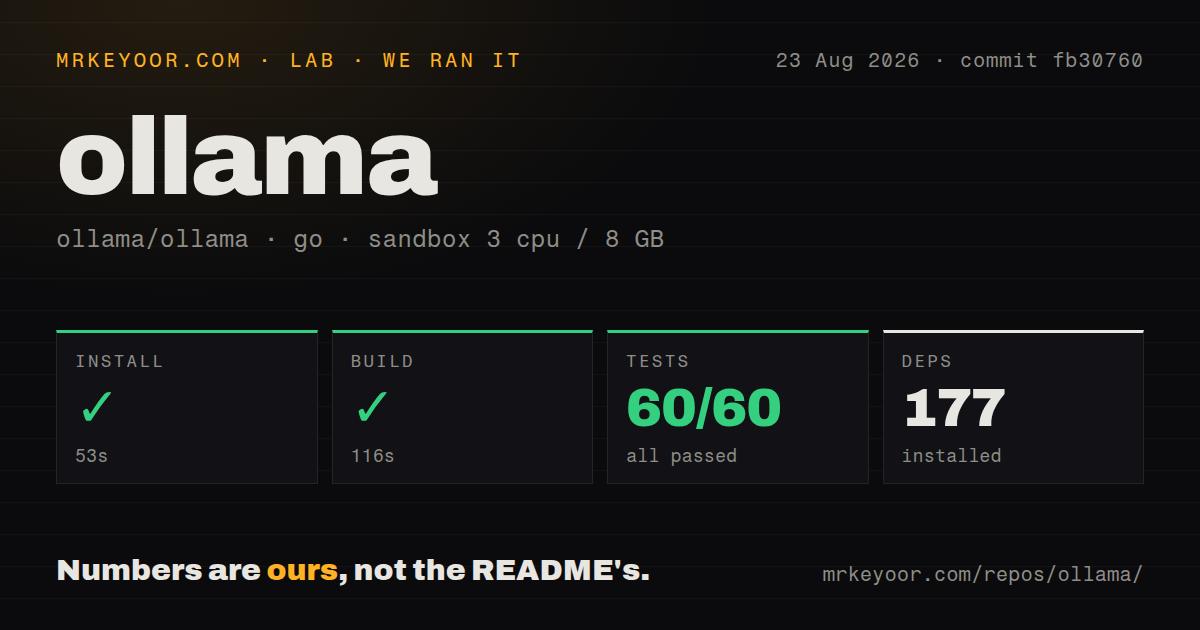
Our sandbox installed Ollama in 53 seconds and pulled 177 Go packages. The build completed in 116 seconds. We then ran the available Go tests, and all 60 passed in 137 seconds with 0 failures. Those are clean results for the exact fb30760 checkout in a fresh unprivileged Debian container with 3 CPUs and 8 GB of RAM.
The repository scan found 5 CI workflow files and a Dockerfile, but no separate tests directory. Go projects commonly keep tests beside the code they cover, so the missing directory does not conflict with the 60 passing packages. We did not download a model, measure token generation, or test a GPU in this run. The figures say the source installs, compiles, and passes its available suite in our environment. They do not predict whether a chosen model will be fast on a reader's machine.
Hardware support depends on the exact platform and backend
A fresh source build on macOS arm64 includes Metal inference. On other platforms, the development guide says the default build is CPU-only unless the operator selects a backend. Current choices include CUDA 12 and 13, ROCm 7.1 and 7.2, Vulkan, and JetPack variants. Optional MLX support has another branch of requirements. CUDA MLX needs CUDA 13 or newer plus cuDNN 9 or newer, while Apple Silicon requires Xcode and the Metal toolchain.
That matrix matters when the easy demo becomes a hardware purchase. Windows ARM does not support the extra acceleration libraries. On Linux, CUDA, ROCm, and Vulkan each bring their own SDK or packages. Open issue 17971 reports one Windows and Nvidia setup using less than 40% of available GPU memory and falling back more heavily to system RAM. It is one unresolved report, not a general benchmark, but it is a good reason to test the exact model, Ollama release, driver, and machine before promising response times.
Integrations are broad, while compatibility still needs testing
Ollama's ecosystem is one of its strongest reasons to choose it. The README lists web chat products, desktop clients, coding tools, orchestration libraries, and language-specific SDKs. Its REST example is small enough to understand at a glance. For a developer switching between a terminal experiment and an application prototype, using the same local service removes a lot of glue code.
The integration list should not be read as a guarantee that every model speaks every client's dialect correctly. Open issue 18059 reports a 400 response when GLM5.3-flash cloud was used with Claude Code 2.1.247. Another long-running issue describes an escaped macOS image path being treated as text in the CLI. Both reports are narrower than the whole product, yet they show where model-specific formats and client parsing can leak through the abstraction. Test tool calls, images, structured output, and thinking controls with the exact combination you intend to ship.
August 2026 activity is high, along with a large work queue
GitHub recorded 179,525 stars and 3,800 open issues and pull requests when fetched. The last push was August 27, 2026, and v0.33.1 was published on August 26. That release updated MLX and llama.cpp, added structured output to the MLX runner, and addressed Metal GPU timeouts while loading models from slow storage. The combined open count is not a defect count, but it does signal how much hardware, model, and integration variety the maintainers receive.
Ollama earns a first try because the local workflow is direct and our 60-test run was clean. Keep the decision narrow: it is a convenient model runner and API, not a complete chat product or a guarantee that inexpensive hardware will run any model well. For one workstation or a private development service, that trade is usually sensible. For a shared GPU fleet with service-level targets, compare vLLM or another server under the real workload before standardizing.