The GPU deployment deserves more scrutiny than the install
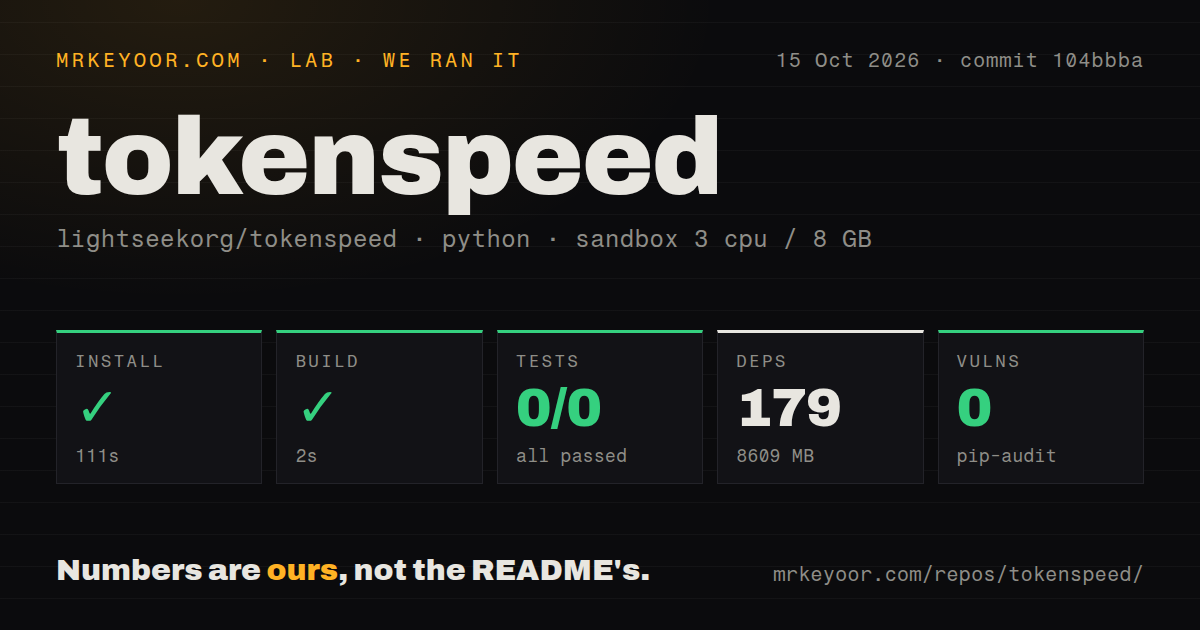
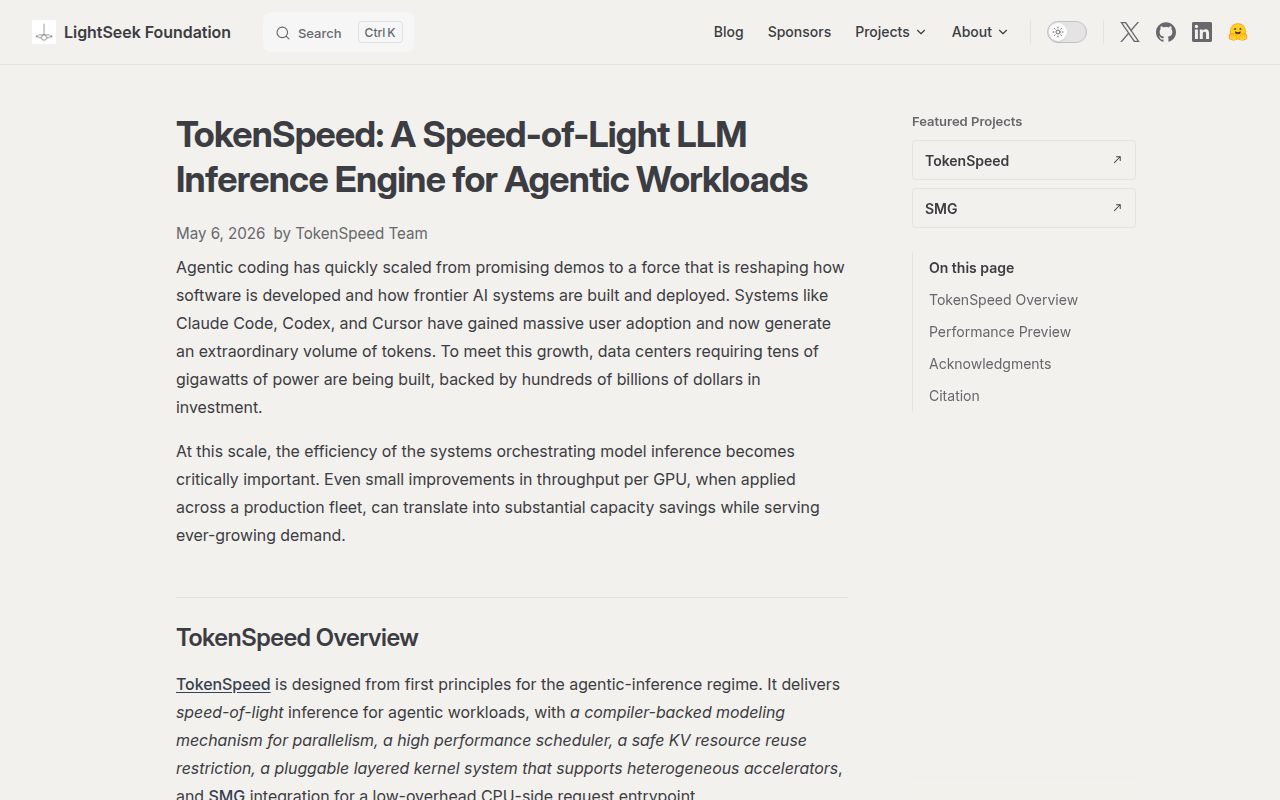
TokenSpeed occupied 8,609 MB after installation in our sandbox. Before replacing a working inference server, you should have a particular model and GPU combination worth evaluating. The project targets agent workloads, where a coding assistant repeatedly asks a model for more output. Its README makes ambitious performance comparisons, but our measurements cover repository setup. They provide no basis for calling it faster than your current server.
The architecture gives an inference engineer something concrete to investigate. A C++ scheduler manages request lifecycles and ownership of the model's cached attention state. Python handles execution, while a separate kernel system chooses accelerator operations. That separation lets you work on model execution without putting the whole scheduling system in Python. Whether it pays off depends on the requests and hardware you actually operate.
What happened when we ran it
Our run installed TokenSpeed commit 104bbba in 111 seconds and completed its build in 2 seconds. The October 15, 2026 measurement used an unprivileged Debian container with 3 CPUs, 8 GB RAM, and the Python 3.12 uv image, without secrets. Installation added 179 packages. These are successful package and build steps, with no measured inference throughput or model-output result attached.
Pytest exited with code 5 after 3 seconds. The log says "no tests ran in 0.07s", and the summary reports 0 passed and 0 failed out of 0. No individual assertion failed because the command ran no test cases. The log doesn't explain why collection found nothing. A different working directory or missing system package would be speculation, so neither is a diagnosis we can make.
Pip-audit reported 0 known vulnerabilities. The checkout contained 2,624 files, roughly 952,763 source lines, and occupied 41 MB before installation. Our scan found 48 CI workflow files and a tests directory, but no Dockerfile. Those signals don't convert an empty local collection into a passing suite. The practical finding is that our setup reached a successful build without producing behavioral test evidence.
The documented runner needs privileges our sandbox did not have
The getting-started guide expects a GPU host and launches its development container with privileged mode and host namespaces. That deserves a check against your container policy before adoption. A successful unprivileged package install does not validate that runner. Access to the chosen checkpoint is another requirement, with credentials depending on the model's distribution terms.
The 8,609 MB installed footprint is a capacity consideration even before you assess checkpoint storage. The source runtime lives in ./python/, with separate kernel and scheduler packages. CUDA and ROCm have distinct package routes, and the guide warns against mixing their nightly indexes. Pin the backend you intend to deploy. A generic Python environment is too little information to reproduce a GPU serving setup.
Familiar client calls still need TokenSpeed-specific settings
TokenSpeed's launch guide exposes an OpenAI-compatible HTTP server. Existing clients can point at its base URL, which makes an application trial easier. The production example also selects reasoning and tool-call parsers for the model family. Those settings matter to an agent that expects a structured tool call it can execute, rather than ordinary text containing a description of one.
Our 2-second build says nothing about whether those parsers preserve your application's behavior. Keep recorded agent conversations and check the returned tool arguments before switching traffic. The documentation also asks operators to choose memory limits, parallelism, and kernel backends explicitly. That is reasonable infrastructure work for a serving team. It is a poor fit for someone looking for a small local chat application with automatic hardware choices.
vLLM-style flags can change meaning during migration
The parameter compatibility table distinguishes the per-iteration scheduling budget from the global token pool. A familiar batching flag therefore needs interpretation before you copy a launch command. Attention and expert backends also use TokenSpeed-specific choices. An accepted command line is insufficient evidence that your concurrency and memory assumptions survived the move. Compare the documented meanings against the workload your existing server handles.
The Python 3.12 sandbox result is a useful starting point for package compatibility, with a much narrower scope than migration approval. Teams already using vLLM should keep it as their comparison deployment. SGLang is another serving option worth checking for an exact model recipe. Choose between them using the model, accelerator, and response format you need, rather than transferring performance claims between unrelated configurations.
October activity includes a hardware-specific correctness follow-up
GitHub recorded a push on October 15, 2026, with 2,333 stars and 82 open issues and PRs. Release v0.1.1 was published on October 6. Recent issue discussion also shows continuing engineering work. In issue 1373, the reporter moved the weight-transfer concern from removed endpoints to the distributed-update path. An October 12 maintainer comment says the root-cause fix was verified on H200 and asks for confirmation on AMD.
That unresolved hardware check matters if you're connecting a trainer to a live server. It doesn't establish that every TokenSpeed deployment has broken weight transfer. With 0 locally executed tests in our run, though, we have no independent correctness evidence to settle it. For an AMD rollout loop, require the reported round-trip check: change weights, restore the originals, and confirm that model output returns to its baseline.