One task file reaches more than 20 infrastructure targets
SkyPilot's README lists Kubernetes, Slurm, and more than 20 cloud or infrastructure providers behind one task format. A YAML file states the requested CPU or accelerator, the files to copy, setup commands, and the command to run. The same job can then move when capacity, price, or hardware availability changes. For a team that regularly hunts for GPUs, that is a concrete reduction in provider-specific scripts.
Across those 20-plus targets, the abstraction reaches beyond provisioning. SkyPilot queues jobs, streams logs, retries capacity failures, and can stop idle resources. It also exposes a Python API and a shared API server for teams. Those features put it between the workload and every account it touches. You gain one control surface, while failures in IAM, quotas, storage mounts, networking, or provider adapters still belong to your operators.
What happened when we ran it
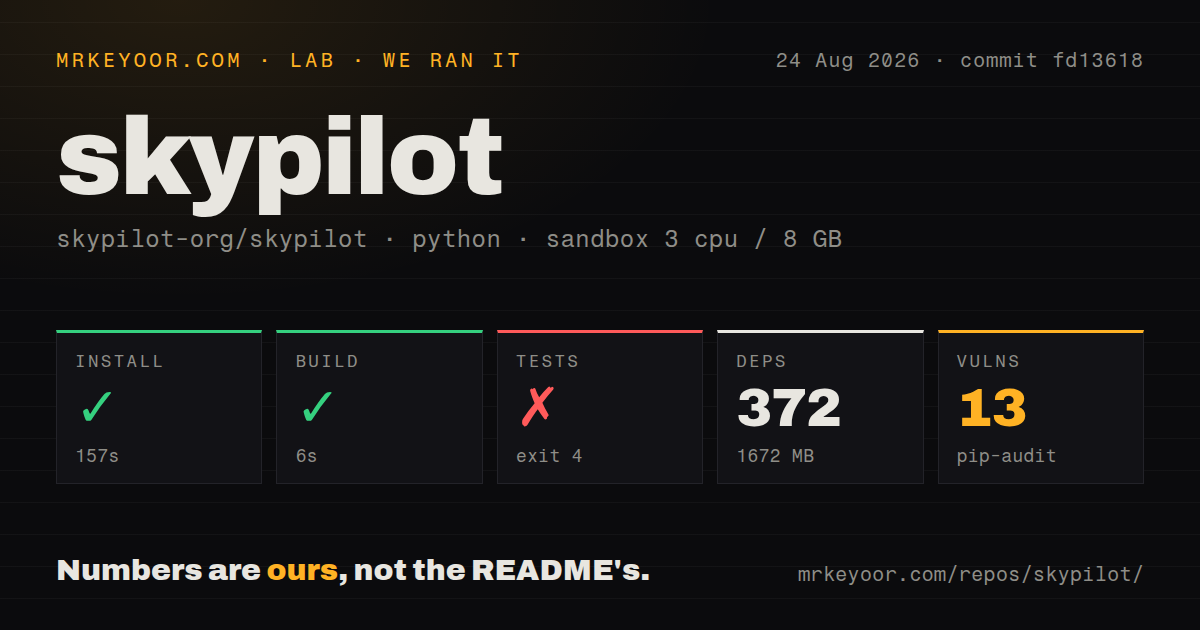
Our sandbox installed commit fd13618 in 157 seconds. The process added 372 packages and left 1,672 MB on disk. The source checkout was already 98.8 MB, with 2,526 files and about 524,825 lines of source. That is a large local tool before a model, dataset, container image, or cloud workload enters the picture. The repository also contained 29 CI workflow files, a Dockerfile, and a tests directory.
The build succeeded in 6 seconds. Tests then failed with exit code 4 after 10 seconds. The log ends inside generate_user_hash(): Python's getpass.getuser() called pwd.getpwuid(os.getuid()), and UID 1000 had no passwd entry. The log supports that narrow finding. It does not show a failed cloud integration or a broken scheduler, and it does not prove how the suite behaves when the user lookup succeeds.
Pip-audit reported 13 known vulnerabilities in the 372-package environment. The supplied measurement does not include names or severities, so we cannot rank the exposure from that number alone. It is still enough to require an audit review before this environment handles cloud credentials. These results came from an unprivileged Debian container with 3 CPUs, 8 GB of RAM, no secrets, and Python 3.12 on August 24, 2026.
The first launch needs credentials and hardware quota
The installation guide supports uv and pip, with Python versions extending through 3.13 in its current examples. The uv environment must include pip because SkyPilot uses it to build wheels during remote setup. Provider extras are installed separately, then sky check inspects credentials. A remote API server removes most local provider dependencies, though somebody still has to deploy and secure that server.
The README's sample asks for 8 A100 GPUs and warns that the account needs access to those instances. New cloud accounts may begin with low or zero GPU quota, according to the setup guide. SkyPilot is bring-your-own-cloud: resources stay in your accounts, VPCs, and clusters. Budget limits and autostop help, but they do not replace IAM review, quota requests, network policy, or billing alerts.
Version 0.13.0 adds another operating layer
Release v0.13.0, published July 22, 2026, added Sky Batch, Hugging Face storage, lifecycle hooks, a debug-dump command, and per-instance hourly cost caps. The same release expanded GKE Autopilot handling and changed API-server behavior. This is useful work for a platform team. It also shows why SkyPilot should be evaluated as infrastructure software rather than a disposable launch script.
Sky Batch splits data across worker pools and reuses workers between jobs. Lifecycle hooks run around autostop, preemption, or shutdown events. The debug dump collects logs, state, and configuration into a zip. Each feature can save operator time, and each deserves its own access policy. A diagnostic archive and automatically supplied API-server credentials are sensitive artifacts, especially on a shared deployment.
Two open issues affect scripts and secret handling
Open issue 10713, updated September 16, 2026, demonstrates sky status -o json writing a colored human message before an empty JSON array when a cluster is absent. The command exits 0, but a normal JSON parser fails on the extra line. If cleanup, monitoring, or deployment code consumes this output, reproduce the absent-cluster case before trusting the machine-readable flag.
Open issue 10741 reports that credentials passed with --env persist in plaintext request records, while --secret values receive client-side redaction. Issue 10742 reports a separate naming collision in which distinct display names can map to the same cloud resource name. Both reports were opened September 12, 2026 and include code paths or reproductions. Treat them as open reports to verify against the revision you plan to deploy.
The narrower alternatives remove one whole layer
SkyPilot's 372-package install buys a broader job-and-infrastructure layer than Ray or Kueue. Ray is the closer choice when distributed Python execution is the main job and compute already exists. Kueue fits teams committed to Kubernetes that need admission and queueing. dstack deserves a direct trial when cross-provider AI orchestration is still the requirement.
That choice depends on how often infrastructure placement changes. The repository had 10,617 stars, 127 open issues, and a last push on September 18, 2026, so maintenance is active despite a sizable issue queue. A team launching the same workload into AWS, GCP, and Kubernetes each month can justify this control plane. A team with one stable cluster should keep the 372 packages and 1,672 MB out of its path.