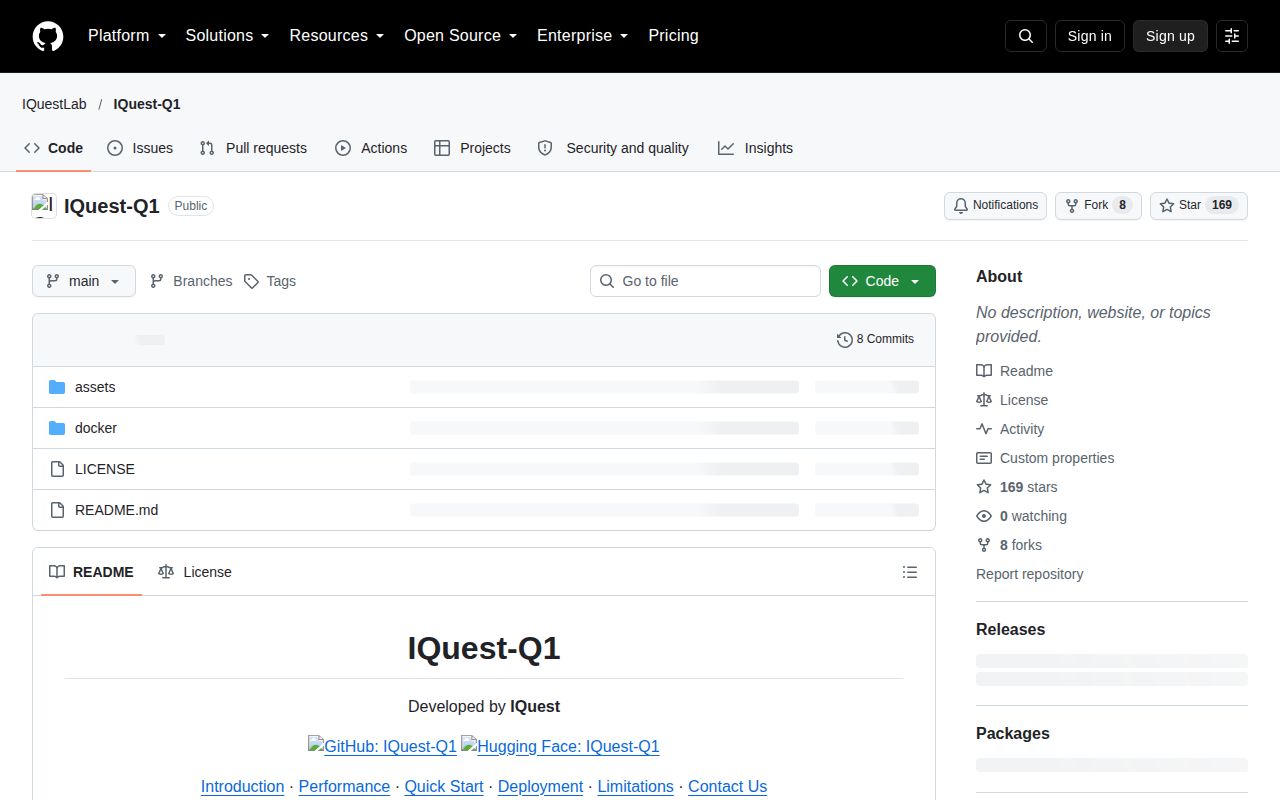
A 320B-parameter model makes serving the first decision
IQuest-Q1 describes a mixture-of-experts model with about 320B total parameters and an estimated 15B activated per token. Those figures answer different questions. Activating a subset of experts does not turn the published checkpoint into a small laptop download. The repository's practical value is its serving and agent-integration guidance. Before comparing benchmark charts, decide whether your team can operate the model behind a compatible endpoint at all.
The IQuest-Q1 README gives a context length of 524,288 tokens and describes coding, reasoning, and multi-step tool use. It also states that the checkpoint is text-only. A large context allowance cannot make a screenshot or audio recording readable to this model. That limitation rules it out for coding workflows that depend on directly inspecting browser images, unless another component converts the input into something the model can consume.
What happened when we ran it
We did not run IQuest-Q1 at commit 1815b60 on October 15, 2026 because our harness detected no supported ecosystem and no Dockerfile, with language recorded as null. The sandbox allocation was 3 CPUs and 8 GB of RAM, without secrets or elevated privileges. There are no installation timings, build results, test results, or vulnerability-audit findings from that attempt. The correct outcome is an execution gap, not a failed inference benchmark.
The current repository links Docker recipes under docker/, while our harness record says it found no Dockerfile. Those statements concern different evidence: a detection result and the files documented upstream. Neither establishes that an image was built successfully on our equipment. The serving instructions and model benchmark images remain author-provided material. We cannot use them to fill in missing lab measurements or claim that an agent completed a task successfully.
Both serving examples use tensor parallelism of 8
The README's vLLM and SGLang examples set tensor parallelism to 8 and require downloading the IQuest-Q1 weights. They also name IQuest-specific reasoning and tool-call parsers. This is useful configuration detail for an inference operator, but it is a substantial prerequisite for someone expecting a quick coding assistant. The repository does not give us a measured memory footprint or a validated smaller deployment from which to recommend hardware.
The Docker build guide targets Linux x86-64 and pins base images by digest. It warns that those pins do not constitute a complete dependency lockfile. The vLLM recipe combines an upstream wheel with the IQuest plugin, while the SGLang recipe uses a fixed fork revision for an FP8 loading fix. An operator needs to preserve those relationships when updating components, rather than swapping image tags and assuming compatibility.
Chat compatibility does not settle agent compatibility
The quick-start client sends a chat-completions request to a local OpenAI-compatible endpoint. The agent instructions demand more: Anthropic Messages support for Claude Code or Responses support for Codex, plus compatible handling of tools and reasoning. A greeting returned by the chat endpoint would leave those integration requirements unresolved. Evaluate the actual client you intend to use, including malformed tool calls and task recovery, before trusting an unattended session.
The README recommends specific client versions and explicitly warns that a client-side model label does not expand its 524,288-token context window. Those details are reasons to pin the complete combination of client, gateway, parser, and model. A model comparison that changes all of them at once cannot tell you which component helped or failed. The supplied benchmark chart does not replace that application-level check.
The example agent configuration removes execution protections
The Codex snippet sets approval_policy to never and sandbox_mode to danger-full-access. It backs up existing configuration files, then writes replacements in the user's configuration directory. That is a consequential default in an example intended for running generated actions. Read it before copying it, and prepare an isolated configuration appropriate to your environment instead of running the whole snippet against a working account.
IQuest's limitations section says real CLI tasks may involve repeated failed attempts, overlooked constraints, and unresolved issues. That candor matters more to an adoption decision than a favorable chart. Pair those stated reliability limits with the example's unrestricted execution settings and the operating burden becomes clear: the person running the agent must provide the boundaries and judge whether a task actually finished. The model's own explanation is insufficient evidence of completion.
October documentation work shows attention, not verified inference
The last push was October 5, 2026. GitHub listed 169 stars and no open issues and PRs, while the fetched history contained closed documentation contributions. Pull request 2 added the Docker recipes and explicitly said its validation did not include image builds or GPU inference. The latest-release endpoint returned no release record. There is evidence of documentation maintenance, with little public discussion showing how runtime defects are handled.
Qwen3-Coder and DeepSeek-V3 are reasonable comparison candidates if you already operate their serving stacks. Choosing among them needs a workload and execution environment, neither of which this lab attempt supplied for IQuest-Q1. I would shortlist it for an inference team's controlled trial. I would not move a working coding agent onto it based on the README's chart or copy its unrestricted client configuration into a normal development account.