TensorRT-LLM turns NVIDIA GPUs into a model-serving stack
TensorRT-LLM combines a PyTorch-facing model layer, GPU kernels, request scheduling, and serving tools. The goal is practical: take a supported model checkpoint and run it efficiently on one NVIDIA GPU, several GPUs, or several nodes. You can call the model from Python for offline work or expose an OpenAI-compatible HTTP service. The repository also covers visual-generation models through a separate API.
This is infrastructure for teams that have already chosen NVIDIA hardware. The current supported-hardware page names B200, GB200, B300, GB300, DGX Spark, H100, H200, GH200, L20, L40 and L40S, plus A100. CPU, AMD, and Apple Silicon paths are outside that list. If portability is the deciding requirement, llama.cpp or another server is a more direct fit.
Online serving and Python inference use the same model layer
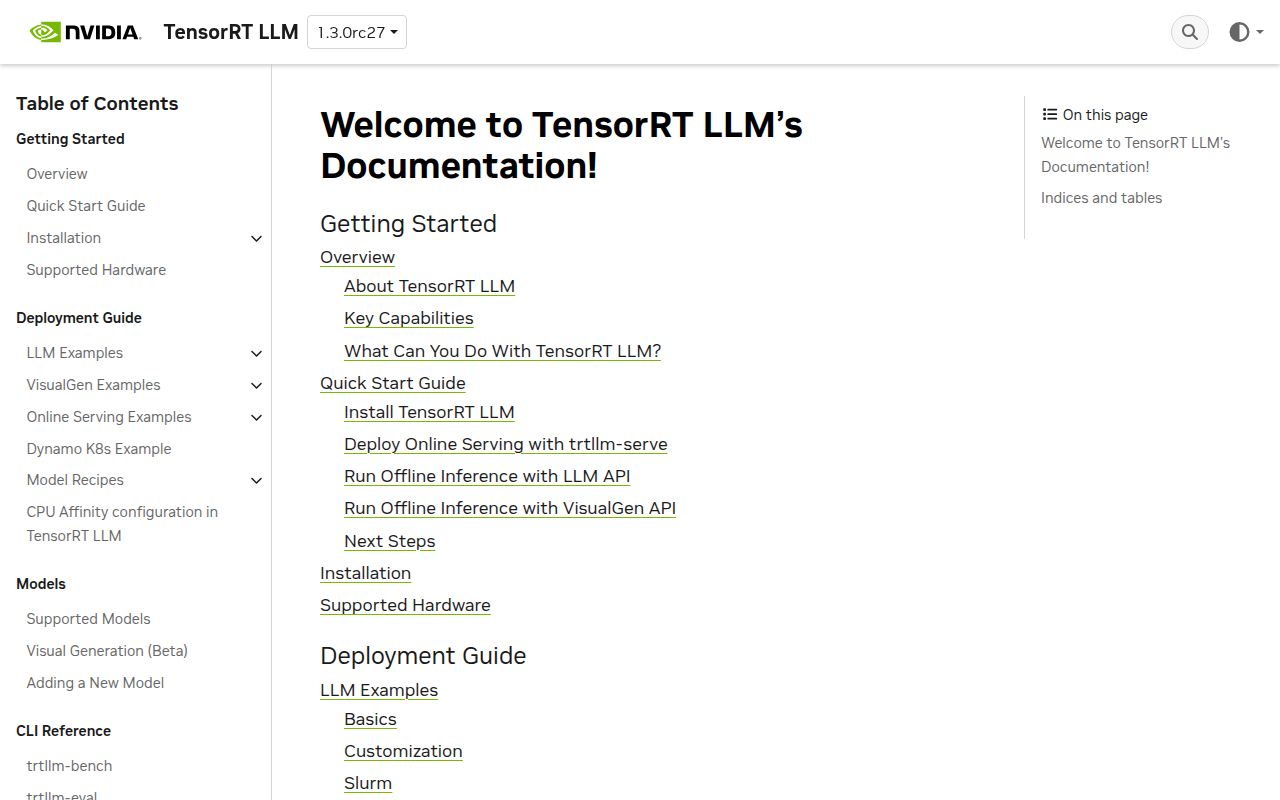
The quick start launches trtllm-serve with a Hugging Face model name and exposes endpoints such as /v1/chat/completions on port 8000. Offline code creates one LLM object, which handles loading, tokenization, optimization, and generation. That gives application teams a familiar HTTP surface while model engineers can stay inside Python.
The convenient entry point does not make model support uniform. NVIDIA publishes separate matrices for language, encoder-decoder, multimodal, and visual-generation workloads. Entries call out combinations that are unsupported or untested. DeepSeek-V4, for example, is listed only for Blackwell GPUs at SM100 or newer. Treat the row for your model and feature set as part of the deployment contract.
What happened when we ran it
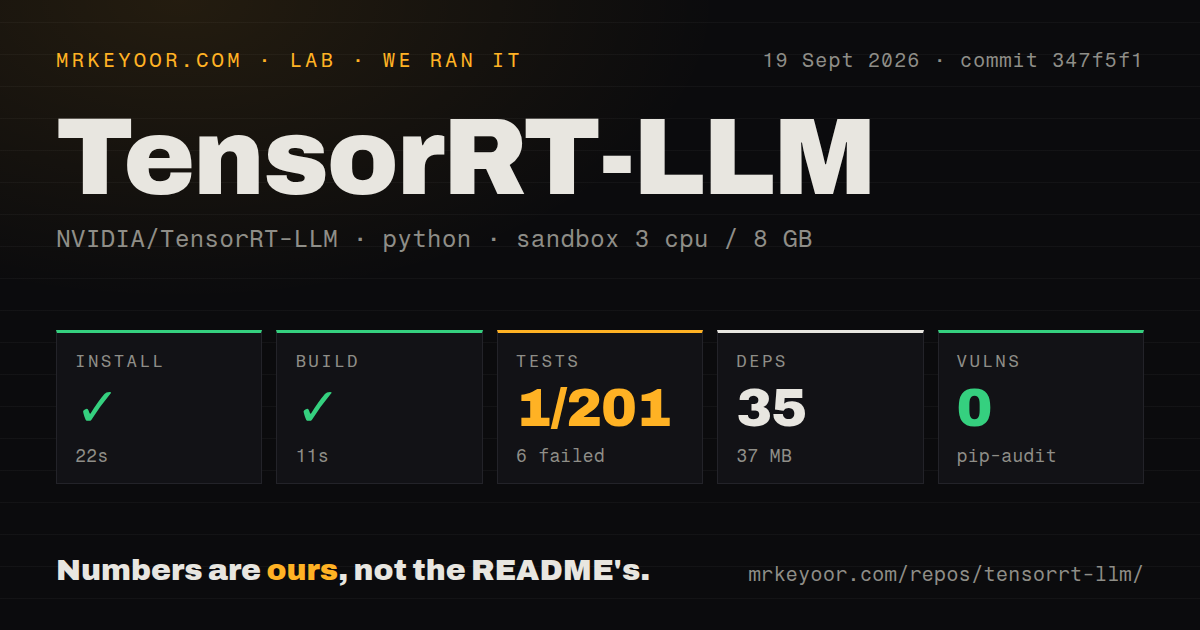
Our sandbox installed 35 Python packages in 22 seconds and used 37 MB on disk. The build completed successfully in 11 seconds. Pip-audit found 0 known vulnerabilities in the installed environment. Those checks ran against commit 347f5f1 in an unprivileged Python 3.12 Bookworm container with 3 CPUs, 8 GB of RAM, and no secrets.
The test command failed after 18 seconds. Pytest reported 1 passed, 6 failed, and 194 collection or setup errors out of 201 before stopping. The GPU-test log repeatedly ended with FileNotFoundError for nvidia-smi, which was absent from the container. That result says the checked test selection expects NVIDIA system tooling that our plain sandbox did not provide. It does not measure inference correctness or speed on a supported GPU.
Six agent-flow tests failed separately. The summary showed one ModuleNotFoundError for claude_agent_sdk and five assertion failures around examples, environment overrides, help output, and entry-point imports. The log tail does not establish one shared cause, so we will not assign one. The checkout itself was large: 16,351 files, about 2,300,011 source lines, and 221.2 MB, with 19 CI workflow files and a tests directory.
The NGC container avoids much of the dependency matching
NVIDIA calls the prebuilt NGC release container the simplest installation. It arrives with the wheel and runtime environment together, accepts --gpus all, and exposes port 8000 in the documented command. The image also records its source commit in TRT_LLM_GIT_COMMIT, a useful detail when an operator needs to match a running container to code.
The Linux wheel route asks for more care. It is tested on Ubuntu 24.04, requires CUDA Toolkit 13.2 and libopenmpi-dev, and may need a CUDA compatibility package depending on the driver. The guide warns that the public PyTorch wheel can differ from NVIDIA's NGC PyTorch build. It also documents a case where pip replaced an existing CUDA-compatible Torch package with an unusable version on some Ubuntu 22.04 systems.
Default telemetry and a 3-month window affect governance
Usage reporting is enabled by default outside CI and test environments. The README says it excludes prompts, outputs, model weights, paths, and persistent identifiers. It does collect items such as GPU type and count, CUDA version, model architecture, parallelism settings, quantization, feature flags, process status, and selected API configuration. That can be acceptable operational data, but the decision belongs in deployment review rather than an engineer's shell history.
Four opt-out paths are documented: environment variables, a configuration file, the Python API, and CLI flags. The API policy deserves the same review. Beginning with version 1.0, deprecated interfaces receive a 3-month migration period before removal under the versioning policy. Teams that update slowly should pin the container and read release notes before changing either the wheel or model recipe.
September activity is intense, while stable releases trail main
GitHub showed 14,664 stars and 1,501 combined open issues and pull requests when fetched. A separate issue search returned 596 open issues. The repository was pushed on September 19, 2026, with issue and pull request activity on the same day. The latest non-prerelease GitHub tag was v1.2.1 from April 20, while the main README identified a 1.3.0 release candidate. That is active development, with a meaningful gap between stable and main.
Release v1.2.1 fixed a KV-cache corruption issue, which is the sort of change an inference operator should notice before rollout. Current issue 19319 carefully reports a possible cache-prefix boundary problem in scaffolding from source inspection and explicitly says it did not demonstrate output corruption or performance loss. That precision is useful. It also shows why serious adopters need model-specific tests on their actual GPUs instead of treating our 11-second build as production proof.
TensorRT-LLM is a strong candidate for a committed NVIDIA fleet, especially when an OpenAI-compatible endpoint and Python experimentation must share one runtime. Budget time for the container, model matrix, telemetry choice, and upgrade testing. Without that ownership, the GPU optimizations become another large system that nobody on the team can confidently change.