Fixed choices make a model decision easier to inspect
A support ticket saying a card was charged twice should reach the right queue without another program interpreting an essay. AnyJev accepts the ticket, a question, and named choices, then returns a probability distribution. The Python package supports choice, yes/no, and ordered-score questions. That is a useful contract when the application must decide whether to route automatically or ask a person, provided you check what those probabilities mean on your own tickets.
The checkout we measured was 5.8 MB across 117 files, with roughly 6,157 source lines. Its scope is narrower than an agent framework: you supply the state and possible answers. AnyJev reads scores for the answer labels from the model rather than extracting them from generated prose. That removes one parsing problem. It leaves the harder question of whether the model chose correctly, which deserves its own evaluation before you automate a consequential action.
What happened when we ran it
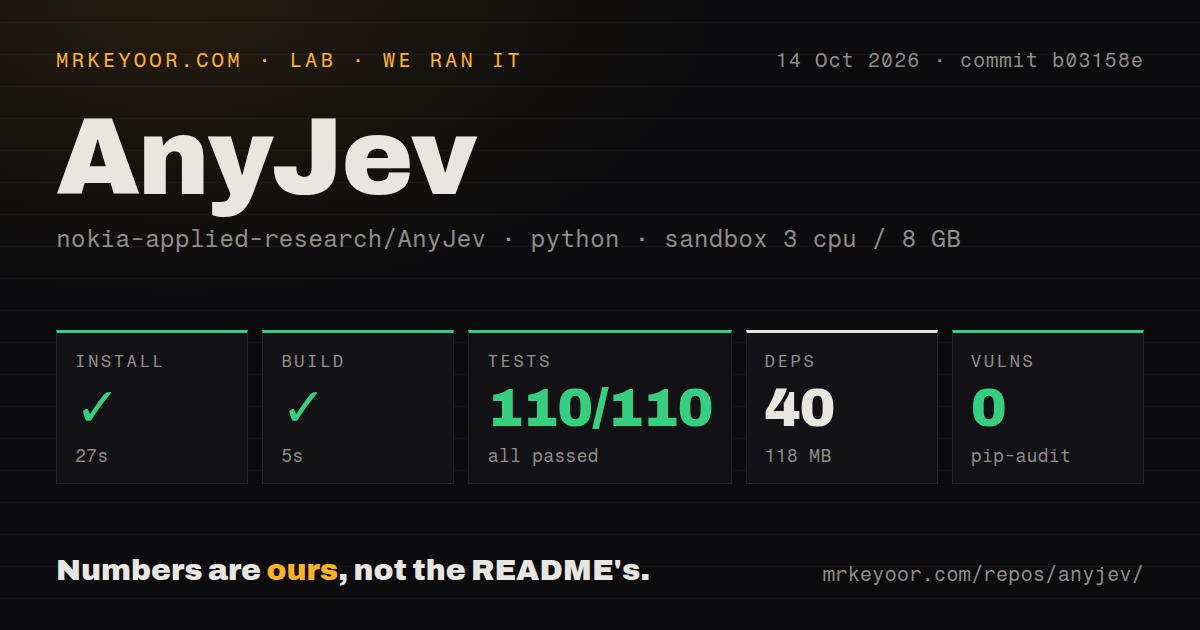
Our sandbox installed AnyJev commit b03158e in 27 seconds, adding 40 packages and using 118 MB on disk. The build passed in 5 seconds, and pytest finished in 13 seconds with 110 passed, 0 failed, and 9 skipped in the lab report. Pip-audit reported 0 known vulnerabilities. These are encouraging repository results for someone deciding whether the code is practical to inspect and try.
We ran the October 14, 2026 checks in an unprivileged Debian container with 3 CPUs, 8 GB of RAM, Python 3.12, and no secrets. The scan found a tests directory and two CI workflow files, with no Dockerfile. The supplied pytest summary reports the passing and skipped counts without explaining the skipped cases. Those results do not establish classification accuracy, calibration, serving latency, or the hardware needed for a chosen checkpoint.
L0 and Tacit make different compromises
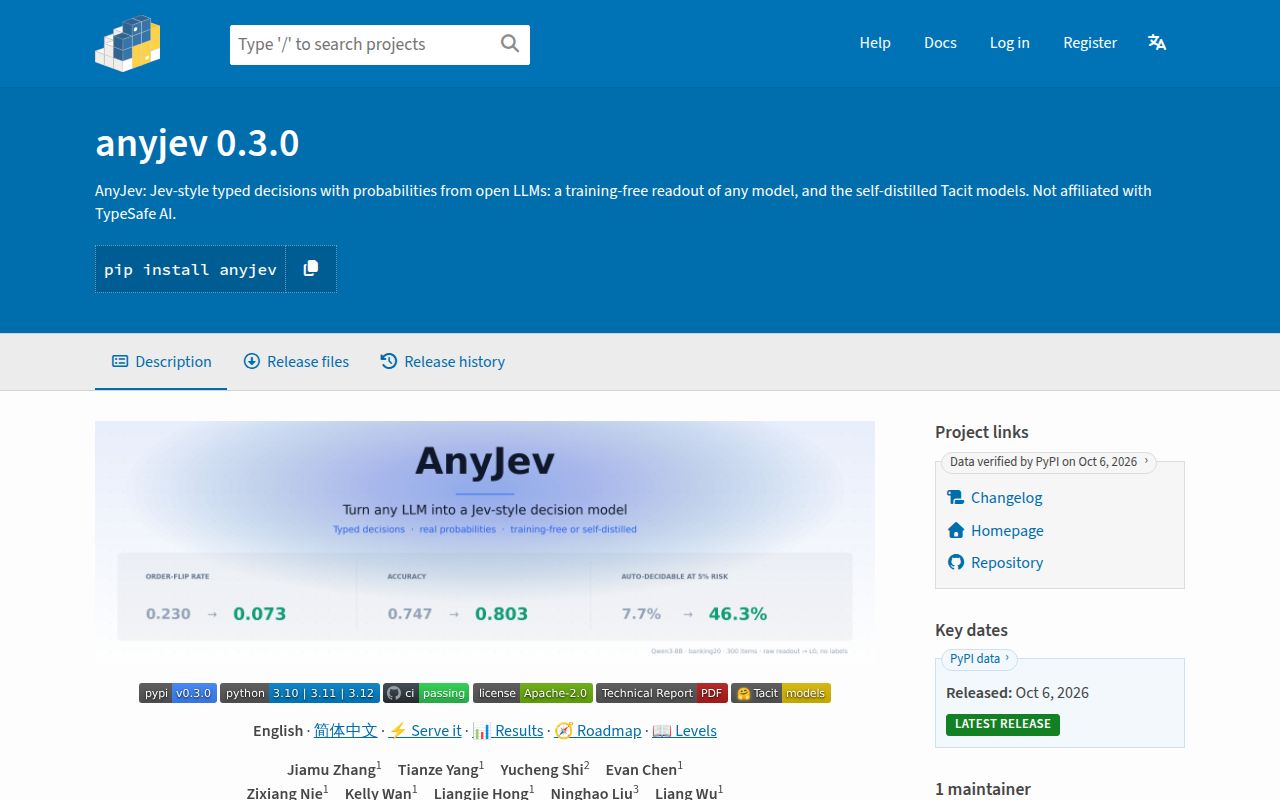
The README separates the training-free Decider from the self-distilled Tacit models. L0 rotates the supplied options and adjusts for label preferences, while Tacit reads a decision from a checkpoint trained for that job. Tacit's direct path keeps the options in their supplied order. The limitations document explicitly says this path does not average over rotations, so choosing Tacit does not give you every property of L0 automatically.
The 118 MB environment from our run should not be treated as the footprint of either inference service. The README's examples load model weights or connect to an upstream server, and backend extras change what you must operate. Pick a model and serving route before estimating your deployment. A successful package build answers whether this checkout can be prepared in our container. It cannot tell you whether your laptop or server can hold a particular model.
Confidence still needs evidence from your own inputs
AnyJev's limitations say L0 can lose accuracy when one label dominates a batch. The documented responses are to use a content-free prior or no prior, rather than blindly applying the default to every workload. That matters for a queue where most tickets belong to the same category. The probability values remain useful for inspecting decisions, but the batch composition is part of the method and needs to match the way your service receives requests.
The letter readout also stops at 26 options. Our 110 passing tests do not change that interface limit or demonstrate that a confidence threshold will meet your error budget. For a trial, use representative inputs with known answers and include cases your system should decline. Compare the chosen answer and its confidence together. If the task needs a large product catalog or free-form extraction, forcing it into this choice interface may add work without solving the underlying problem.
The gateway needs access controls outside the package
The documented HTTP gateway listens on localhost and has no authentication of its own. It exposes decisions and escalation statistics in front of a model server. Keeping a shared escalation cap there can be useful when several clients use the same upstream, but exposing that gateway beyond a trusted local boundary requires access controls you supply. The README's curl example is enough to explain a request, not to define an internet-facing service.
Our build took 5 seconds, while the model runtime has separate requirements. The limitations specify Transformers 5 or newer for the Qwen3.5-based Tacit checkpoints and describe a CUDA-toolkit requirement for their Hopper serving path. Adaptive reasoning also caps the share of decisions that escalate, rather than guaranteeing a response deadline. These details belong in the adoption decision even if you already run another language model successfully.
October maintenance comes with an unstable API
GitHub recorded a last push on October 12, 2026, and listed 11 open issues and PRs when checked. Recent discussion includes an Ollama backend design question and a request for multimodal inputs. Release v0.3.0 shipped on October 7 and removed L1, L2, and automatic level-selection interfaces. The project is receiving attention, but an older example can describe an API the current release no longer contains.
I would try AnyJev for a bounded routing task before adopting it across an agent workflow. Outlines and Guidance are better starting points when the requirement is structured generation rather than decision probabilities. The 40-package install makes the first experiment approachable. Keep that experiment tied to actual decisions you can grade, and pin the API version before another release changes the contract your application depends on.