One forward pass returns typed option probabilities
SemIf accepts some state, a question, and between 2 and 16 described options. It formats those inputs for an open language model, reads the logits for fixed answer tokens, and applies softmax across the allowed choices. No answer sentence or JSON object has to be generated and parsed. The result includes option scores, timings, the model revision, and a prompt hash, which gives an application more evidence than a bare label.
That narrow interface is the point. Many agent decisions are closer to route this request than write an explanation. SemIf turns such decisions into a command-line job through semif-score, with direct scoring, serial prefix reuse, shared-state execution, and a reranker comparison path. It reproduces a public interface pattern associated with Jev. The README repeatedly says it does not reproduce Jev's private model, training, or service economics.
The 7,074 MB environment is the first practical constraint
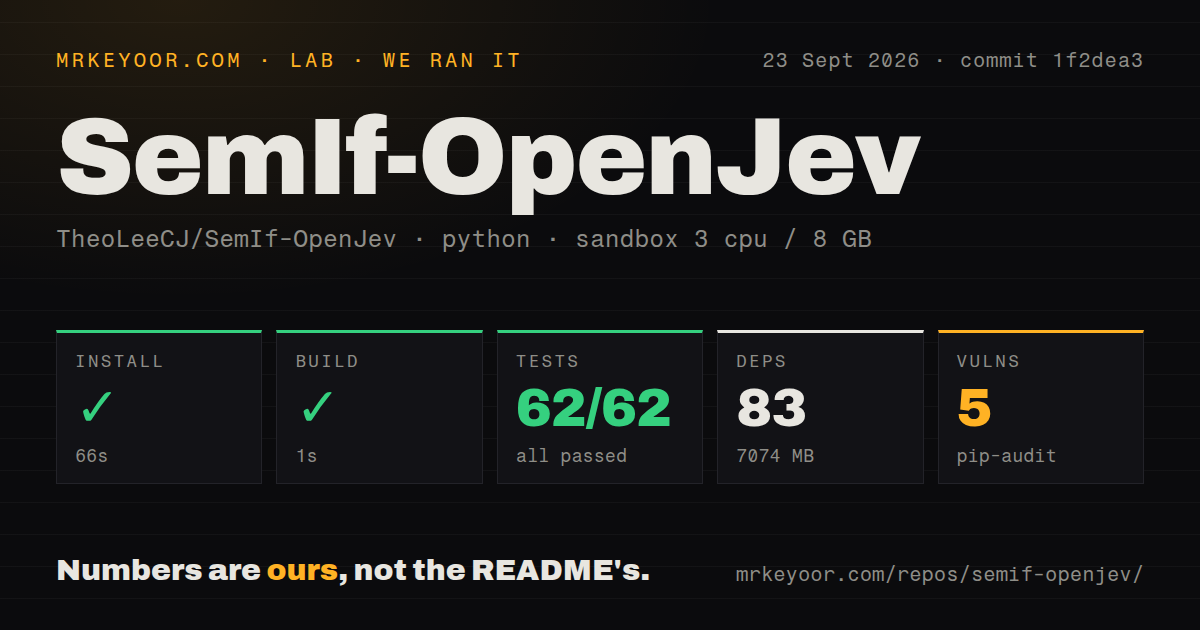
Our fresh container installed 83 Python packages in 66 seconds and occupied 7,074 MB before model weights. The core requirements pin PyTorch 2.10.0 and Transformers 5.17.0 alongside the tokenizer and Hugging Face libraries. That is a large starting point for a utility whose public interface looks like a small conditional. Put the virtual environment and model cache on storage sized for ML work, not a slim application image.
The standard path asks for Python 3.10 or newer, CUDA, and a GPU able to hold a 4B BF16 model. Model revisions are pinned in the examples, and the reproduction guide tells users to place HF_HOME on a drive with room. SemIf also has Apple Silicon and CPU routes, though each changes the runtime and comparison basis. There is no hosted credential in the basic local flow; model access and storage are still prerequisites.
What happened when we ran it
Our sandbox install completed in 66 seconds with 83 packages and 7,074 MB on disk. The build passed in 1 second. The test command passed in 7 seconds, with pytest reporting 62 passed, 0 failed, and 3 skipped of 62. Those results came from commit 1f2dea3 in an unprivileged Python 3.12 Debian container with 3 CPUs, 8 GB of RAM, and no secrets.
Pip-audit reported 5 known vulnerabilities. The supplied result does not name their packages or severities, so it would be wrong to turn that count into a specific exploit claim. It is still a release gate for any service deployment: identify the affected dependency paths, check whether the application reaches them, and decide whether a compatible update or containment is needed before exposing an endpoint.
The checkout contained 158 files, about 6,021 source lines, and occupied 20.8 MB before installation. It had a tests directory, no Dockerfile, and 0 CI workflow files. Passing 62 tests is useful local evidence. Without repository CI, an adopter still needs to automate those checks across the hardware path it plans to run.
The scores are choices, not ready-made confidence values
SemIf's own method guide gives the warning a production buyer needs: softmax over allowed tokens is conditional on the alternatives supplied. Add, remove, or reword an option and the distribution may change. A score of 0.8 therefore cannot be read as an 80 percent chance that a business action is safe. The project includes per-workload temperature calibration because thresholds have to be fitted and checked against labeled decisions.
The committed research also records uncomfortable results. On the author's 777-decision shared-state fixture, faster BF16 reuse paths changed 5 or 6 argmax choices compared with fresh scoring. The browser model ladder uses separately quantized artifacts, and the docs avoid presenting native BF16 quality as measured browser quality. This restraint makes the evidence useful, but it also tells you that backend, quantization, batch shape, and prompt wording belong in your acceptance tests.
Hardware support comes through separate execution paths
CUDA on a single NVIDIA GPU is the reference environment. Apple Silicon users can choose an MLX backend or PyTorch MPS. The CPU route uses llama.cpp with a local GGUF checkpoint, and the README calls the full-precision PyTorch CPU route much slower. A browser-only WebGPU demo lowers the barrier to seeing the idea, while production code still needs local model files and a deliberate backend choice.
One loaded llama.cpp backend owns 1 stateful scoring context. Shared mode only applies when every row has exactly the same state, while serial mode caches consecutive equal states. These details affect how a queue can schedule requests. A general multi-tenant API would need isolation, concurrency limits, model lifecycle management, and error handling around the research CLI. SemIf supplies the scoring experiment, not that service layer.
A September push shows momentum without a release contract
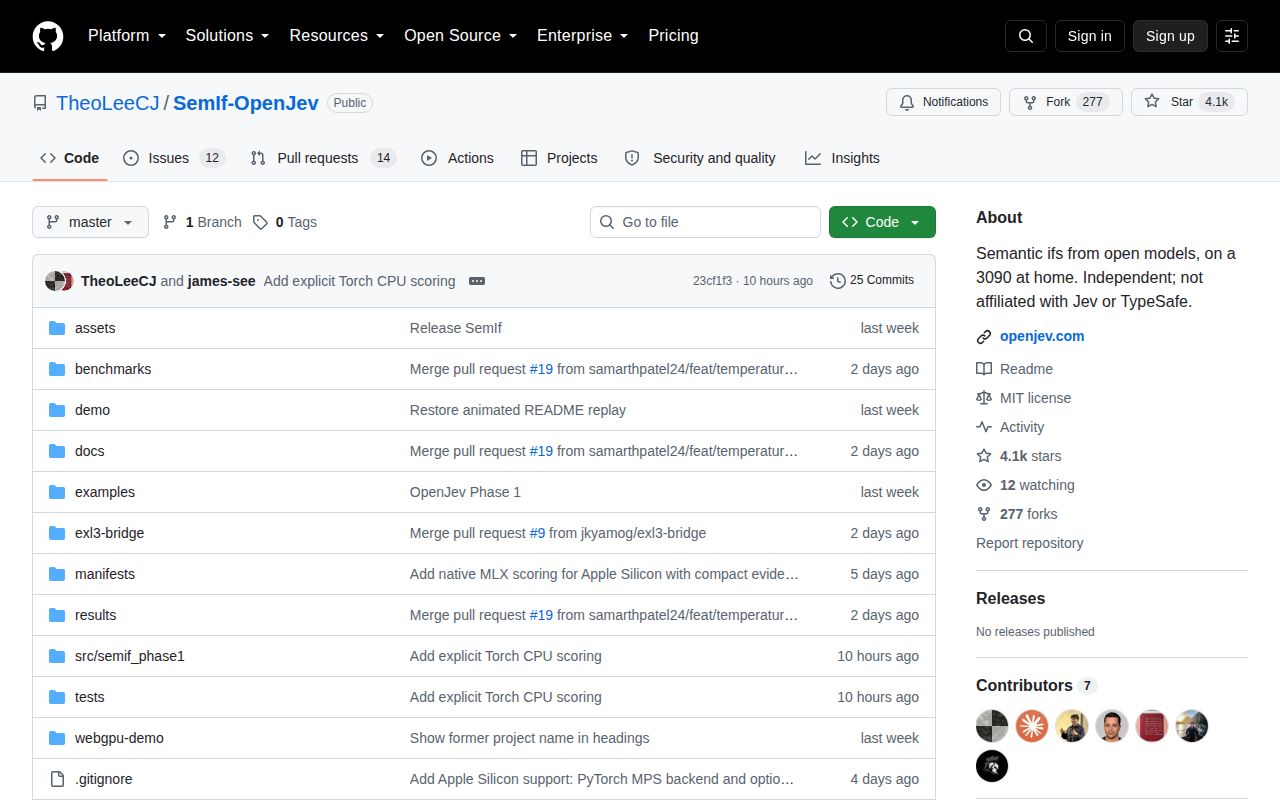
The repository was pushed on September 23, 2026 and had 4,122 stars plus 26 open issues and pull requests when fetched. GitHub returned no latest release, while pyproject.toml identifies version 0.1.0. Recent contributions cover Apple Silicon, llama.cpp, calibration, browser work, and more hardware paths. That is fast research activity, with the compatibility churn such activity can bring.
vLLM is the stronger choice when the job is serving generated output at scale. llama.cpp fits a local application that mainly needs a portable GGUF runtime. Transformers gives researchers the broadest control if they are willing to build the decision protocol themselves. SemIf is more focused than all three: it is worth using when the experiment is specifically whether direct typed choices beat generation for your workload. The passing 7-second test run earns that experiment; the 7,074 MB environment and calibration burden keep it from being a drop-in product component.