Read the attention calculation before adopting the training stack
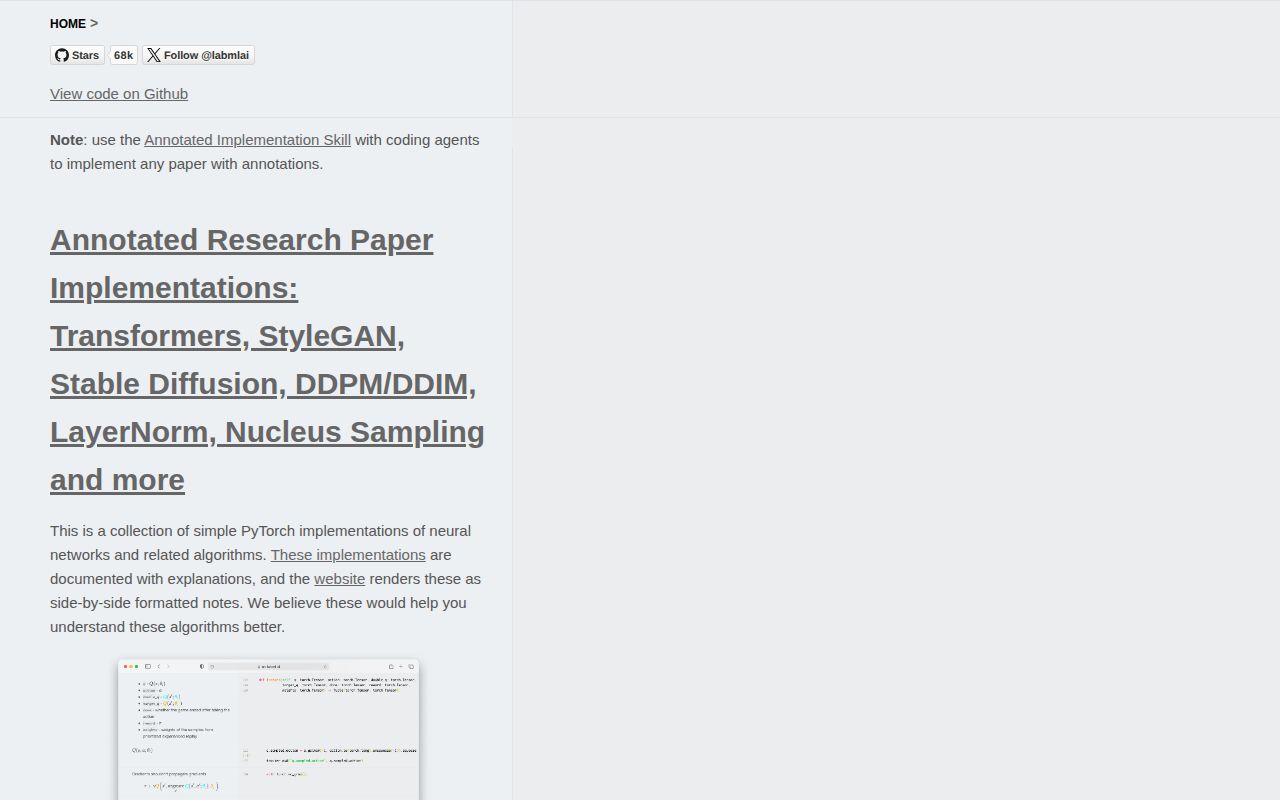
Labml.ai's multi-headed attention page places tensor-shape explanations beside the PyTorch operations they describe. You can follow the query and key projections, attention scores, masking and multiplication by values without switching between an equation in one tab and unexplained source in another. That is the reason to use this collection: it gives a reader somewhere concrete to stop when a paper's notation stops making sense.
The repository covers considerably more than transformers. Its README links diffusion models, reinforcement learning, optimizers and normalization layers, among other subjects. Breadth helps when you're comparing mechanisms across papers. Installing the package and reading an annotated page are separate commitments, with different evidence requirements.
What happened when we ran it
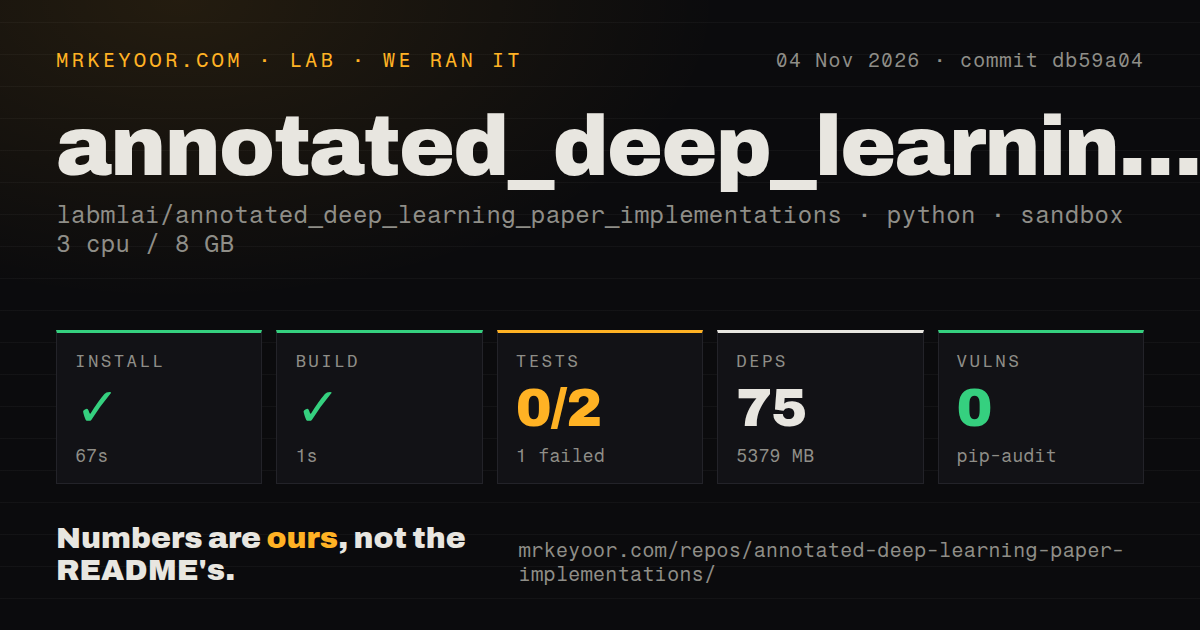
Our run installed labml.ai's paper-implementation collection in 67 seconds, recorded 75 dependencies and occupied 5,379 MB at commit db59a04 on November 4, 2026. The build step succeeded in 1 second. These setup results do not establish correct training or reproduction of a paper’s results.
The test step failed with exit 1 after 136 seconds. The record lists zero passes, one failed test and one collection/setup error. The tail identifies labml_nn/optimizers/performance_test.py::test, which exceeded pytest-timeout's 120-second limit. Captured output includes CPU and MyAdam.... Exceeding that limit does not establish an incorrect Adam update or a comparative optimizer-speed result.
The separate error names test/rl/test_game.py. Its underlying exception is absent from the supplied tail, so its cause remains unknown. Pytest's own summary reports 132.04 seconds, while the outer step reports 136 seconds. Those differently scoped durations do not explain the reinforcement-learning error.
The sandbox configuration specified 3 CPUs, 8 GB of RAM and image ghcr.io/astral-sh/uv:python3.12-bookworm. The label does not establish the executed Python or operating-system version. Pip-audit reported zero known vulnerabilities in our run, which is a dated advisory result rather than proof of security. The scan found a tests directory, no CI workflow files and no Dockerfile in the measured checkout.
The Adam page makes implementation choices inspectable
The annotated Adam implementation explains its first and second moment estimates, bias corrections and parameter update beside the code. It also exposes an optimized_update switch and explains how moving the bias correction changes the epsilon expression. That is useful material for a reader trying to connect a paper's equations with actual parameter state, rather than merely recognizing the optimizer's name.
A productive study session would trace the moment buffers and step counter, then explain why each update uses those values. For attention, trace the documented sequence, batch and feature dimensions through the head split and mask. These are suggested exercises based on the pages we inspected, not experiments completed in our sandbox. The learning benefit depends on doing that work yourself rather than copying a class because its annotations look reassuring.
The README's package instruction is pip install labml-nn. It does not document a mandatory external credential or service for that basic command. Browsing the annotated website avoids creating a local Python environment at all. Executing an experiment needs a separate reading of its data, configuration and hardware requirements. Our measured package setup is no substitute for verifying the specific example you intend to run.
A successful build leaves numerical behavior unverified
An open pull request, number 325, proposes applying GroupNorm before the DDPM attention projections. The contributor reports that the layer is constructed but unused in the forward path. That is a specific report about this collection's diffusion implementation, not a finding from our optimizer timeout. The proposal remained open in the November 5 source check, so we cannot describe the correction as shipped.
This distinction matters if you plan to carry an implementation into research. An annotated explanation can make a numerical choice easier to inspect while still needing review against the paper. Pin the revision, read the relevant open discussions, and compare the selected component's behavior with an independent reference before relying on its results. The repository's MIT license permits reuse under its terms, but licensing does not establish numerical correctness.
GitHub recorded a last push on November 2, 2026, with issue and pull-request updates continuing into November 4. The latest-release endpoint returned no release. Alongside recent activity, that is no basis for calling the project abandoned or assuming packaged releases do not exist elsewhere. Support responsiveness and the reliability of individual implementations remain separate questions that this run cannot settle.
Choose a book for foundations or nanoGPT for focused source reading
Dive into Deep Learning is an interactive book drafted in Jupyter notebooks. Choose it if you need a connected learning sequence with concepts and executable examples before approaching individual paper implementations. Labml.ai is easier to approach with a particular mechanism already in mind, such as Adam bias correction or an attention mask. That comparison concerns how the material is organized, with no comparative learning or runtime measurement behind it.
NanoGPT's README marks the repository deprecated and points readers toward nanochat. It remains a possible source-reading choice when you specifically want its GPT model and training loop, provided you accept that status. I would not choose it as a fresh maintained platform. Labml.ai's broader collection serves a different study task: looking up a mechanism across several model families.
Setup is usable; the observed test run did not pass
The editorial scale here uses 1 for a demonstrated blocker, 3 for a usable path with material limits, and 5 for detailed evidence plus independent verification across the assessed scope. Intermediate scores sit between those anchors. Setup earns 3/5 for successful installation and build with a substantial footprint. Documentation earns 4/5 for the inspected equation-to-code explanations. Maturity earns 2/5 because the observed test run failed and numerical behavior remains unverified. Community support is unassessed.
Start with the annotated page for the operation you cannot yet explain. If that answers your question, the website has done its job without occupying 5,379 MB locally. Install the collection when you have a particular component to change, then verify that component before carrying it into a training run.