The PR Reviewer profile tells its bot to stop if GitHub is disconnected. Templates for Grok Bot is worth inspecting if you want instructions that name required evidence and approval boundaries. Whether the hosted bot follows those instructions remains unverified by our run.
Copy a profile before considering the CLI
The repository README describes a direct path: copy a PROFILE into Grok Bot's Edit Profile interface, connect its named plugins and send a task. Ordinary use does not require cloning the repository or installing Node. A separate Setup path uses START.md to help choose a team.
This is an independent profile collection. The repository has an MIT license, but using its profiles still requires access to Grok Bot and the relevant plugins. Our run did not establish account eligibility, service cost or connector availability. The README labels its status v1.1.0; that is a documentation statement, not independently established release availability.
The optional CLI can list, generate and score catalog artifacts. Those documented capabilities should be kept separate from the repository commands recorded below. We did not verify each CLI workflow or execute a hosted bot task.
What happened when we ran it
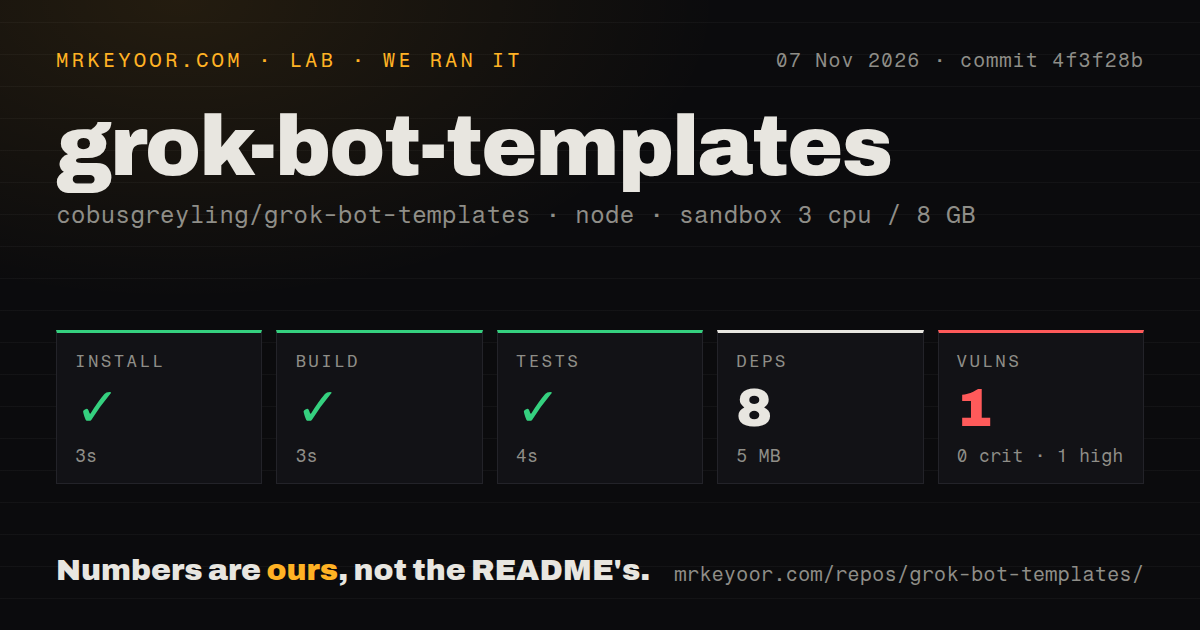
Our recorded sandbox run on November 7, 2026, at commit 4f3f28b completed installation in 3 seconds, the build in 3 seconds and the test step in 4 seconds. It recorded 8 dependencies and 5 MB on disk. No passing-test count is supplied, so these results cannot be translated into a count of verified bot behaviors.
The checkout contained 473 files, approximately 2,778 source lines and 1.9 MB of repository data. The scan found 3 CI workflow files and a tests directory, with no Dockerfile. These observations describe the repository, not a bot reviewing a real PR or completing a scheduled routine.
Npm audit reported 1 known vulnerability, rated high. The supplied measurement does not identify its package, dependency path or reachability. Investigate the advisory before adopting the optional tooling; the evidence does not support an exploit claim or a package-specific fix.
The recorded sandbox configuration used 3 CPUs, 8 GB of RAM and image label lab-node:22. Actual runtime and operating-system versions require the raw toolchain logs. Account access, hosted task quality and enforcement of approval boundaries were not measured.
Use the PR Reviewer as an acceptance exercise
The PR Reviewer profile names GitHub pull requests, linked CI logs and workspace clones as sources. It asks for breakage risks with file paths, missing tests and gaps between the description and diff. It also instructs the bot to report missing CI and avoid inventing files.
The profile requires explicit approval before posting a GitHub comment. This is a written instruction; our repository run did not verify a permissions system that enforces it.
A proposed acceptance exercise is to choose a PR whose changes you understand and request a draft review. Compare each finding with the diff and linked CI. Then try a case where required source access is missing and check whether the bot identifies the gap and stops. This exercise was not executed in our sandbox.
Specialist profiles do not establish access isolation
The PR Reviewer profile warns that bots share one computer and that files, browser sessions and command-line credentials are not a security boundary between them. Different job descriptions therefore do not establish isolated access for different roles.
The README defaults the first week to L1 Draft and says to wait for satisfactory runs before enabling routines. The PR Reviewer profile requires the owner to accept two successful skill runs before creating a routine. These are adoption instructions, not measured guarantees. Inspect the draft, check its sources and decide which access the task needs before scheduling it.
Bot Ready is the project's structural profile score. Its documented criteria include a job, sources, approval boundaries and missing-data behavior. It does not measure PR-review accuracy or establish that a model will obey every boundary. Keep that score separate from our successful repository commands.
Alternatives offer different ways to obtain a profile
Awesome Grok Bot provides copy-paste profiles. Consider it when you want another profile to inspect for the same job. Compare the requested integrations and standing instructions before using one.
Awesome Grok Bot Templates curates public share links. Consider it when you prefer browsing shared configurations. Its README explicitly distinguishes engagement from quality. Neither alternative was run in our sandbox.
The supplied existing awesome-grokbot page addresses discovering public configurations. This review addresses whether to adopt this repository's written profiles and how to evaluate their behavior.
Documentation is clearer than the operational evidence
GitHub metadata records the last push on September 24, 2026. The supplied tracker extract includes a template contribution updated on October 10, 2026. These timestamps do not establish support responsiveness. The latest-release lookup is inconclusive: its null value does not establish an HTTP response or whether a release exists.
Documentation earns 4/5 for a clear entry path and concrete source, missing-data and approval instructions. Our rubric assigns 1 when there is no usable entry path, 3 for usable guidance with material omissions, 4 for clear entry and task-boundary guidance, and 5 when guidance has been verified across the relevant workflows. We did not reproduce the hosted instructions, so 5 is unsupported.
Setup ease, community support and operational maturity remain unassessed. The next useful step is one draft-only task you can judge against its sources, followed by a missing-source check before recurring automation.