GGUF gives local models a common runtime
llama.cpp is an inference engine for running language and vision-language models without handing every prompt to a hosted provider. Its command line can download a compatible model from Hugging Face and start a chat. The server exposes OpenAI-compatible routes and a built-in web interface. Underneath those entry points is a C++ runtime aimed at ordinary CPUs, Apple Silicon, and several GPU families. That breadth is the reason to consider it.
The common boundary is GGUF, not every model file you find online. The model guide says llama.cpp requires GGUF and provides Python conversion scripts for other formats. It also points to hosted conversion and quantization tools. A developer can start with -hf and a published GGUF repository, but shipping a less common model may involve conversion, metadata checks, and a quantization choice. The runtime makes many models portable only after they enter its format.
Eighteen backends create choices rather than one universal build
The README lists 18 backend rows, covering CPU libraries and hardware paths such as CUDA, HIP, Metal, Vulkan, SYCL, OpenCL, WebGPU, and several vendor-specific accelerators. CPU and Apple Silicon are prominent, while CPU plus GPU offload can help when a model exceeds available VRAM. Quantization ranges from 1.5-bit through 8-bit integers. These controls let a careful operator fit useful models onto hardware that a full-precision deployment would exceed.
Each backend has its own dependencies and failure modes. The Docker guide splits default, CUDA, MUSA, and Intel SYCL images. It says the GPU images are built by CI but are not tested there beyond the build, and different library versions require local image builds. CUDA containers need the NVIDIA container toolkit on the Linux host. SYCL may need host drivers, and the guide says WSL support has not been verified for that path.
What happened when we ran it
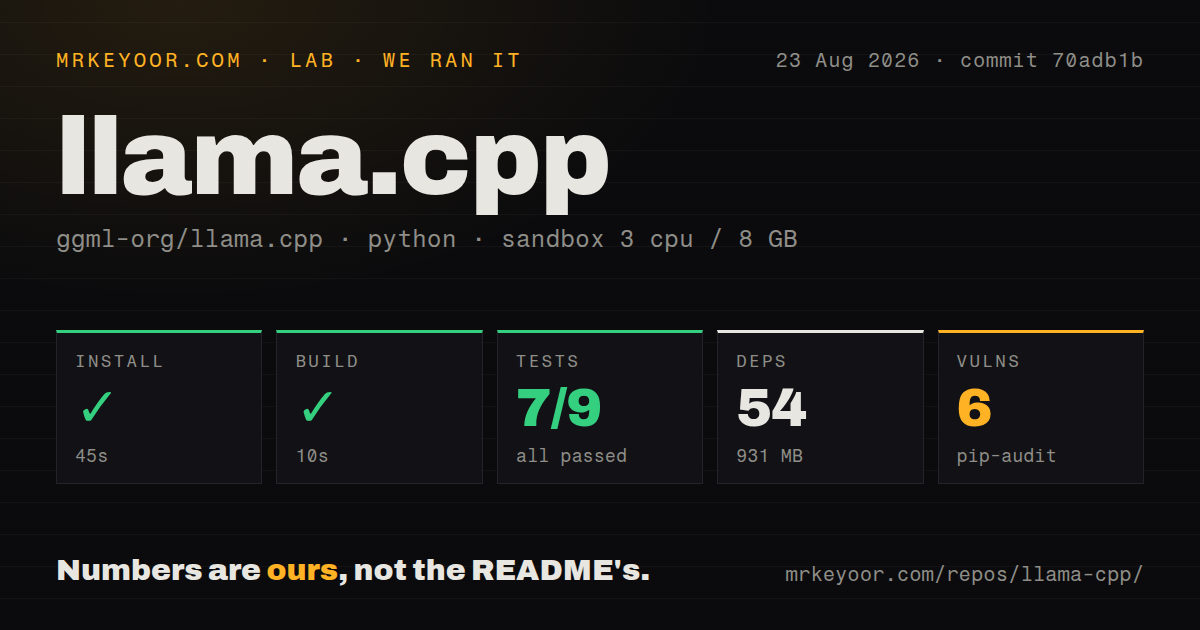
Our fresh Debian sandbox installed the detected Python environment in 45 seconds. That added 54 packages and occupied 931 MB. The repository at commit 70adb1b contained 3,428 files, about 780,849 source lines, and a 159.7 MB checkout. The build succeeded in 10 seconds, so neither installation nor compilation was the point where this run broke.
The pytest step exited 1 after 12 seconds. It reported 7 passed tests and 2 collection or setup errors out of 9. The Snapdragon QDC tests could not import appium; the server tests could not import wget. Those are the causes shown in the log. We cannot infer from that tail whether the missing modules were meant to be optional, installed by another development command, or omitted from the tested dependency path.
Pip-audit reported 6 known vulnerabilities in the installed Python environment. The checkout scan found 50 CI workflow files, a tests directory, and no root Dockerfile. Docker support still exists through files and instructions elsewhere in the repository, so the scan result should not be read as "no containers." It means the root did not present the conventional single Dockerfile that some automated build systems expect.
The server is useful only after exposure is handled
The bundled server matters because it turns a local binary into something existing clients can call. Its documentation covers chat and text completion, embeddings, reranking, models, slots, metrics, structured output, and a web UI. That is enough surface area for prototypes and internal applications without writing a wrapper around the C API. Model downloads can also be initiated by the server in its router mode.
A local default is not a public deployment policy. Operators still need to decide authentication, TLS termination, allowed origins, request limits, model access, logs, and which endpoints should be exposed. A 931 MB development environment also says nothing about model storage: the selected GGUF weights and runtime context are separate costs. Before putting the server behind a gateway, test the exact model, quantization, context, concurrent slots, and restart behavior on the target host.
Rapid model support comes with a large change surface
GitHub showed 125,813 stars, 2,228 combined open issues and pull requests, and a last push on August 27, 2026. The combined count is not a defect count. It does show the size of the contribution and support queue. Release v0.3.0 arrived on August 25 with a new multimodal model, DeepSeek 4 tensor splitting, GLM-4.5-Air multi-token prediction, server changes, and fixes across several compute backends.
That release pace is attractive when a newly published architecture needs local support. It also means operators should pin a known commit or release and repeat their own correctness checks before upgrading. Model parsing, chat templates, quantization, kernels, multimodal input, and server behavior can all change in the same project. The 50 workflow files indicate serious automation, while our 2 collection errors show that one broad test invocation still did not prove the checkout clean in a fresh container.
Use llama.cpp when hardware freedom repays tuning time
For a workstation tool, offline assistant, edge device, or private service, llama.cpp gives more control than most local runners. It has a direct CLI, a capable server, broad hardware coverage, and MIT licensing. The 10-second build in our sandbox makes experimentation cheap before model weights enter the picture. Teams can start on CPU, then choose offload or another backend after measuring their own workload.
The cost is ownership. GGUF conversion, quantization, model licenses, memory fit, backend dependencies, and server security remain your decisions. Our run also left 6 audited vulnerabilities and never collected the full 9-test sample because two modules were absent. Adopt llama.cpp when that control is the product requirement. If the requirement is simply a stable hosted endpoint, an opinionated local runner or GPU serving system will demand fewer choices.