The common language of model repositories
Transformers solves a compatibility problem that appears whenever a research model becomes software. Each architecture needs configuration, preprocessing, weight loading, generation behavior, and task-specific outputs. Hugging Face collects those definitions behind familiar classes and a high-level pipeline API. A developer can load a published checkpoint for text generation, image classification, speech recognition, or another supported task without translating the paper into application code.
The library is also infrastructure for other tools. The README describes its model definitions as a shared point used by training systems, inference engines, and adjacent runtimes. That explains why teams may depend on Transformers even when production requests eventually run through vLLM, SGLang, or another server. A supported definition helps the checkpoint travel between experimentation, tuning, and deployment.
Breadth is both the reason to choose it and the reason to be careful. Text, vision, audio, video, and multimodal models do not share one simple runtime profile. The tidy pipeline() example handles common preparation, but hardware fit, batching, generation settings, and output validation still belong to the application team.
What happened when we ran it
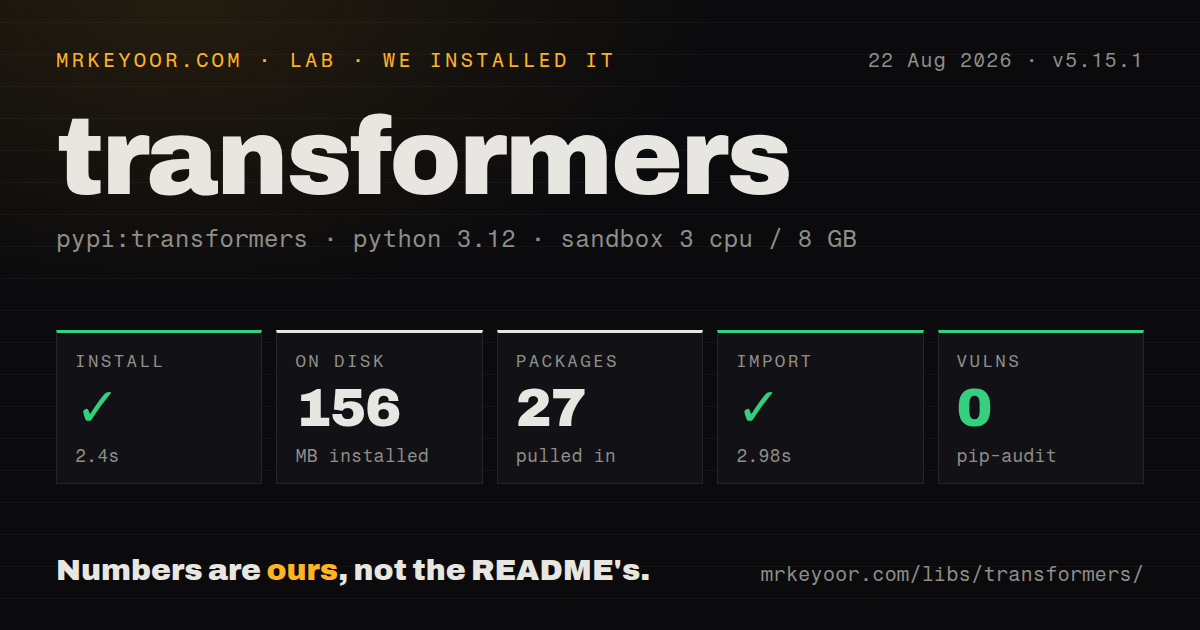
We cloned commit d56c55b into an unprivileged Debian container with 3 CPUs, 8 GB of RAM, Python 3.12, and no secrets. The checkout contained 6,413 files, about 1,734,962 lines of source, and occupied 94 MB. Installation succeeded in 29 seconds with 51 packages and 130 MB on disk. The package build succeeded in 39 seconds.
The test run did not reach an executed test. pytest stopped after 200 collection or setup errors, reporting 0 passed and 0 failed, and exited 1 after 30 seconds. The tail named modules for EfficientLoFTR, EfficientNet, ELECTRA, Emu3, EnCodec, and encoder-decoder models, then said it was stopping after 200 failures. It did not show the exception that those modules shared, if any.
Calling this a 200-test failure would be wrong. Collection and setup errors occur before assertions can give a pass or fail result. The finding is that the measured install could build the package but could not prepare this broad test slice. Transformers has a tests directory and 57 CI workflow files; reproducing its contributor environment plainly requires more than the base dependency set our harness installed. pip-audit found 0 known vulnerabilities in that environment.
A small first example hides a large runtime decision
The README requires Python 3.10 or newer and PyTorch 2.5 or newer, then suggests installing the torch extra. Creating a pipeline downloads and caches the named checkpoint. That is an excellent trial path because preprocessing and output decoding come with the model class. It also shifts important decisions to the moment a specific checkpoint is selected.
Model files can be far larger than the library. Some require access approval, a compatible tokenizer, optional media libraries, or model-specific code. Device placement and numeric precision decide whether weights fit. A CPU can be acceptable for a small classifier and impractical for an interactive generative model. None of those outcomes can be inferred from our package installation, and we did not measure model inference.
The Hub relationship adds another supply-chain boundary. Transformers itself uses Apache 2.0, while checkpoint authors choose model licenses and publish their own configuration, tokenizer assets, and sometimes custom code. Pin a model revision instead of relying on a moving branch. Read its card and license, record the files admitted to production, and avoid enabling remote code casually. A library license does not grant rights to every set of weights it can load.
Consistency stops at model behavior
Auto classes and pipelines make code portable across related architectures, but checkpoints still have exact expectations. A current report says a tokenizer regression in the 5.x line strips spaces for a specific DeepSeek math model and emits byte-level markers on decode. Another says a MiniMax configuration loses a legacy rotary-dimension field and applies rotation differently. These are issue reports rather than our reproduced results, yet they show why a successful load is not enough. Tokenization round trips and reference outputs belong in upgrade tests.
Production teams should pin the Transformers version, checkpoint revision, tokenizer files, and generation settings together. For classifiers, compare expected labels and scores on a fixed fixture set. For generative models, inspect tokenization and output structure as well as text quality. Model support moving into the library can improve interoperability, but a general API cannot certify a checkpoint for your data.
Training has a boundary too. The README says its training API is optimized for Transformers models and directs generic machine-learning loops elsewhere. It also warns that example scripts may need adaptation. That candor is useful. An example establishes the calls and flags; it does not settle data validation, evaluation design, checkpoint retention, or distributed failure recovery.
Health and who should adopt it
GitHub recorded a push on August 24, 2026. The latest patch release, v5.15.1, arrived on August 19, and the repository showed 2,410 open issues and pull requests combined. That is a huge queue, but it sits beside current releases and daily development. With so many architectures and environments, issue volume is better read as maintenance surface than a simple defect count.
The documentation is among the project's strongest assets. The README gives task examples and states where the library is a poor fit. Model-specific pages, task guides, API references, Hub model cards, and translated READMEs help users move past the quick start. The remaining work is choosing which slice applies to one model and one deployment.
Use Transformers for model evaluation, customization, and training when its definitions save you from bespoke integration. If the application only calls a stable language-model server, keep this library behind that server or omit it from the client. The best adoption unit is not Transformers in general. It is one pinned model path that your tests and hardware can support.