mrkeyoor.com_
Thu 01 Oct 21:35 UTC
Webevaluationupdated 01 Oct 2026

RhineLabUI review

RhineLabUI is documented in Chinese, and we found no full English guide. It is a finished Three.js archive interface inspired by the Rhine Lab video from Arknights, with 40 searchable records, a 3D cassette array, decryption sequences, an exploded model viewer, audio, PWA support, and a separate Wallpaper Engine edition.

Verdict

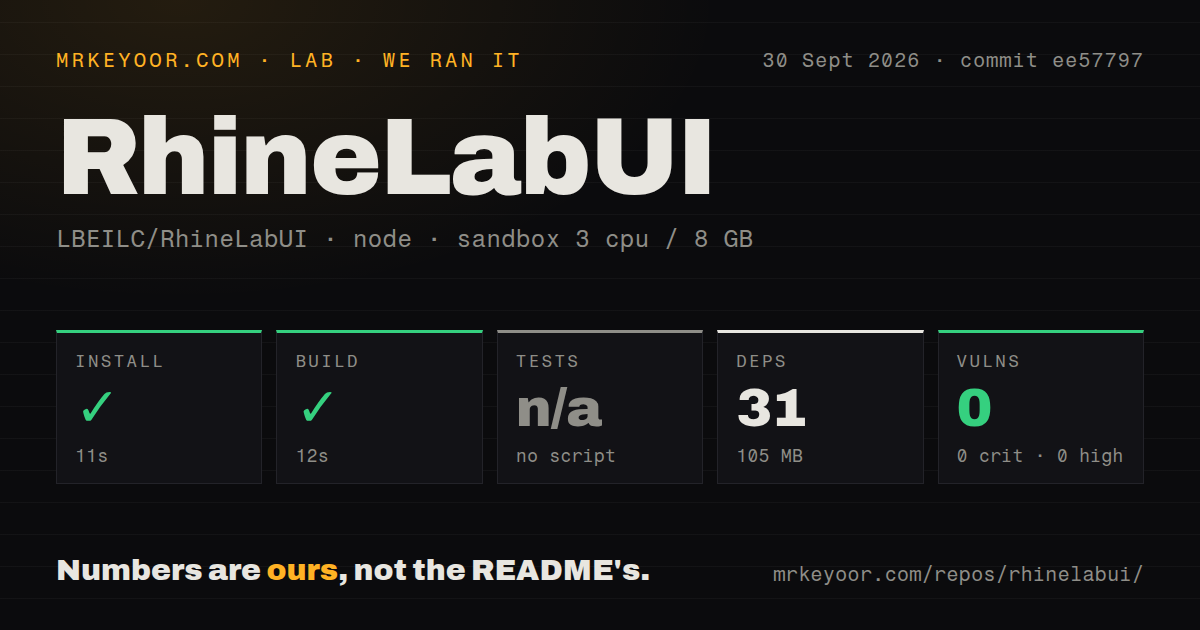
Our RhineLabUI run installed 31 packages in 11 seconds and built in 12 seconds, but the source checkout itself weighed 144.7 MB and came with no standard test target. Use it as a runnable fan experience or as a deep Three.js motion reference. Fork it for another brand only after replacing protected Arknights elements and deciding which heavy verification and media files belong in your distribution.

We ran it

Lab card: what happened when we ran RhineLabUIScreenshot of RhineLabUI (rhine-lab-ui.vercel.app)
Install✓ · 11s31 packages · 105 MB
Build✓ · 12s
Testsn/ano test script
Known vulns00 critical · 0 high · 0 moderate · 0 low (npm audit)
Repo1217 files~16,581 lines of source · 144.7 MB · 0 CI workflows

Answers from our run

Does RhineLabUI build from source?

Dependencies installed in 11 seconds (31 packages), and the build succeeded in 12 seconds. We cloned commit ee57797 into a clean Debian container with 3 CPUs and no project-specific setup.

Does RhineLabUI have tests you can run?

Not through a standard command: the project exposes no test script or target that our harness could run.

Does RhineLabUI have known vulnerabilities in its dependencies?

npm audit found none in the dependency tree at the time of our run.

Who should not use RhineLabUI?

English-only contributors: the 20,430-byte README and most interface copy are Chinese, with no complete English documentation.

What are the alternatives to RhineLabUI?

Astro, React Three Fiber, Babylon.js. Our RhineLabUI run installed 31 packages in 11 seconds and built in 12 seconds, but the source checkout itself weighed 144.

Setup4/5Quick static build with no backend, offset by a 144.7 MB checkout
Docs4/5Exceptional Chinese detail, but no complete English guide
Community3/5692 stars and ten resolved threads, with no open queue
Maturity3/5Working PWA and many checks, but no test target, CI, or release

Who it’s for

Chinese-speaking Three.js developers studying a large, art-directed interface with measured motion and camera rules.
Arknights fans who want to run or adapt a nonofficial Rhine Lab archive experience.
Technical artists interested in the included Blender files, GLB models, review pages, and visual verification artifacts.
Teams prepared to replace the fan branding and third-party material before using the interface for another product.

Who it’s NOT for

English-only contributors: the 20,430-byte README and most interface copy are Chinese, with no complete English documentation.
Projects that need uncomplicated brand rights: the README excludes Arknights names, logos, setting, source-video design, and sampled audio from the project's MIT grant.
Lightweight component consumers: our checkout was 144.7 MB, and the package is a private application rather than a published UI library.
Older or non-WebGL clients: the documented minimum is Node 22.12 for development and WebGL 2 in a modern browser.
Mobile-first products expecting parity with a phone-native design: the README says the 1920 by 1080 layout mainly targets desktop and horizontal screens.
Release pipelines that require a standard test command and versioned artifacts: our run found no test target, CI workflow, tests directory, or GitHub release.

Setup reality

Our sandbox installed commit ee57797 in 11 seconds, adding 31 npm packages and using 105 MB on disk. The production build succeeded in 12 seconds. There was no test script or target, so tests were skipped; npm audit reported 0 known vulnerabilities at every severity.

Development needs Node 22.12 or newer and a modern WebGL 2 browser. Runtime models, audio, fonts, content, and verification media are already checked in, so the application needs no API key, backend, or Blender install for ordinary use.

The static build can run from a normal HTTP host, and the PWA caches assets after an initial online visit. The 144.7 MB checkout contains extensive visual evidence and source assets. Before reuse, separate MIT-covered original work from Arknights material, fonts, Rolling Number, and short sampled sounds with their own terms.

Forty archives make a finished application

RhineLabUI arranges 40 records across 5 categories in a looping 3D cassette wall. A user searches, changes columns, opens a record, waits through synchronized glass and document decryption, reads the archive, saves it locally, or exports the text. A separate viewer rotates and explodes the cassette into 6 structural groups. The interface extends its video reference with working search, favorites, quality controls, sound settings, and offline PWA behavior.

That completeness makes RhineLabUI compelling to study and awkward to treat as a kit. State, scene choreography, archive content, audio, visual identity, and model behavior belong to one directed experience. The package is marked private, with no exported component library. Rebranding means editing more than colors and text: camera timing, boot language, 3D assets, sound, archive geometry, and the meaning of the decryption sequence are tied together.

A 144.7 MB checkout buys evidence as well as code

Our lab found 1,217 files and about 16,581 lines of source in a 144.7 MB checkout. Much of that weight is visible in the repository: browser screenshots, comparison runs, GIFs, GLB studies, Blender projects, audio, and checked-in web fonts sit beside the application. The README says 4 MiSans font groups alone total about 19.7 MB, loaded according to actual use.

This is useful if you want to audit how a glass effect or camera move evolved. Directories named reference and verification keep before-and-after assets, captured states, and run data that most projects discard. A consumer shipping the application probably does not need every study file. Split authoring evidence from production assets in your fork, then check the generated dist rather than using the Git checkout size as a proxy for the user's download.

What happened when we ran it

Our fresh Debian sandbox installed commit ee57797 in 11 seconds on 3 CPUs with 8 GB of RAM and no secrets. Npm added 31 packages, and the installed dependency tree used 105 MB. The production build passed in 12 seconds. Npm audit reported 0 known vulnerabilities: 0 critical, 0 high, 0 moderate, and 0 low.

The repository supplied no test script or test target, so we skipped tests. Our scan also found 0 CI workflow files, no Dockerfile, and no tests directory. RhineLabUI does include a content check plus many targeted Node scripts for motion, appearance, assembly, decryption, viewport behavior, and rendering settings. Those checks did not run in our measured test step. A passing build proves TypeScript and Vite completed; it does not prove the 3D sequences in a browser.

Fifteen motion switches give reduced motion real control

A merged September change expanded one reduced-motion toggle into 15 individual preferences, grouped around boot, archive, detail, interface, and the 360-degree viewer. The setting can follow prefers-reduced-motion, use a reduced preset, or preserve selected effects. That is better than one blanket switch for an interface whose identity depends on timed text, glass reveals, array waves, and camera travel.

Input coverage is also broad. The archive uses arrow keys, Enter, Escape, /, buttons, mouse dragging, wheel zoom, and touch. The README calls the 1,920 by 1,080 composition its baseline and says desktop and horizontal screens remain the main targets, even though portrait phones and home-screen installation are supported. Test your own content at narrow widths because longer titles and translated labels can stress a layout tuned around Chinese and English fan terminology.

Issue 10 clarified what MIT can and cannot grant

Issue 10 asked for permission to redistribute 2 GLB models, prompting a detailed public clarification. The current README applies MIT to code, modeling scripts, original Blender projects, the named GLB files, original music and effects, and author-created documentation or media. Redistribution and commercial use are allowed for material the author owns, with the normal copyright and license notice.

The same section draws a sharp boundary around Arknights. Rhine Lab names, logos, setting, source-video design, sampled original audio, and third-party fonts or libraries keep their existing rights. The author's model license cannot authorize elements derived from the franchise. A personal fan page can accept that ambiguity differently from a client product or app-store release. For commercial reuse, replace the fictional institution, marks, copied visual cues, and sampled sounds, then review each retained asset.

A September 26 push closed every reported thread

GitHub showed 692 stars and 0 open issues or pull requests on October 1, 2026. The last push was September 26. The API returned 5 closed issues and 5 closed pull requests covering Pages deployment, content separation, archive motion, audio, motion preferences, CDN suggestions, and asset permission. There is no tagged release, so production users should pin a commit and maintain their own changelog.

RhineLabUI is worth downloading when you want to learn how one visual reference becomes a working 3D information system. It is a poor shortcut for a generic dashboard because the strongest parts are specific to its fiction and motion grammar. Keep the design research, interaction checks, and quality controls you need. Replace the franchise identity, trim the 144.7 MB authoring archive, and publish only after the real browser path has been watched from boot through model reassembly.

Alternatives

ProjectWhat it isPick it when
Astro gh↗A content-oriented web framework that can ship mostly static pages with selective interactivity.pick this instead when searchable archives and fast reading matter more than a continuous 3D scene.
React Three Fiber gh↗A React renderer for composing Three.js scenes with an application component model.pick this instead when the 3D archive must become reusable React components inside a larger product.
Babylon.js gh↗A browser 3D engine with broader tooling for scenes, assets, and game-like interaction.pick this instead when editor support and general engine features matter more than preserving RhineLabUI's specific direction.

What people are saying

  1. [velocity-scout] LBEILC/RhineLabUI

Sources

  1. RhineLabUI README
  2. RhineLabUI package manifest
  3. Issue 10: GLB asset redistribution permission
  4. Pull request 9: fine-grained motion preferences
  5. RhineLabUI repository metadata

More web reviews

truanayangi · hit-and-run-web · ming-official-atlas · clay-safari · javranking-extension · heroui · the whole board →