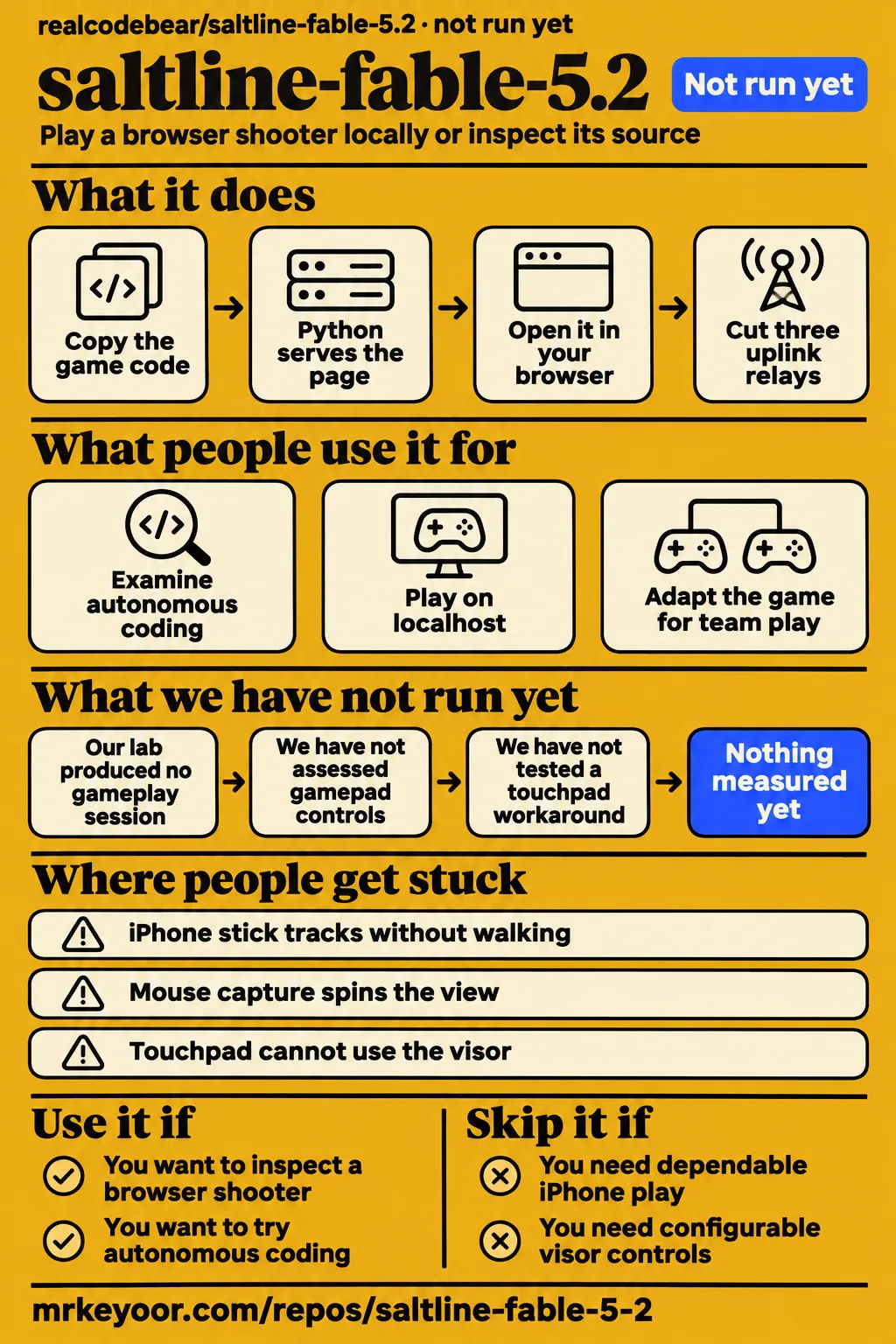
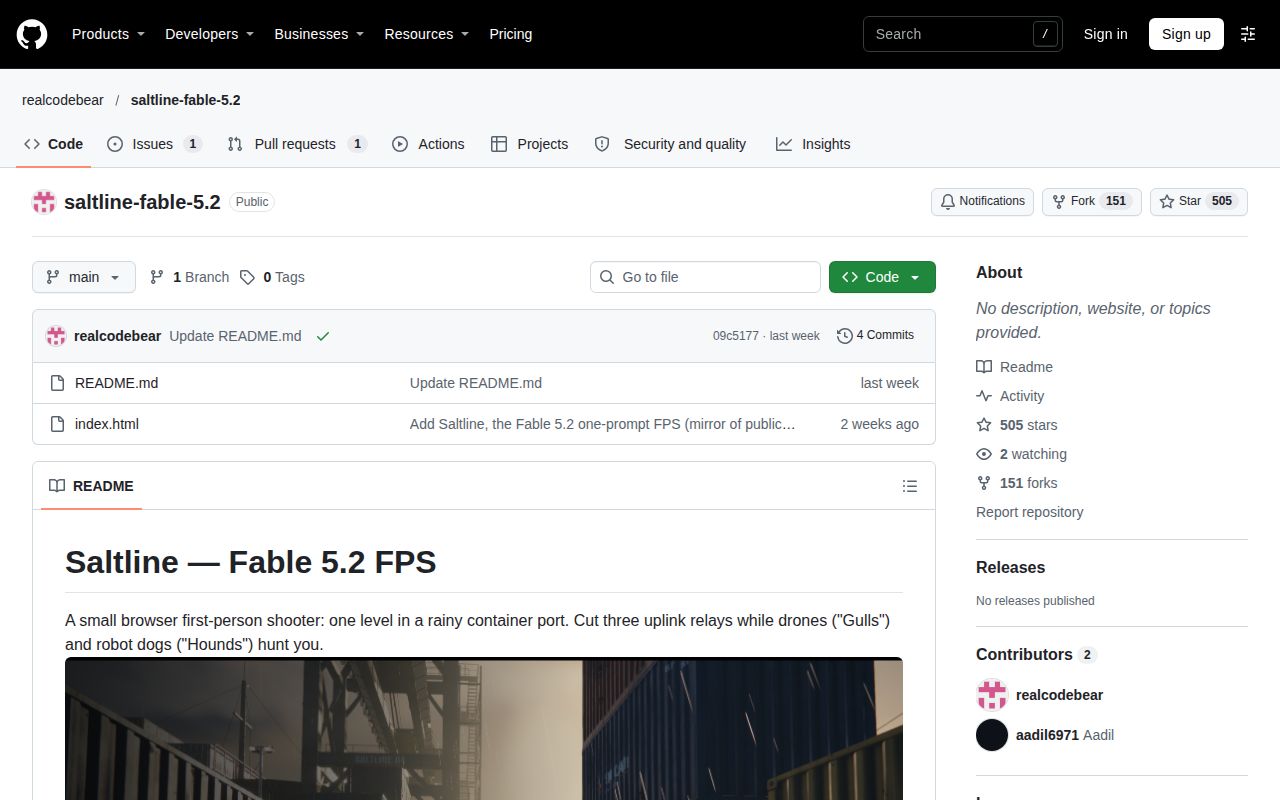
Saltline gives you a small browser first-person shooter (FPS), and realcodebear/saltline-fable-5.2 provides a standalone source mirror for local play, according to its README. Use it if you want to study a complete, compact browser game or try the result of an autonomous coding experiment. Skip it if you need dependable iPhone play: issue #2 reports touch input without walking. Our lab stopped before gameplay because its execution paths did not support this HTML repository.
Your objective is concrete: cut three uplink relays in a rainy container port while flying Gulls and ground-based Hounds hunt you. That narrow scope helps explain the appeal. You can examine how a game connects scenery, enemies, sound and an objective without first navigating a large engine project. The maintainer says the mirror changes the page wrapper, with no changes to the game code, and credits the original author rather than presenting the mirror as a new game (README).
What people use saltline-fable-5.2 for
People have used Saltline to examine autonomous coding, play locally and adapt the game, with different levels of proof behind each outcome.
| Who used it | What they did | Reported outcome |
|---|---|---|
| Anthropic engineer Felix Rieseberg | Tested a game brief without human feedback | Reported eight hours and about $550 at API pricing; these are his figures (launch posts). |
| The realcodebear mirror maintainer | Made the artifact a plain web page | Removed frame scripts and added HTML metadata, reporting no game-code changes (README). |
| The presenter of “Fable 5.2 Creates AAA Style Games in One Shot” | Copied the exposed code and played on localhost | Reported enjoyable play without lag during that session (YouTube walkthrough). |
| Hacker News user leothetechguy | Played using hiding places and elevated positions | Enjoyed the suspense and tactical opportunities, while reporting control and rendering problems (player account). |
| X user Pengoioi and collaborators | Modified Saltline for team play | Claimed a 5v5 online mode, with the first team to five rounds winning (mod announcement). |
The localhost video is useful because the presenter goes beyond repeating the launch claim: they describe copying the code, show the same game running locally and report that it isn't lagging. Their earlier comparison with a week spent struggling over weapon animation in Opus 5.5 is personal experience, not a controlled contest between models. The useful result for you is the demonstrated local copy, rather than the presenter's much broader claims about what game studios would spend (walkthrough transcript).
What happened when we ran it
We did not run Saltline: our November 21, 2026 sandbox attempt at commit 09c5177 had no supported ecosystem for HTML and found no Dockerfile (lab summary). The recorded configuration was 3 CPUs and 8 GB of RAM, with the image listed as n/a. Those are allocation details, not measured game requirements.
| Recorded check | Result | What you can conclude |
|---|---|---|
| Build/test execution path | NOT RUN: HTML had no supported ecosystem; no Dockerfile | No installation, build or test result was produced (lab summary). |
| Hands-on safety step | FAILED: none of compose.yaml, compose.yml, docker-compose.yaml or docker-compose.yml existed | The lab required a Compose file and stopped at that rule (safety log). |
| Teardown | ok | The cleanup step completed (teardown log). |
The hands-on attempt reached a gate that expected a container deployment. Its error called the repository “unsafe” because the required Compose file was absent. That wording describes the lab rule; it is not a finding that the browser game contains dangerous code. There was no gameplay task or answer-quality exercise after that stop.
A generic run entry says “deployed with its own docker compose”, but the safety failure contradicts a successful deployment. We treat the explicit failure as the outcome, consistent with the lab summary. The README's local web-server instructions describe a different route, so this failed automation step also gives you no reason to conclude that those instructions fail.
Where people get stuck: movement can fail after touch registers
The reporter of iPhone Safari issue #2 could turn the camera and drag a visible movement stick, yet the player stayed still. The report concerns landscape play and reproduces on the repository's own GitHub Pages build, which matters if you intend to embed that mirror elsewhere.
The sequence is more informative than a label saying “mobile bug.” The stick ring appears, its centre follows the finger, and dragging on the right turns the camera normally. Touch events are reaching at least part of the game. The reporter traces movement input toward the controller and suggests the movement or physics step as a suspect. That is a debugging hypothesis, not a diagnosed cause. The issue was open with no comments in the research snapshot.
| Symptom and reporter | Practical response in the account | Resolution status |
|---|---|---|
| iPhone stick tracks without walking, issue #2 | The same reporter says desktop keyboard and mouse work | Open; no documented fix (issue #2). |
| iOS D-pad fails, Hacker News player | Moved to desktop to try the game | Workaround, not an iOS repair (discussion). |
| Mouse capture spins the view, Hacker News player | No successful response accompanies that report | Unresolved in that account (discussion). |
| Touchpad cannot use the visor, leothetechguy | Says keybinds cannot be changed | No alternative visor binding documented there (player account). |
| Stutters or frozen tabs, reported by Vibegamer | Lowering graphics quality reportedly helps | A reported mitigation (Vibegamer review). |
| Mission/holdout toggle fails, Chrome player | No complete reproduction or response accompanies the excerpt | No documented resolution (discussion). |
The play guide documents drag-to-look and arrow-key or IJKL turning when mouse capture is unavailable. Keep that separate from the spinning-camera report: an alternative input method is not a demonstrated fix for that bug. Likewise, leothetechguy's container-rendering and drone-collision complaints describe visible defects, while their suggested skybox explanation is speculation (Hacker News account).
The $550 claim describes generation, not the price of playing
Rieseberg reports about $550 at API pricing for an eight-hour autonomous run, according to the README's attribution. That describes making the original game. It is not a fee to launch the mirror or an estimate for your next game brief.
“One prompt” needs the same care. The claim is one initial instruction without human feedback, followed by a long autonomous run. The copying guide explicitly says Saltline did not come from one reply (generation guide). If you're deciding whether to fund a similar experiment, the distinction changes your expectations: a brief can be short even when the model works through many steps. Neither a polished screenshot nor a short prompt tells you how repeatable the process is.
Attention also answers a different question from adoption. The public GitHub API returned 505 stars and two open issues and PRs during our November 21 check, with the last push dated November 11, 2026. Those counts show interest and repository activity, not successful play sessions or support capacity (repository metadata). The unresolved iPhone report is more useful to a phone player than the star total.
Local play uses a web server; fonts still use the network
The README's local route is python3 -m http.server 8731, followed by opening localhost:8731 and clicking the game to capture the mouse and start sound (local instructions). Python serves the page here; it isn't the game's rendering engine. The same README says Three.js is bundled into the HTML file.
No credential or hosted AI service appears in those play instructions. Copying an artifact into a Claude conversation is a separate activity: the copying guide requires signing in to save the copy to your account. You can therefore distinguish playing an existing file from asking an AI service to change it, without treating the reported generation bill as a continuing runtime requirement.
The README explicitly lists Google Fonts requests. For a restricted network or an offline demonstration, that is an external connection worth accounting for. “All game assets are made in code” and “the page never contacts another host” are different claims. The repository's description supports the former with an explicit font exception to the latter (asset description).
saltline-fable-5.2 vs Unreal Engine and Unity
Saltline is a finished small example to inspect; the engine alternatives discussed by reviewers are routes for building your own project. Choose according to which of those jobs you need done.
| Choice | Why people bring it up | Decision for you |
|---|---|---|
| Saltline mirror | The maintainer exposes a standalone copy with no game-code changes | Start here to examine or play this particular game (README). |
| Unreal Engine FPS demos | A Hacker News commenter says ready-made demos provide playable starting points faster | Consider a ready-made demo when your goal is an engine-based prototype, rather than reproducing the AI experiment (comparison). |
| Unity with separate AI tools | Promptzone recommends a standard engine workflow for control and iteration | Consider that workflow when you want to direct an original project; reject the page's claim that Saltline cannot be edited (Promptzone comparison, copying instructions). |
A commenter also compares Saltline with kkrieger, earlier procedural FPS work, to challenge the idea that generating assets in code began here (Hacker News discussion). That comparison concerns technique and history. It isn't a reason to choose either engine, or a measurement of how much development time Saltline saves.
If you want a shooter to keep playing, Vibegamer's objection is simpler: it describes one level, two enemy types and no human enemies (game review). The same small scope that makes the source approachable limits the amount of game you get. Hiring a developer appears in the X discussion as a question about spending the reported $550, not as a costed alternative with a known winner (X discussion).
What the other reviews get wrong
Promptzone's “generated in minutes” description conflicts with Rieseberg's reported eight-hour run, and its “no customization” claim conflicts with the public mirror and copying instructions (Promptzone, README, copying guide). Those errors would send a curious developer away for the wrong reason.
The same page says keyboard and mouse are required and controller support doesn't exist. The play guide documents touch and gamepad mappings, while issue #2 demonstrates that visible touch controls can still fail at movement (control guide, iPhone report). Documentation of an input mode is a narrower claim than successful play on every device.
Fable52.games also contradicts itself in consequential places. Its FAQ says the prompt hasn't been published, although TweakTown reproduces it. Its claim that nothing loads from the network conflicts with the README's Google Fonts disclosure. And its unconditional yes to iPhone support overlooks the mirror's movement report (play-page FAQ, published prompt, README, issue #2).
Fanboydestroy's statement that no further builds or updates had been announced is incomplete against TweakTown's account of an updated version with model and gameplay improvements (Fanboydestroy, TweakTown). Promptzone's separate claim that Fable lacks a public API conflicts with TechPowerUp's API coverage; Charlie Hills also documents selecting the model in Claude Code (TechPowerUp, November 15 guide). Neither statement about model access determines the game mirror's redistribution rights.
Questions people ask
Rieseberg describes Saltline as one initial prompt without human feedback, followed by about eight hours of work, according to the README. The original artifact, the mirror and a later polished version need to be distinguished when you compare footage or player reports.
Was Saltline really made from one prompt, and which playable version is the original?
The creator's account says one prompt without human feedback; it describes an autonomous process rather than one short reply. The README links the original Claude artifact and says the mirror preserves its game code. TweakTown separately links an updated version and the original (README, version distinction).
What engine does Saltline use: Three.js, Unity or something custom?
The README says Saltline bundles Three.js into its HTML file. Three.js is a JavaScript library for drawing 3D scenes in a browser. This mirror is therefore a browser game using Three.js, rather than a Unity or Unreal project (README).
Were Saltline's models and textures generated in code or taken from asset packs?
The maintainer attributes the models, sounds and textures to code, following Rieseberg's account. The README also says Three.js is bundled and fonts load from Google Fonts. That font exception belongs alongside any description of a self-contained game (asset description).
How did Saltline achieve its graphics?
The play guide describes procedural Three.js meshes and textures generated when the page loads: code constructs the objects and surfaces instead of downloading separate model files. It identifies containers, cranes, corrugated steel and wet concrete as examples. This is the guide's technical explanation (graphics description).
How much did Saltline cost to generate?
Rieseberg reports about $550 at API pricing for about eight hours of work. The README explicitly attributes those figures to him and says they weren't checked there. Treat the amount as the reported cost of that particular generation, rather than a quote for making a similar game (creator figures).
Why does the iPhone Safari movement stick respond to touch without moving the player?
Issue #2 reports working stick tracking and camera look, but no walking. The reporter suspects the movement or physics step after input reaches the controller. The thread contains a hypothesis and reproduction steps, with no confirmed cause or repair (issue #2).
Does Saltline work on iPhone and Android?
The iPhone report shows a movement failure on Safari, including the mirror's GitHub Pages build. A Hacker News commenter reports success in Firefox on Android. That supports a specific Android success report alongside a specific iPhone failure, rather than a blanket mobile promise (iPhone report, Android player).
Can I download Saltline's source and run it locally?
Yes: the public mirror includes local web-server instructions, and the presenter of “Fable 5.2 Creates AAA Style Games in One Shot” reports playing a copied version on localhost. The maintainer's command serves the page with Python, after which you open it in your browser (README, local-play video).
Can Saltline be copied and modified in Claude?
The Saltlinegame.pro guide describes making an artifact copy while signed in, then requesting changes in its conversation. It also warns against publishing the modified copy as your own work. Technical access to an editable copy and permission to redistribute it are separate matters (copying guide).
What changed between the original one-shot build and the polished version?
TweakTown says the updated version improves some models and gameplay, without identifying specific changes. The mirror maintainer separately reports only wrapper edits: removing frame-runtime scripts and adding basic HTML metadata. Those descriptions concern different changes and should not be merged into one changelog (TweakTown, mirror README).
What prompt was used to make Saltline?
TweakTown reproduces a brief requesting an FPS with very detailed, photorealistic graphics and a deliberately tiny level. The governing tradeoff is explicit: high visual ambition within a small scope. That is enough to correct the play-page claim that the prompt was never published (prompt reproduction).
Which tool and settings ran Saltline's eight-hour generation?
CellCog's investigation says the posts it checked name neither the tool behind the eight-hour run nor its settings. A later guide recommending Claude Code is advice for a similar experiment, not a record of Rieseberg's configuration (CellCog investigation).
What we have not tested yet
Our lab produced no gameplay session, compatibility matrix or performance result for commit 09c5177. Installation time, build time, test totals, frame rate, browser memory and security-audit coverage are all unmeasured. The configured sandbox allocation cannot stand in for minimum hardware requirements, and its image label supplies no operating-system or runtime version.
We have not reproduced the iPhone failure, assessed gamepad controls or tested a touchpad workaround. Firefox reports conflict, and the player accounts aren't tied to a common device, browser version and game build. The multiplayer announcement needs an independent networking and functional assessment before you can treat it as a dependable team shooter. It is a modification claim, not a feature demonstrated in this mirror.
The original-to-polished version map, generation logs and exact generation settings remain missing. The $550 figure is creator-reported, not independently audited. The README's local instructions are documented rather than reproduced by our lab. Nor have we inspected every graphics or audio implementation claim made by the guides.
The license field returned by GitHub is null, and the README credits the creator while offering to remove the mirror on request. That combination leaves permission for redistributing modified builds unresolved; public access alone isn't a license (repository metadata, README). The Hugging Face community article also displays an October 31 date while describing a November experiment, so its chronology needs reconciliation before it can support a provenance claim (community article). For your next step, distinguish private source study from publishing a derivative, and settle permission with the rights holder before the latter.