React is a UI foundation, not a complete application framework
React describes itself plainly as a JavaScript library for building user interfaces, and that narrow definition still matters. Its core idea is to describe a view for each state, split the interface into encapsulated components, and compose those pieces into larger screens. That solves a real maintenance problem: interactive pages become easier to reason about when rendering follows application state instead of scattered DOM instructions. JSX provides the familiar HTML-like authoring style shown in the README, although the project explicitly says JSX is optional.
The repository is popular and actively maintained. It had 247,898 GitHub stars when reviewed, its latest listed release was v19.2.8 on July 21, 2026, and its last push was August 26, 2026, the review date. Those dates together are stronger evidence of health than release cadence alone. The 1,276 open issues are substantial, but issue count needs context for a foundational project with a huge user base. It signals a busy maintenance surface and a potentially noisy contributor experience, not abandonment.
What happened when we ran it
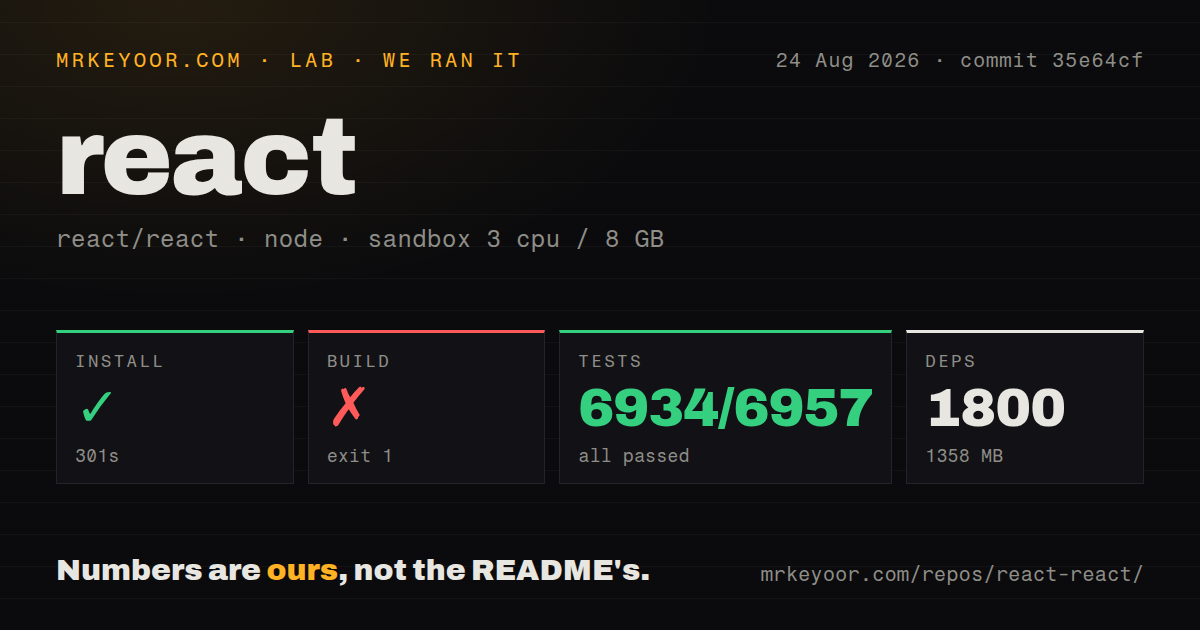
Our run used commit 35e64cf inside an unprivileged Debian container with 3 CPUs, 8 GB of RAM, Node 22, and no secrets. The repository contained 7,206 files, roughly 827,748 lines of source, and occupied 40.4 MB when checked out. Installation succeeded in 301 seconds, bringing in 1,800 packages and consuming 1,358 MB on disk. That is contributor-scale machinery, not the footprint a product team should confuse with installing React as an application dependency.
Tests were the strongest result: Jest reported 6,934 passed, 0 failed, and 23 skipped out of 6,957, completing in 234 seconds. The repository also exposed 23 CI workflow files and monorepo workspaces. We measured no conventional tests directory and no Dockerfile, so contributors should expect the project’s own layout and automation conventions rather than a generic Node repository structure. The passing suite is persuasive evidence that the checked-out revision was internally sound in our environment.
The build failed after 9 seconds. The final log shows the Rollup Closure Compiler plugin invoking the Java compiler jar, then receiving spawn java ENOENT because java was not in the path. That is the boundary of the evidence: the log demonstrates a missing executable, not a defect in React or proof that installing Java is the only preparation required. Still, it exposes a documentation gap for source contributors. The README’s installation section focuses on using React in projects, while a fresh source build needs system-level tooling beyond the Node and Yarn path visible there.
Its strengths are composability, adoption, and unusually clear learning paths
The component model remains React’s practical advantage. A team can build small stateful units, pass rich JavaScript data through them, and compose them without storing application state in the DOM. The declarative approach makes updates predictable: developers state the intended interface and React handles the relevant rendering work. The README also supports gradual adoption, from adding React to an existing project to starting a new application, so a migration does not inherently require rewriting an entire interface at once.
Its documented reach is broader than browser-only rendering. The README points to server rendering with Node and mobile development through React Native, while keeping React itself neutral about the rest of the technology stack. The official learning material is divided into a Quick Start, tutorial, Thinking in React, state management, escape hatches, and an API reference. At version 19.2.8, that combination of conceptual teaching and precise reference material makes the library easier to introduce across teams than projects that offer only generated API pages.
React’s maturity is also visible in the contribution surface. The repository links a code of conduct, a contribution guide, and labeled good-first issues. There are dedicated runtime build-and-test and compiler TypeScript workflows advertised in the README. The MIT license is simple for commercial use. None of this eliminates the complexity of contributing to a codebase of roughly 827,748 source lines, but it does provide explicit entry points rather than leaving new contributors to reverse-engineer expectations.
The rough edges begin where React deliberately stops
React does not claim to choose routing, data fetching, authentication, styling, caching, or deployment for you. That flexibility is useful for experienced teams, but it moves architectural choices into the surrounding stack. Newcomers asking how to build a whole production application can follow the documentation’s start-a-new-project guidance, yet the core README itself is not an end-to-end operating manual. Teams should budget for framework selection, conventions, dependency governance, and upgrades rather than treating a component library as a finished platform.
The source repository is also heavy. Our 301-second install and 1,358 MB dependency footprint are reasonable for a major compiler-and-runtime monorepo, but inconvenient for casual contribution or constrained CI. The missing Java executable stopped the build quickly, and the top-level README excerpt did not prepare us for that prerequisite. With 1,276 open issues, prospective contributors must also search carefully before filing reports and should expect triage to be more complex than in a small project.
It belongs inside a framework-shaped production stack
For most new web products, React should sit at the view layer inside a framework or established company platform that supplies routing, server rendering, data boundaries, builds, and deployment. Existing applications can adopt it more selectively, mounting components where interaction complexity justifies them. React Native is the adjacent path when shared concepts and skills across web and mobile matter, although the README does not promise identical rendering across those targets.
Choose React when a long-lived interface, broad hiring pool, strong documentation, and ecosystem compatibility outweigh the cost of assembling the surrounding architecture. Consider Vue for template-oriented teams, Svelte for a compiler-led approach, Preact when a smaller React-like runtime is central, or Angular when one integrated framework should make more decisions. The clearest conclusion from our box is balanced: 6,934 passing tests show serious engineering discipline, while the failed build shows that developing React itself is not the same easy setup as consuming it.