Vue binds HTML-shaped components to reactive state
Vue starts with two ideas: templates describe output from JavaScript state, and the runtime tracks state changes to update the DOM. In a single-file component, a .vue file can hold the template, script, and scoped styles together. The result feels close to ordinary web markup while still giving a component model, lifecycle hooks, computed values, event handling, and reusable logic for larger interfaces.
That shape is approachable for designers and frontend developers who prefer seeing the rendered structure directly. It is also flexible enough for a component library or a full single-page application. Vue can mount into one element on an existing server-rendered page, so adoption does not require a complete rewrite. For full applications, the official guide recommends single-file components and the Composition API with <script setup>.
Two API styles solve the same component problems
The Options API organizes code under fields such as data, methods, and mounted, with component state available through this. The Composition API imports functions such as ref and onMounted, then groups logic in normal function scope. Both use the same underlying system and cover common cases. Options is easier for developers who like an instance-shaped object; Composition scales better when related logic spans several lifecycle stages.
A team should choose one default for new code even though Vue allows both. Mixed styles are valid, but constant local switching makes examples and reviews harder to follow. The official guidance points low-complexity, no-build use toward Options API and full applications toward Composition API plus single-file components. That is a reasonable boundary, not a requirement imposed by the runtime.
What happened when we ran it
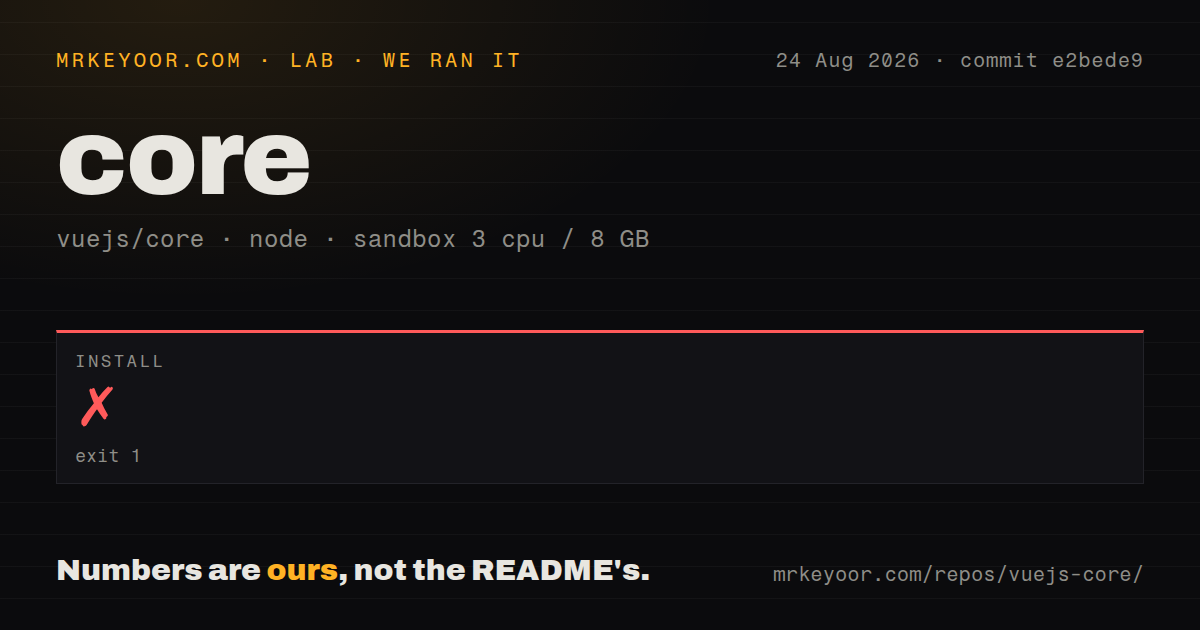
Our lab cloned commit e2bede9 into a fresh unprivileged container with 3 CPUs and 8 GB RAM. The checkout contained 705 files, about 159,231 source lines, and 6.3 MB. Installation failed after 10 seconds with exit code 1, so the run produced no dependency count or installed disk size.
The tail shows pnpm 11.19.0 failing inside its bundled modules with ERR_UNKNOWN_BUILTIN_MODULE. It reports Node.js v20.20.2. The provided sandbox image was named lab-node:22; those are the two facts available, and the log does not explain why that image executed the reported Node version or which built-in module pnpm requested. Assigning the failure to Corepack, pnpm, or Vue would go beyond the evidence.
Because installation stopped, our harness did not run the build or test commands. It would be wrong to call either step failed or passed. The repository package file does define build, type-check, unit, browser, declaration, and coverage scripts. Our structural scan found 9 CI workflow files, monorepo workspaces, no Dockerfile, and no top-level tests directory. Vue's tests live within its package layout rather than a conventional root folder.
Application setup is easier than core contribution
Most users should not clone vuejs/core. The documentation directs new applications to the official scaffolding flow and Vite-based setup, while a direct browser import remains available for progressive enhancement. Application developers consume published packages; core contributors install a pnpm monorepo, build several package formats, type-check separately, and use Vitest projects for unit and browser coverage.
The distinction explains why Vue can be easy to adopt while our core checkout failed at installation. The package file declares Node 20 or newer and pnpm 11.19.0, and its preinstall script rejects other package managers. Contributors should use the exact repository version files rather than whichever Node happens to be active in a general development image. A project using Vue as a dependency has a much smaller toolchain contract.
Vue 3 leaves legacy browsers and Vue 2 behind
Vue 3 requires native ES2016 browser support and does not support IE11. That is a clean stopping point for government, embedded, or enterprise applications tied to old browser engines. Vue 2 reached end of community support on December 31, 2023. The project points organizations that cannot migrate toward an extended-support offering rather than promising continuing free maintenance.
Migration is not a version-number change alone. Vue 3 has breaking changes, and its official migration guide exists because component behavior, global APIs, and ecosystem packages may need work. New projects should start on Vue 3. Existing Vue 2 systems should inventory plugins and build tooling before estimating the move, especially if they depend on abandoned component libraries.
Server rendering adds a framework-sized operating layer
Vue can render on the server and hydrate in the browser, but the SSR guide is explicit about added complexity. Code may run in Node and the browser, request-specific state must not leak between users, browser-only APIs need guards, and hydration requires matching output. A hand-built SSR server is educational; a production team usually wants a Vue meta-framework that owns routing, data loading, bundling, and deployment conventions.
For a client-heavy internal tool, ordinary Vue and Vite may be enough. For public content where initial HTML and search visibility matter, evaluate Nuxt or another SSR-capable route before designing a custom server. Vue core supplies the renderer, not an opinionated production platform. That separation keeps the core flexible but leaves architectural choices with the application team.
Release activity is current despite the failed sandbox install
GitHub showed 54,251 stars, 899 combined open issues and pull requests, and a last push on August 27, 2026. Release v3.5.41 was published on August 5. Its changelog includes fixes for server-rendered asynchronous setup state and several custom-element behaviors. The combined open count measures bugs, requests, and code contributions together, so it is not a defect total.
Vue is mature enough that framework selection should turn on programming model and ecosystem fit, not whether it can render a production interface. Our 10-second install failure still matters to anyone planning core changes or a fork. Confirm Node and pnpm resolution in a clean environment, then require installation, build, type checks, and the relevant Vitest projects to pass before accepting a contributor setup.