The 3D scene carries the landing page
Dioramas ships complete fictional brand sites built around a 3D scene, rather than adding a spinning object beside conventional content. Its README describes a shared three.js engine with lighting effects and scroll-driven camera choreography. The examples include wiping condensation from a glass cloche and taking a watch movement apart. Those are useful references because the interaction relates to the subject. A developer can study how the scene gives the page something specific to do.
Our checkout contained 384 files and about 34,201 source lines. That makes this a substantial collection to adapt, even with shared rendering utilities. The Dioramas README separates the asset pipeline, engine, and brief-led production method. Choose an example whose interaction fits your subject before deciding which visual effects to keep. Copying every effect into a different brand would give you more code to maintain without necessarily making the page clearer.
What happened when we ran it
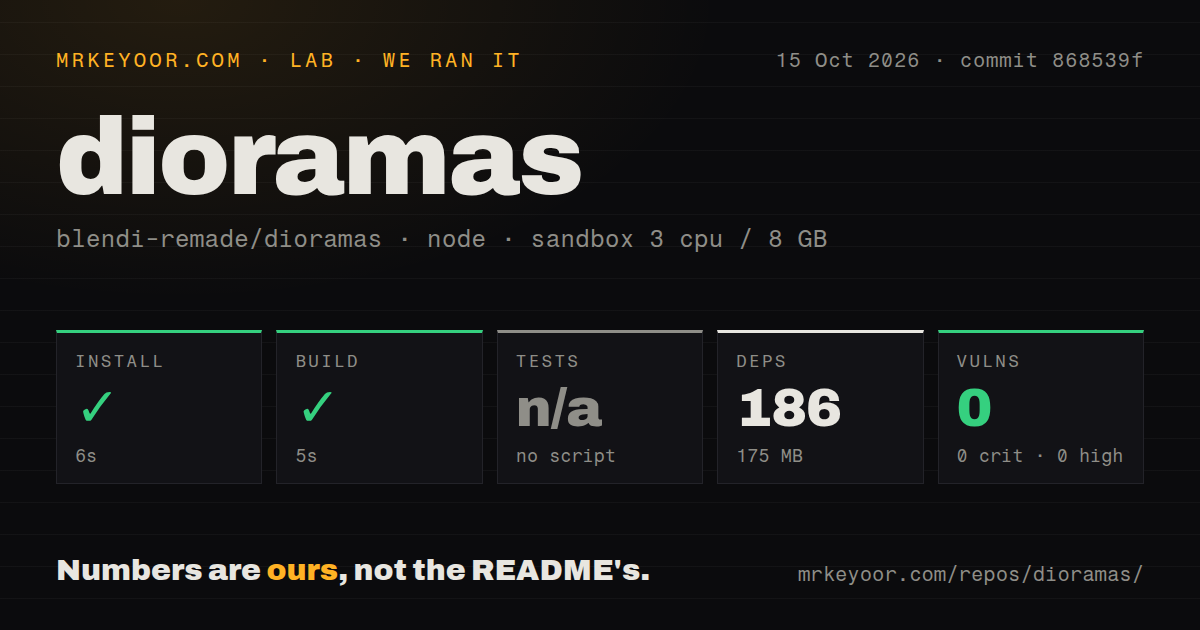
Our sandbox installed commit 868539f in 6 seconds and built it in 5 seconds on October 15, 2026. Installation added 186 packages and occupied 175 MB. The checkout itself was 348.7 MB, so those are separate footprint measurements rather than a claim that the whole repository fits inside the smaller figure. The run used a fresh Debian container with 3 CPUs, 8 GB of RAM, Node 22, no secrets, and no elevated privileges.
Tests were skipped because there was no test script or target. Our scan found no CI workflow files, Dockerfile, or tests directory. Npm audit reported 0 known vulnerabilities. That is a clean dependency-audit result and a successful build, with no browser-quality result attached. We did not measure frame rate or loading time, and we cannot turn the author's rendering targets into observations from our equipment.
Bundled models remove the first generation step
The README puts optimized GLB models directly in the repository and gives a local gallery route alongside individual examples. You can therefore inspect the supplied scenes before creating a generation account. That is an appealing starting point for a frontend developer: an existing object, its lighting, and the interaction code arrive together. The models also make the download much larger than a normal source-only starter.
Our measured 348.7 MB checkout captures that trade-off. The separate asset workflow uses Nano Banana 2 to create an image and Meshy 7.1 to turn it into a textured model through fal. It needs FAL_KEY and makes external generation calls. The repository may be free to obtain, but new generation is a service-backed workflow with its own cost and data decisions. Our local run did not exercise it.
The engine offers control at the price of rendering knowledge
The engine guide names three.js r186 and describes ambient occlusion, bloom, volumetric lights, and planar reflections. It exposes rendering and asset-loading helpers rather than hiding every decision in a visual editor. That suits someone who can read a render loop and adjust scene materials. It will be less comfortable for a designer expecting to replace a photograph and publish without touching JavaScript or understanding what the GPU is drawing.
A 5-second build gives no assurance about the cost of those effects in a visitor's browser. The README recommends a desktop GPU, and the engine guide's quality target uses a powerful desktop graphics card. Mobile layout and touch equivalents appear as requirements in that guide, not results from our lab. Test the actual adapted page on the devices you intend to support before making a performance promise to a client.
Asset attribution survives a change of branding
The asset license file assigns CC BY 4.0 to generated models and images and supplies a Dioramas credit. The code uses MIT. Those are distinct reuse terms, so copying a scene requires looking beyond the code license badge. If your campaign cannot carry the specified credit, resolve that constraint before building its visual identity around a bundled model.
The 175 MB installed package footprint also excludes the work of making a generated object appropriate for your product. The documented pipeline produces visual assets from prompts, not verified product CAD. For a real manufactured object, check the mesh and materials against the item you are representing. An attractive reflection can make an inaccurate detail more noticeable. Nothing in our successful build validated the geometry, branding, or suitability of those assets for a commercial page.
The guide still contains production-workspace assumptions
The engine guide refers to pages/ paths and an already-running development server, while the README directs readers to examples/. That mismatch is small enough for an experienced developer to resolve, but it shows why the internal production notes need interpretation. Treat the guide as implementation context and inspect the current tree before following a path or assuming a process exists on your machine.
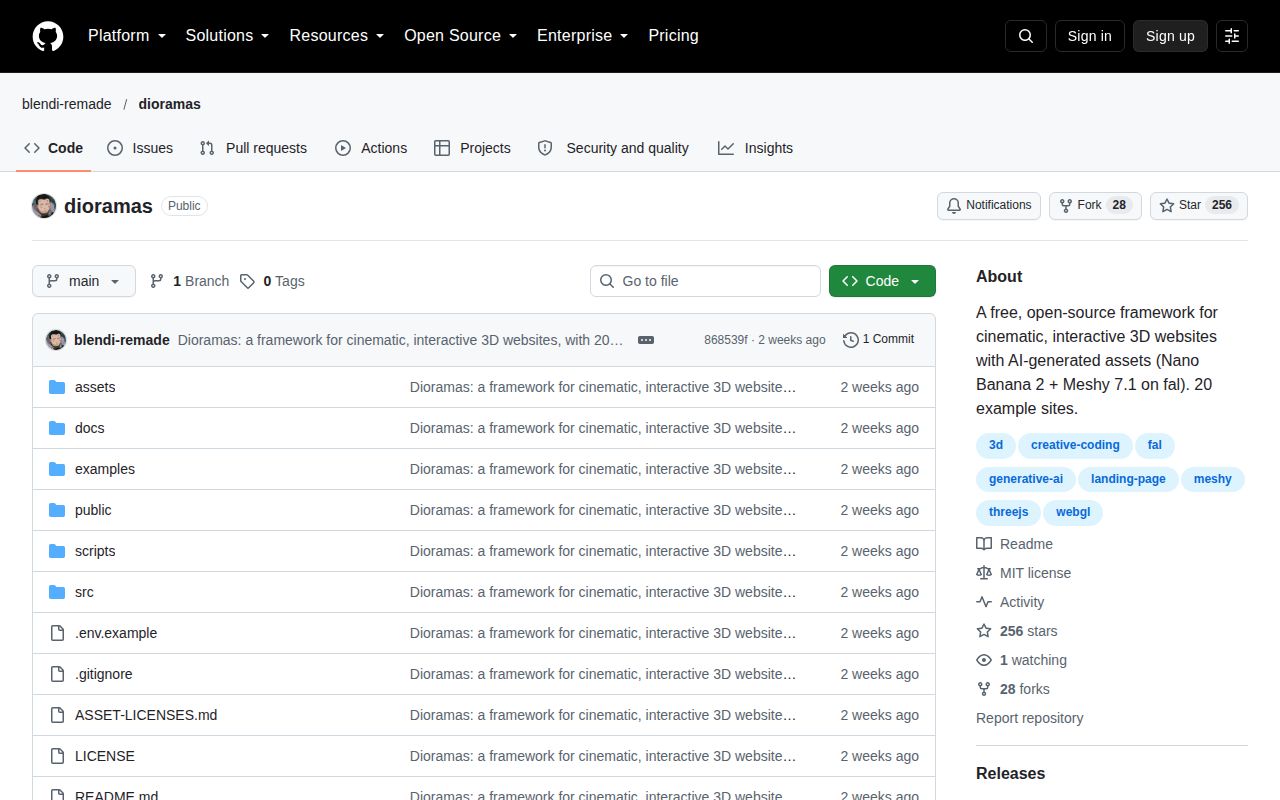
The last push was September 30, 2026. GitHub listed 256 stars with no open issues and PRs, and the fetched issue list contained no discussion. The latest-release endpoint returned no release record. That provides little evidence about support responsiveness, without proving the collection is abandoned. For a product you will maintain, assume your team owns the adapted scene and its future browser behavior.
Use three.js directly if you need a small scene with different rendering conventions. Consider Theatre.js if animation authoring is the central problem. Dioramas is the more interesting reference when an object should shape both the page composition and its interaction. I would borrow one well-matched example, remove effects that do not help it, and judge the result on a real phone before treating it as a finished site.