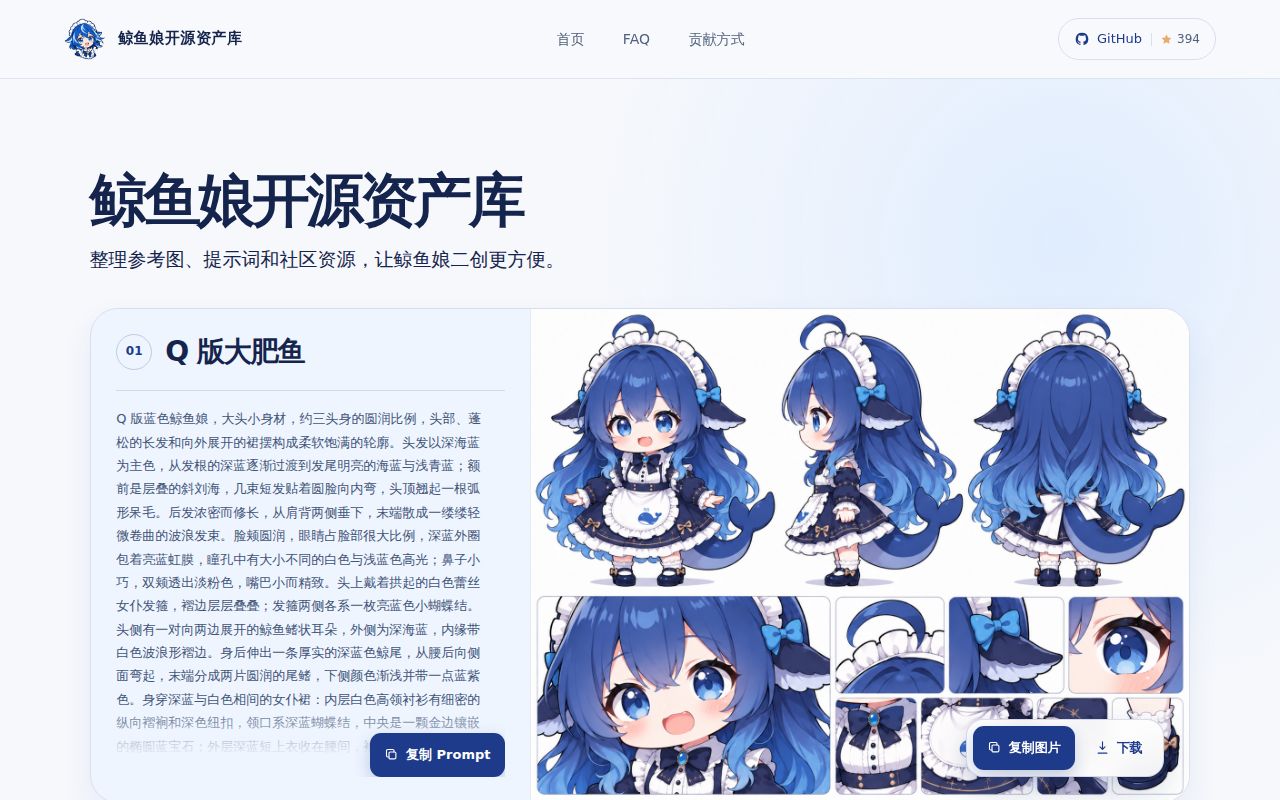
The library collects a community character without defining one canon
DeepSeek Whale Girl collects reference artwork, prompts and community creations around a fan-made character inspired by DeepSeek's whale logo. The README and project FAQ are in Chinese, and we found no English documentation in the repository. Its practical appeal is giving an illustrator or fan-project developer somewhere to start looking. It explicitly leaves the character open to different interpretations instead of prescribing one official appearance or personality.
The README describes reference sheets, a community gallery and downloadable ComfyUI workflows. A separate section preserves attribution for work described as entirely handmade. You can contribute artwork through an issue form without editing HTML or opening a pull request. Those details make this a participatory archive, with the maintainers deciding what enters the published site. The project FAQ also states that it has no official connection to DeepSeek.
What happened when we ran it
Our lab did not run commit 99fdf6e: the repository's language was HTML, our harness had no supported ecosystem for it, and there was no Dockerfile. The October 15, 2026 record therefore contains no install, build or test results. This review rests on the repository and its documentation. It does not establish browser behaviour, image-generation success or the compatibility of downloaded workflows with a local ComfyUI installation.
The README gives a local preview command using Python's HTTP server to serve the site directory. It also documents a gallery-generation script and a site-validation script. Those are instructions a maintainer can follow, not successful checks from our lab. A static website can still contain broken image paths or browser-specific problems, so a deployment recipe alone cannot settle whether your fork renders correctly.
The MIT badge does not cover the artwork
The README draws a useful distinction between website code, original explanatory text and image assets. Code uses MIT. Original site writing and generation prompts use CC BY-SA 4.0. Character reference images, community submissions and material from other projects follow their respective authors' or sources' permissions. The site's inclusion of an image does not mean it owns that image or has granted you permission to reuse it. The licensing section says this directly.
That distinction is the main purchasing decision, even though the repository itself is free. An artist browsing for visual references gets a useful collection. A product team looking for ready-to-ship commercial mascots still has to check individual assets. The gallery manifest contains entries with unknown authors and empty source fields. Treat those as incomplete provenance, especially if the image will appear in a paid product or public campaign.
The manifest makes attribution visible without resolving every source
Gallery entries record fields for the author, source, creation type and submission link, as well as image dimensions. Preview images and full-size downloads load separately, according to the README, and static image links remain available without JavaScript. Keeping that information next to the image is a sensible design for a collection whose contributors use different creation methods and attribution practices.
The gallery manifest also shows why a structured record needs human judgement. Some source links lead to shared chat pages, while older entries say the creator is unknown. A link is a lead for investigating origin, rather than proof of permission. When you select an image, preserve its author and source details with your local copy instead of assuming the filename will be enough later.
Downloadable workflows need their own generation environment
The archive includes ComfyUI task files with dependency notes and submitted sample images. That helps a creator move beyond copying a prompt, because the surrounding workflow can describe how an image was produced. It still requires a separate generation environment. Serving the gallery locally does not execute those graphs, provide model weights or establish that your available nodes match what a contributor used.
Choose ComfyUI itself if your immediate job is to build and run an image-generation graph. Choose SillyTavern if you want an interface for character conversations with a language-model backend. Neither is a replacement archive of this character's art. They are alternatives for the activity a reader might mistakenly expect from the repository's name. This project is useful before those steps, when you are gathering references and deciding what to create.
Submissions go through maintainers before appearing on the site
The contribution instructions ask for image attachments rather than chat-sharing links alone. Maintainers collect submissions and publish them with the website, so posting an issue does not automatically add an image to the gallery. They ask contributors to name the original creator and mark unknown authors honestly. For a small community archive, that manual process makes sense, though it gives contributors no automatic publication schedule.
The last push was October 4, 2026. GitHub listed 394 stars and 13 open issues and PRs, while artwork submissions and resource recommendations continued through mid-October. The latest-release endpoint returned no release. Taken together, the push date and issue activity describe an active community collection whose publishing work happens separately from submissions. A missing release tag is not evidence that the archive has stopped.
Start with a source record before downloading an image
The Chinese README, FAQ and issue forms suit people already comfortable participating in that community. An English-speaking developer can still inspect the HTML and manifest, but translation adds effort when interpreting attribution and submission context. That matters more here than it would for a purely mechanical command-line utility, because understanding where an image came from is part of deciding whether it belongs in your project.
I would use the gallery to find references for a fan creation, then follow the selected asset back to its named source. I would pass on it as a ready-cleared brand kit or as a working DeepSeek chat client. Before putting one of its images into your own release, obtain the permission record that belongs to that file.