Schema configuration builds dashboard pages around NestJS
Elpis combines a NestJS backend with Vue pages and a Vite frontend builder for business applications. Its documentation is primarily Chinese, and we found no English guide in the repository. The interesting part is its dashboard model: menu configuration selects schema-driven views, custom pages or embedded content. For an internal application with many similar forms and tables, those conventions could save repeated wiring. You have to want its application structure to benefit.
Our checkout contained 164 files and about 9,051 source lines. The README shows how schema properties map to table columns, search controls and create or edit forms. That gives a developer a fairly concrete picture of what adopting the framework means. You describe an application's screens through configuration and add custom components when the stock conventions run out. The README includes those examples, although understanding them requires reading Chinese comments.
What happened when we ran it
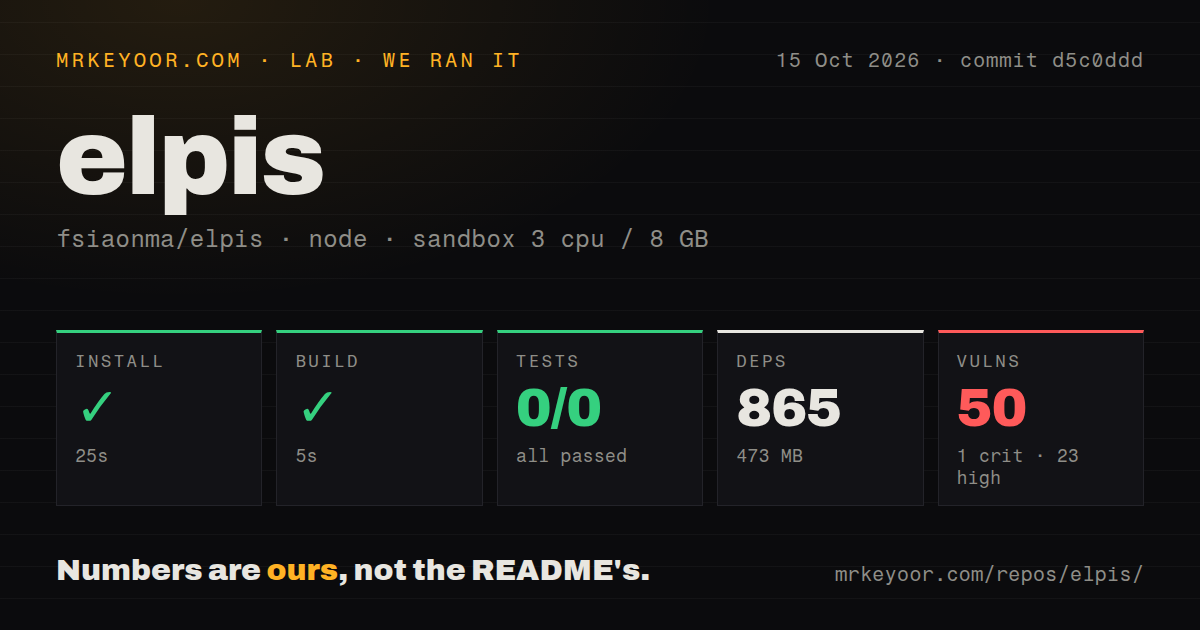
Our sandbox installed commit d5c0ddd in 25 seconds, adding 865 packages and using 473 MB on disk. The build succeeded in 5 seconds. The October 15, 2026 run used lab-node:22 in an unprivileged container with 3 CPUs, 8 GB of RAM and no secrets. This establishes that the measured source could compile in that environment. It does not establish that a business application started or that its dashboard behaved correctly.
The test command succeeded in 1 second, but Mocha reported 0 passed and 0 failed out of 0 tests. That is an empty result, and we give it no credit as a regression check. Our scan found a tests directory but 0 CI workflow files and no Dockerfile. A directory name and a successful command exit are weaker evidence than assertions that actually ran against application behaviour.
Npm audit reported 50 known vulnerabilities: 1 critical, 23 high, 24 moderate and 2 low. The supplied measurements do not identify affected packages, dependency paths or exposure through a deployed application. Calling this a confirmed remote exploit would exceed the evidence. The actionable conclusion is that dependency review belongs before deployment, with the critical and high findings understood and addressed rather than hidden behind the successful build.
A business repository supplies the runnable application
Elpis exposes serverStart and frontendBuild, with additional Nest exports for application extensions. The README uses a separate business repository, such as elpis-demo, to supply modules and development commands. Its documented development flow runs Vite and Nest in separate terminals. This is a framework to incorporate into an application, so cloning the framework is only part of reaching a useful working screen.
The 865 packages we measured cover the framework environment, while your business application's services and configuration add their own responsibilities. The README describes compiled business modules being discovered under dist/modules. Changes to framework TypeScript need recompilation and a business-process restart. A team already comfortable with Nest modules and Vue should recognize the pieces. A newcomer must learn both those tools and Elpis's directory and configuration conventions together.
The model examples expose the cost of custom conventions
The dashboard configuration carries separate options for table display, searching, creation and editing. A property can choose a control type, supply an enumeration or load choices through an API. Row buttons have configured events, while custom views and components live in documented framework directories. That is useful when most screens share a shape. It also means that an unusual interaction may send you into the framework's own component registration rules.
Our 5-second build is encouraging for iterating on the code, but the 0-test result leaves those application contracts unchecked by our run. Before adopting Elpis, build a representative screen with a real validation error and an actual update request. Confirm what the API returns and what the user sees. The README discusses preserved response formats and cookie behaviour, yet compilation cannot verify that your business modules follow those expectations.
AI support adds model configuration and MCP processes
The repository also contains agent, retrieval and memory modules. More concretely, its model configuration loader reads ai.llm, selects a configured model and supports an OpenAI-compatible path or a custom provider. The compatible path rejects a missing or placeholder API credential. You therefore need your own endpoint configuration and credentials when using that path, rather than assuming the framework build includes a working assistant.
None of our 1-second test step established a successful agent call. The MCP client can launch a configured local command or contact an HTTP server to list and call tools. That is real integration code, but our lab did not verify interoperability. Review the configured commands and remote destinations with the same care you give application services, especially before an agent can use tools against business data.
Recent source activity leaves little public support evidence
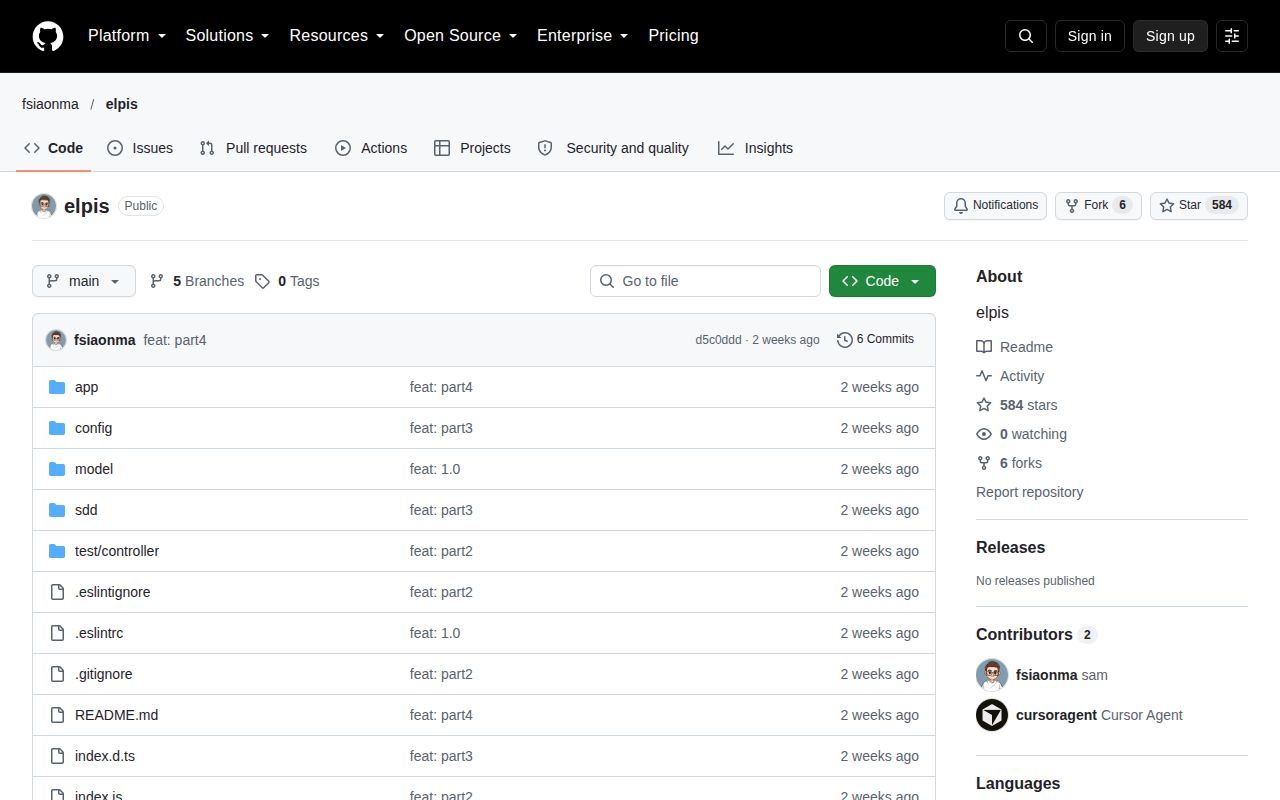
The last push was September 29, 2026. GitHub listed 584 stars, 0 open issues and PRs, and no entries in the issue list we fetched. The latest-release endpoint returned no release. A recent push rules out a judgement based only on an old tag, while the empty issue history offers little evidence about how maintainers handle outside users' problems. The README is more detailed about framework development than about supporting an unfamiliar production deployment.
For a new application, I would start by comparing plain NestJS with a Vue project created through create-vue. That leaves more integration work with your team, while keeping the underlying frameworks' documentation directly applicable. Elpis earns a closer look if its schema-driven dashboard matches your screens closely enough to justify its conventions. Before shipping, resolve the 50 audit findings and replace the empty Mocha result with checks that exercise your actual application.