Thirty-one public skills turn one prompt into a coding process
pstack begins with poteto-mode, a router for work that needs more than a direct edit. A bug playbook reproduces the failure, investigates how and why it happens, delegates the fix, and reruns the failing case. If the change crosses a function boundary, the workflow brings in an architecture pass first. The output is supposed to include the change plus evidence from the failing and passing states.
The repository documents 54 skill directories: 31 public skills and 23 principle references. The public set covers explanation, architecture, test-first fixes, parallel attempts, adversarial review, CI repair, merge conflicts, PR maintenance, and technical writing. That range is pstack's appeal. You do not have to remember a separate prompt for each stage. The cost is accepting somebody else's view of when each stage belongs.
Automatic routing activates on multi-file and uncertain work
Claude Code and Codex receive a startup hook that loads a short routing instruction. It calls poteto-mode when a task changes more than one file, alters a called signature, needs a design choice, involves an unknown-cause bug, or concerns performance. Small work proceeds directly. Codex asks you to trust the hook through /hooks, and setup-pstack can disable automatic routing.
Those triggers are reasonable, but they change the texture of daily work. A two-file maintenance fix can become a staged exercise with more model calls and intermediate artifacts. Teams should try the router on a week of real issues, then compare review quality, elapsed time, and token use with their existing prompts. The repository does not claim that every substantial task benefits from the same amount of ceremony.
What happened when we ran it
We did not run commit 92debb7 in our sandbox. The harness classified the repository as JavaScript but had no supported ecosystem path for it, and there was no Dockerfile to provide a fallback. That means we have no measured install duration, dependency footprint, build result, or test result. Any sentence implying that pstack passed on our machine would be false.
The repository does publish maintainer commands using Bun: install from the lockfile, run the generator, and execute the tests directory. Its contribution guide lists extra checks for scripts, workflows, Markdown links, generated files, and runtime integrations. Those instructions show what contributors are expected to run. They are documentation, not a substitute for our missing execution result at commit 92debb7.
Claude Code, Codex, and Pi get different integration layers
Claude Code uses a marketplace plugin and namespaced commands. Codex gets a native plugin manifest, its own hook mapping, and optional command shortcuts. Pi receives an extension that supplies subagent, messaging, question, and wake-up tools, plus routing at each agent start. This is adaptation work, not a folder of identical prompts copied across products.
Support becomes thinner outside those three. The reference says opencode skill discovery and reading were checked on version 1.18.25. Prime Agent and Gemini CLI rely on documented shared-directory discovery, and their live sessions were not tested. More importantly, delegation and multi-model workflows remain unverified on Prime Agent, opencode, and Gemini CLI. Use those routes as skills-only experiments, not equivalent replacements for the dedicated integrations.
Parallel skills trade more model calls for a broader review
arena runs several attempts and combines their best parts. interrogate asks three different models to attack a diff. swarm splits work among several workers. These are useful when competing designs or a risky change justify independent views, but parallelism multiplies calls. The setup skill exists partly to assign different models and reasoning effort to each role.
Pi's documentation is unusually candid about billing: Claude used through Pi is charged per token, and every subagent adds to that bill even if you hold a Claude subscription elsewhere. Codex also needs its multi-agent feature enabled for the parallel skills, with a sequential fallback documented. Set low-cost defaults for routine roles, reserve panels for consequential changes, and do not let automatic routing decide the budget by accident.
Local scripts avoid telemetry, while prompts still leave the machine
pstack says it runs no server and collects no telemetry. Scripts execute locally, and PR tools use the existing GitHub CLI login. The same paragraph states that anything the skills ask an agent to read, including session transcripts, goes to the selected model provider. Local execution therefore does not make the full workflow local.
The distinction matters for incident logs, customer code, and transcripts containing credentials. Review the skills that read history, set provider retention according to your policy, and keep secret-bearing material out of agent context. Some optional workflows need Bun, Graphite, or GitHub authentication, adding local authority even when no pstack service exists. The project's security policy explicitly treats unintended commands, secret exfiltration, and access outside the pointed repository as valid security findings.
An October 3 push shows an active port with a sync burden
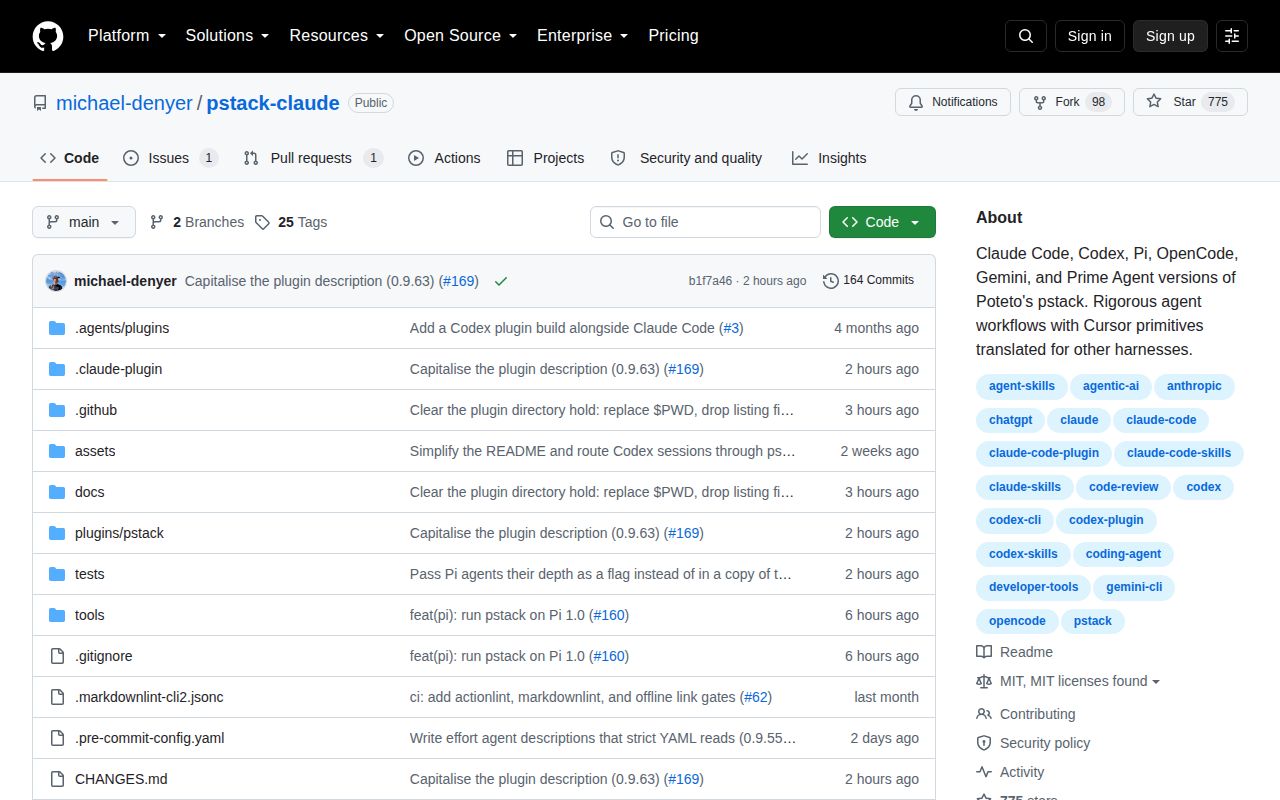
GitHub listed 775 stars and two combined open issues and pull requests, and the repository was pushed on October 3, 2026. The latest GitHub release returned by the API was v0.9.57 from October 1. Main's changelog already contained later 0.9.x entries, so the source was moving faster than the latest release record when checked.
This is a maintained port, not a frozen copy. It tracks an upstream revision, applies mechanical Cursor-to-Claude substitutions, and records deliberate policy forks in tools/forks.json. That discipline makes drift visible, while every upstream change still creates merge and verification work for the maintainer. pstack is a good fit when you want that opinionated process across Claude Code, Codex, or Pi. If all you need is a few reusable prompts, 54 skill directories and an automatic router are needless weight.