The workflow requires approval before implementation
Superpowers changes how a coding agent approaches development. The agent starts by asking questions and shaping a design, presents that design for approval, writes an implementation plan, and only then begins code work. The plan can run through fresh subagents with separate specification and quality reviews, or through staged execution with human checkpoints. This is useful when an eager agent tends to edit before understanding the intended behavior.
The repository itself is small. Our commit b36e082 checkout contained 194 files, roughly 11,856 lines of source, and occupied 1.7 MB. Most of the value lives in Markdown skill instructions, hooks, shell support, and adapters for different coding agents. Superpowers does not ship a model or an application server. The host agent reads these instructions and decides when to invoke the supplied workflows.
Seven named steps make small work feel heavier
The basic workflow lists brainstorming, worktree setup, plan writing, subagent or batch execution, test-driven development, code review, and branch finishing. Each step addresses a common agent failure: vague requirements, edits in the wrong tree, oversized tasks, unreviewed implementation, claims without evidence, or careless cleanup. On a feature spanning several files, that discipline can save a long correction cycle.
For a 2-line configuration edit, the same machinery can feel disproportionate. Release v6.3.0 now classifies work as a spike, bounded task, or architectural task so smaller jobs can avoid a two-document ritual. It still requires approval before implementation. That is an intentional policy rather than a setup flaw. Developers who prefer to give a precise command and inspect one diff should decide whether an enforced conversation adds anything.
What happened when we ran it
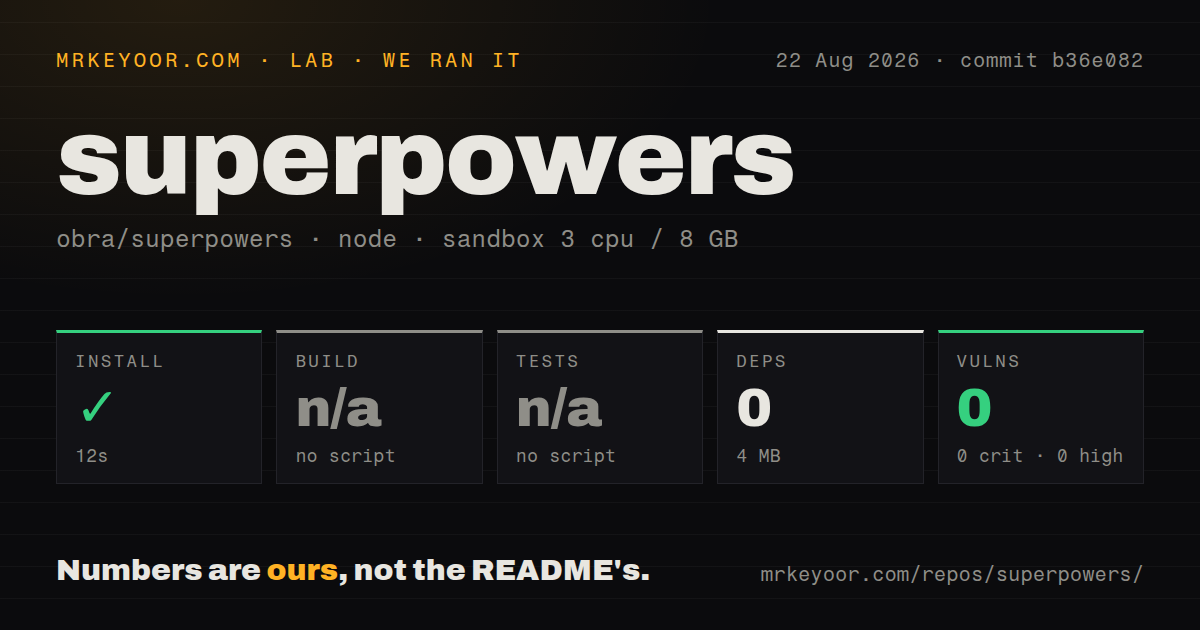
Our sandbox ran npm install at commit b36e082 in 12 seconds. It added 0 packages and left 4 MB on disk. The fresh unprivileged Debian container used Node 22, 3 CPUs, and 8 GB of RAM without secrets. Npm audit reported 0 known vulnerabilities: there were no installed package dependencies for it to flag.
No build script or target existed, so our harness skipped the build. It also found no tests script or target and skipped tests, even though the repository contained a tests directory. The README points contributors to shell runners and an external drill-evaluation repository, and it mentions npm test for plugin infrastructure, but the checked-out package had no npm scripts. We therefore have no passing suite result for this commit.
The repository had 0 CI workflow files and no Dockerfile. Neither is automatically required for a skill collection, but the absence changes what we can verify from the checkout. Superpowers is evaluated mainly by whether agent behavior improves on your real tasks. Teams should trial it on a representative bug and compare review corrections, test evidence, elapsed attention, and unwanted edits against their current agent instructions.
Strict TDD is a compatibility requirement
The test-driven-development skill requires red, green, and refactor in order. The README says implementation written before the test should be removed, then rebuilt from a failing test. That rule can protect codebases where behavior is easy to specify and tests run quickly. It may conflict with exploratory UI work, legacy systems without seams for testing, generated files, or teams that use tests after a validated spike.
Superpowers describes its workflows as mandatory rather than suggestions. That directness is the product. A team should read the skill files before installation because they govern agent decisions, branch handling, review thresholds, and when human approval is requested. Treating the repository as a harmless prompt pack misses the practical consequence: it can refuse the shortcut a developer asks for because the installed method gives another sequence priority.
Each coding agent has a separate integration
The README documents Claude Code, Codex, Cursor, Devin CLI, Factory Droid, Gemini CLI, Copilot CLI, Grok Build CLI, Kimi Code, OpenCode, Pi, Hermes, and Antigravity. Install methods range from official marketplaces to repository URLs and manual instructions. Support across that many hosts is useful, while behavior can still differ because hooks, compaction, subagents, and skill discovery are host features.
Hermes has a concrete caveat: a long session that compacts past the first turn can lose the bootstrap, so the README recommends starting a fresh session if skills stop triggering. Other hosts have their own loaders and update commands. Release v6.3.0 added or changed several harness integrations, including event-driven Codex waits and Devin support. Validate the exact agent and version your team uses instead of treating the compatibility list as one implementation.
Optional telemetry is easy to miss
The optional visual companion loads a Prime Radiant logo from the vendor's website by default and includes the installed Superpowers version. The README says it sends no project details, prompts, or clicks. Three documented environment settings can disable the request, including SUPERPOWERS_DISABLE_TELEMETRY. Air-gapped and privacy-sensitive environments should set that policy explicitly or avoid the companion feature.
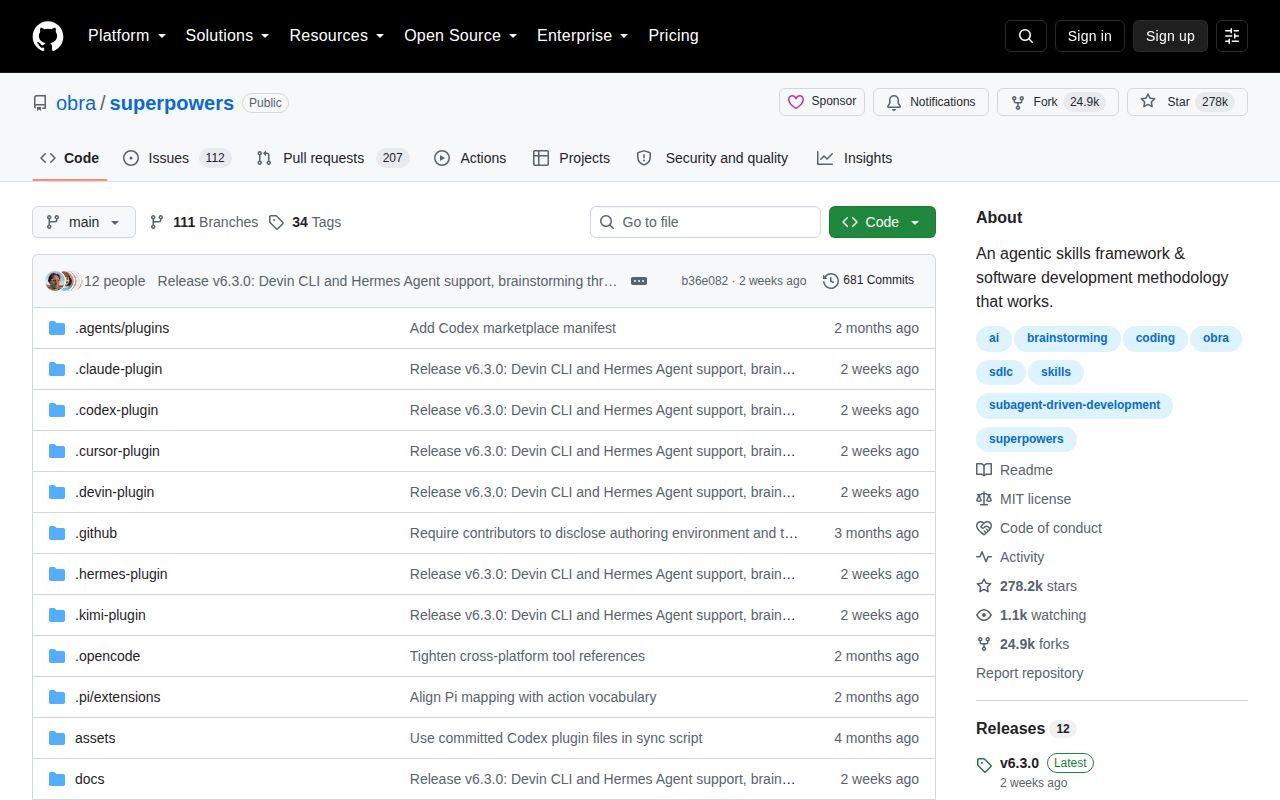
GitHub showed 278,160 stars, 319 open issues and pull requests, a push on 2026-08-19, and v6.3.0 on 2026-08-12. Those figures show remarkable attention and current maintenance; they do not prove the method improves a particular codebase. Our 12-second dependency-free install makes a trial cheap. The missing local test target means adoption should rest on observed agent work, with the team deciding whether fewer mistakes justify the added checkpoints.