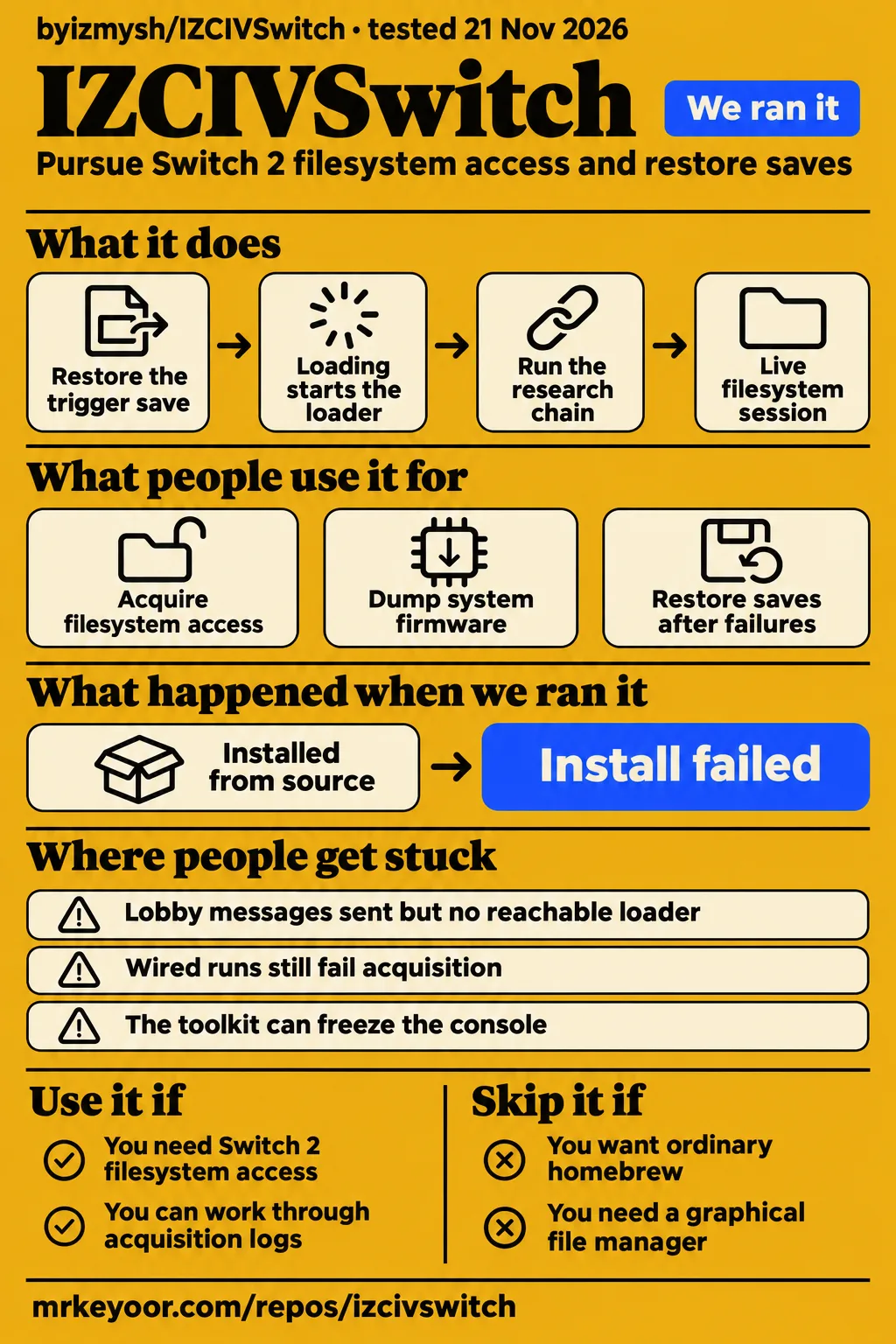
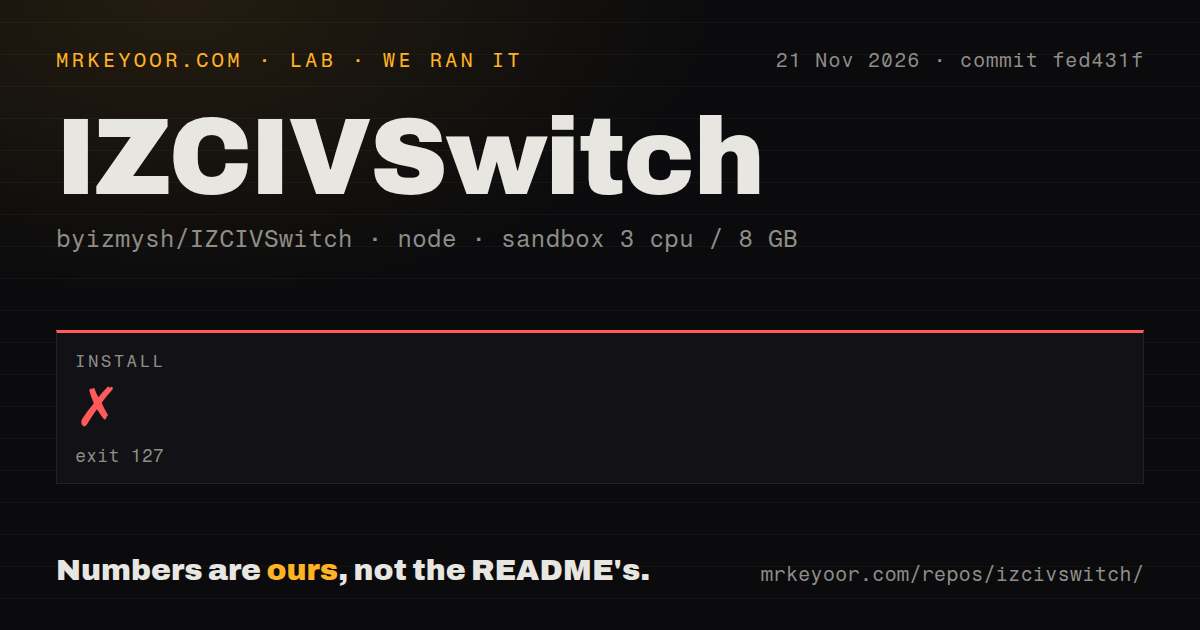
Our IZCIVSwitch npm install failed in 4 seconds, before any console session. Use it if you have a specific Switch 2 filesystem research task and can work through acquisition logs; skip it if you want ordinary homebrew or a dependable file browser. The README describes low-level filesystem operations, and the author of civ7-fs recommends userland functionality for ordinary users.
The decision turns on what counts as success. A loader waiting for a payload, a responsive status command and a live filesystem session are different milestones. IZCIVSwitch packages the pieces needed to pursue the last one, but its own documentation says the status bridge can answer during acquisition. You need the final result, not just a screen that looks ready.
What people use IZCIVSwitch for
Researchers have reported live filesystem access and firmware extraction, while another user restored the trigger save successfully but never completed acquisition. These are different outcomes from different environments, not a shared reliability score.
| Who used it | Task and outcome | What that means for you |
|---|---|---|
| Project author, as reported by BiteYourConsole | Completed all 26 stages in about 669 seconds on the second attempt. | A reported console success, separate from our sandbox install. |
| Bundled civswitch-kit maintainers | Reported RUN 38 completing the chain and a dump of 90 system programs, 222 MB of CodeFS. | CodeFS contains program code and metadata; this is the kit maintainers' result. |
| GitHub issue #4 reporter | Backed up the save tree and restored the bundled trigger save, then repeatedly stopped during acquisition on Windows and CachyOS. | Save restoration can work while filesystem acquisition fails. |
| HerXayah, author of civ7-fs | Uses IZCIVSwitch's save restoration tool after failures and says they also restore after successes. | The restoration utility has a role even when another port runs the filesystem engine. |
| X user Hrvtuirvw_ | Reported success about once in five to eight attempts and better results than their recent SmileBASIC attempts. | One person's experience, useful when choosing what to investigate. |
The useful distinction is between a reusable component and a dependable complete workflow. HerXayah's use of the restoration tool gives you a reason to examine IZCIVSwitch even if you choose another acquisition engine. Conversely, restoring a known save does not tell you whether the next stage will work on your console.
What happened when we ran it
Our November 21, 2026 npm install at commit fed431f failed with exit 127 after 4 seconds in the CivSwitchLDN subproject. A separate November 22 hands-on attempt failed its safety check because no supported Compose file existed.
| Check | Recorded result | Scope |
|---|---|---|
| npm install | Failed, exit 127, 4 seconds | ./panel/engines/CivSwitchLDN/ at fed431f |
| Sandbox allocation | 3 CPUs, 8 GB RAM | Image label lab-node:22 |
| Checkout | 270 files, about 24,245 source lines, 6.2 MB | Repository scan |
| Automation signals | 0 CI workflow files; no Dockerfile; no tests directory | Paths found by the scan |
| November 22 safety step | No compose.yaml, compose.yml, docker-compose.yaml or docker-compose.yml |
Lab deployment prerequisite failed |
| November 22 teardown | Teardown reported ok | Cleanup outcome |
The npm postinstall command invoked bash bash/setup.sh. It printed [setup] Installing Python dependencies, then stopped at /work/repo/panel/engines/CivSwitchLDN/ldn/.venv/bin/pip: No such file or directory. That is the consequential error: the setup script tried to use a pip executable at that path and could not find it. The log also contains npm's warning that --force disables recommended protections.
This failure happened before a console task. The tail does not explain why the executable was absent, so blaming a particular Python version or missing system package would be a guess. The configured image name gives you no independent reading of the actual Node, Python or operating-system version. The scan's missing tests directory also says nothing about checks that might live elsewhere.
The November 22 run summary says it deployed through Docker Compose, but the detailed safety step says the required file was missing. Those entries conflict. We treat that attempt as blocked, with cleanup recorded, rather than claim that a console workflow ran. There are no console screenshots or completed task answers from that attempt to show you.
Where people get stuck: delivery and acquisition fail separately
Issue #6 reaches complete lobby delivery but no reachable loader, while issues #2 and #4 describe later acquisition failures. Match your failure to the stage before changing settings.
| Report | What happened | Response or resolution |
|---|---|---|
| Issue #6, the lobby user | All lobby payload messages were sent, Wi-Fi was restored, then the script kept waiting for the Remote JS Loader. | Open in the checked discussion. The author mentioned an upstream script improvement and an adaptation to follow; no resolution for this reporter is shown. |
| Issue #2, ElMeteK | Repeated attempts never passed 2/4, including on firmware 23.0.1. | The author suggested power cycles, a fresh entry point and wired networking. ElMeteK said the suggestions gave the same result; the issue is open. |
| Issue #4, Windows and CachyOS reporter | Wired runs encountered canary misses, empty address candidates, allocation changes and an unexpected manager allocation size. | Open, with no successful resolution in the checked discussion. |
| Issue #7, earlier-firmware researchers | Experimental 22.1.0 work produced qualified waves without marker hits; a 22.5.0 follow-up also reported misses. | Open. The parameter work documents investigation rather than working earlier-firmware support. |
The issue #6 story starts with an ordinary wrong-directory error: Python could not find IZCIVSwitch.py in Downloads. The reporter changed into the extracted package and got much further. The script joined the lobby, sent the payload and restored the network. Then it waited for the loader until the user interrupted it. Fixing the first error exposed a second, separate problem. A completed progress bar for delivery did not complete the chain.
Issue #4 is more instructive for anyone who assumes a wired connection settles reliability. The reporter used Ethernet for both machines and an existing XSTRIG entry, successfully restored the save, and still stopped at 2/4 Acquiring FS memory. One run reported The bounded native leak contains no qualified, encodable link candidate; another reported General-heap allocation changed while the cache was retained. Those strings distinguish acquisition failures that the same progress label hides.
The Windows EBUSY warning appears in issue #4's title as an error that masks the original failure. The available issue text ends before showing that sequence. Keep the first acquisition error when filing a report; this discussion supports the masking complaint, not a specific explanation of how Windows produced it.
Linux lobby delivery and no-lobby operation have different requirements
PC lobby injection requires Linux; the full archive targets x86_64, while an already installed XSTRIG trigger supports a separate no-lobby route. The README explicitly separates the two paths.
For the lobby path, the documented prerequisites include your own prod.keys, a Wi-Fi adapter for delivery and wired Ethernet to the console. The bundled Python runtime targets Python 3.14. That packaging detail is a requirement to check on your machine, not the runtime version observed in our sandbox. An archive containing a runtime is also a different starting point from the npm subproject our harness selected.
The documented console combination is Switch 2 firmware 23.0.1 with the Switch 1 physical Civilization VII cartridge at version 1.0.0. An XSTRIG save stores the entry trigger: loading it starts the loader again after reboot. It does not turn a saved entry point into guaranteed filesystem access. The optional IZlauncher menu is another way to reach that loader; the main filesystem session does not require the menu.
Save changes and privileged networking are part of the choice
The README warns that IZCIVSwitch can modify game saves and freeze the console, and distinguishes a PC trigger installer that preserves other saves from a Switch 1 ZR path that deletes single-player saves. Read that route-specific warning before choosing an installer.
This is a reason to have a backup you can restore, rather than treating save protection as something to arrange after the first failure. The kit's own workflow includes save restoration between attempts. If your priority is preserving a game in progress, the difference between the two installation paths belongs in the initial decision, alongside whether you already have an entry point.
The lobby runtime also needs Linux network capabilities cap_net_admin and cap_net_raw. These grant networking privileges to its executable. The README recommends restricting access to the console-key directory and file, says the scripts run locally without a cloud service, and excludes keys from release archives. Local execution still leaves you responsible for what you install, the privileges you grant and the logs you share.
English instructions cover the wrapper; kit details continue in Chinese
IZCIVSwitch's main README is English, while the bundled kit offers an English summary and says its detailed instructions are in Chinese. The kit's English summary names that boundary.
You can read the top-level installation choices and troubleshooting table in English. Following the underlying research can take you into Chinese runbooks and technical discussion, particularly when the wrapper's final summary points at an acquisition problem. That is a practical cost if you expect one English manual to explain every low-level error. It is not evidence of a language failure in an interface we ran.
IZCIVSwitch vs SmileBASIC, civ7-fs and CivSwitch
The alternatives solve different parts of the job: civ7-fs is another filesystem port, while CivSwitch and PicoSwitch supply entry delivery. Choose by the stage you need rather than assuming every name is a replacement for the whole chain.
| Option | Why you might choose it | Evidence boundary |
|---|---|---|
| SmileBASIC-based route | You already use that entry and want to compare your own outcomes. | Hrvtuirvw_ reported better results with IZCIVSwitch, without a controlled comparison. |
| HerXayah/civ7-fs | You want to investigate another filesystem port. | Its author hopes for a higher success rate and still uses IZCIVSwitch for save restoration. Hope is not a measured advantage. |
| Gezine/CivSwitch and PicoSwitch | You need the initial loader or persistent-trigger delivery. | PicoSwitch is keyboard-emulating firmware for RP2040 and RP2350, rather than a replacement filesystem engine. |
| Userland homebrew | Your task can stay within the game's process, without filesystem escalation. | The civ7-fs author explicitly recommends userland for ordinary users. |
A comparison based only on successful screenshots would miss the recurring work. HerXayah asks users to restore the save after errors and recommends wired networking. IZCIVSwitch's discussions contain users who followed similar precautions and still failed. If your actual goal needs no system filesystem operations, adding acquisition gives you another stage to troubleshoot without a corresponding benefit to the task.
What the other reviews get wrong
SceneGaming's firmware-omission claim conflicts with the archived README, which explicitly lists 23.0.1. Its 0.2.1 overview also presents console keys too broadly.
The archived README limits prod.keys to PC lobby injection and exempts no-lobby/XSTRIG. Someone arriving with an installed trigger therefore faces a different key requirement from someone using a PC to install that trigger. Saying the tool simply requires keys hides an important route choice. Different documentation snapshots may explain the firmware discrepancy, but the omission claim does not describe the archived page checked here.
SceneGaming also describes the author's modeled retry improvements and says 0.2.1 had not completed a console run. Read those together. Changes to retry and resource-release decisions can be sensible engineering without supplying a newly measured console success rate. The archived v0.1.0 documentation, reported historical runs and a later overview of 0.2.1 answer different questions about different versions.
Attribution was corrected after a public complaint
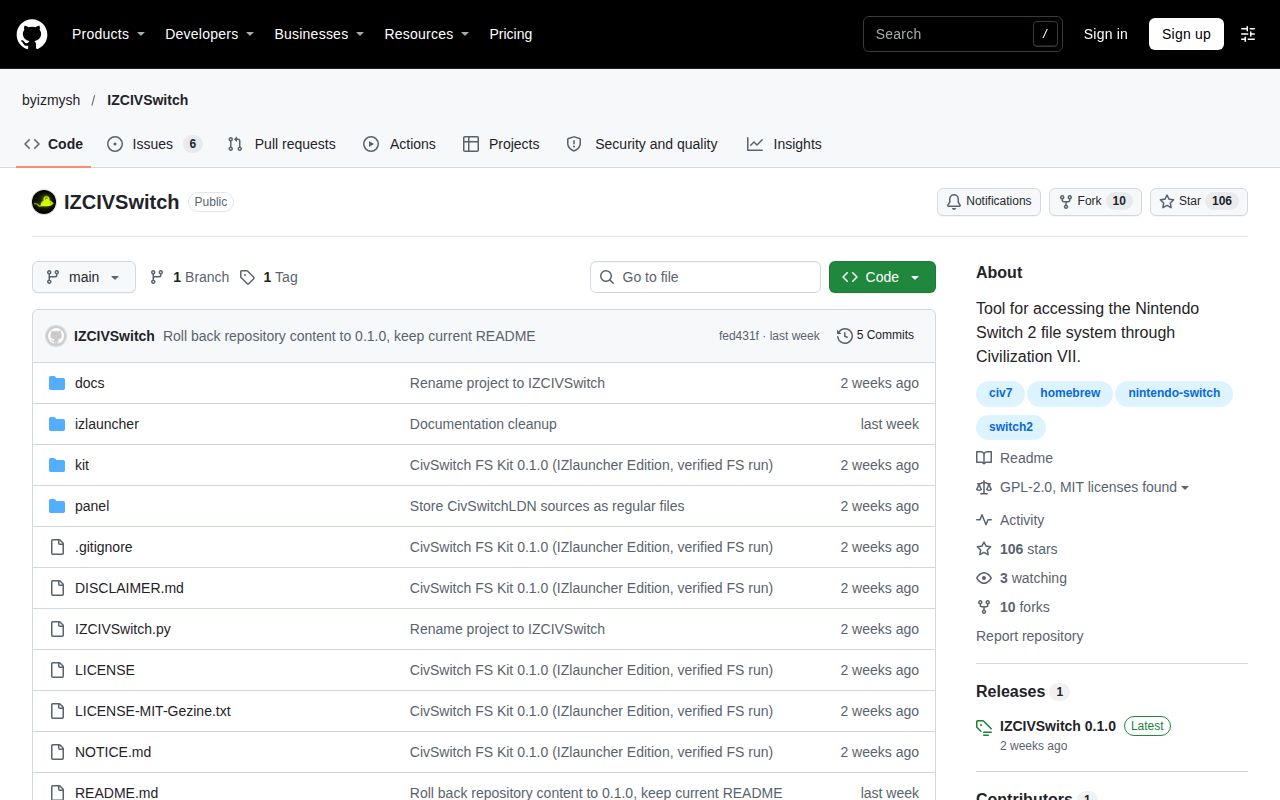
Issue #1 closed after credit changes, and the README now identifies the filesystem kit and lobby implementation separately. The complainant named civswitch-kit and CivSwitchLDN; the author's X post describes integration and packaging work.
The README credits mza1010's civswitch-kit for filesystem support and ItsNerisma's CivSwitchLDN for PC lobby mode. It also names kurumuz, slapah and Gezine in the upstream chain. That attribution helps you find the appropriate project when an engine problem sits below IZCIVSwitch's launcher. The credits section lists different component licenses; the integration code's GPL-2.0 label should not replace reading the bundled notices.
Questions people ask
Repeated 2/4 failures have no confirmed universal fix in issues #2 and #4: ElMeteK reported that the author's recovery suggestions did not help, and the wired Windows/CachyOS reporter also failed acquisition. Both issue #2 and issue #4 were open in the checked discussions.
Why does IZCIVSwitch repeatedly stop at 2/4, and how can I resolve the acquisition failure?
Stage 2/4 can fail with different acquisition errors; issue #4 reports canary misses, absent address candidates and allocation changes. The author recommended a full power cycle and fresh entry in issue #2. Treat those as recovery suggestions, then preserve the exact acquisition error if they fail.
How long should IZCIVSwitch installation take?
There is no supported successful-install duration here: our npm setup failed after 4 seconds, and issue #6 asks about installation time without receiving a duration. The reported console-chain duration belongs to a different operation and cannot serve as an installation estimate.
How can I obtain my own prod.keys, and is title.keys also needed?
The README requires your own console dump for PC lobby injection and says title.keys is unnecessary for that injector. Issue #3 asks for a public extraction tutorial but has no answer. The documented alternative uses a Switch 1 NRO to install XSTRIG, then no-lobby operation needs no keys.
Can IZCIVSwitch work on Switch 1, or could it be ported?
The documented filesystem target is Switch 2; issue #5 asks about a Switch 1 port without an answer. A Switch 1 can help install the entry point on Switch 2, according to the README. That delivery role is separate from running this filesystem chain against Switch 1.
Why do qualified acquisition waves on firmware 22.1.0 fail to flip the canary?
The issue #7 reporter describes qualified waves leaving the canary unchanged, meaning the marker used to detect the intended memory change was not hit. The discussion records experimental parameter changes and later 22.5.0 misses; it supplies no working earlier-firmware fix.
Does an empty address-candidate list relate to identical snapshot hashes?
The issue #4 reporter observed both empty candidate lists and identical snapshot hashes, but explicitly says they do not know whether one explains the other. The relationship is an open diagnostic question, not a demonstrated cause you can repair by changing a hash-related setting.
Do I need a Pico, or can a Switch 1 or another Raspberry Pi deliver the CivSwitch entry point?
A Pico is not mandatory: the README describes a Switch 1 NRO installation route. GBAtemp's CivSwitch discussion describes PicoSwitch's RP2040/RP2350 keyboard delivery and a commenter suggests other keyboard-emulating hardware. That comment is not a compatibility result for every Raspberry Pi.
Which upstream developers should receive credit for IZCIVSwitch's filesystem and lobby components?
The README credits mza1010's civswitch-kit for filesystem support and ItsNerisma's CivSwitchLDN for lobby mode. It also credits kurumuz/ns2jb, slapah's CivSwitch port and Gezine's loader work. Issue #1 documents the attribution complaint and correction.
Can Civilization VII provide access to the Nintendo Switch 2 filesystem?
Yes, researchers report that result through the CivSwitch entry and ns2jb chain: the kit maintainers describe their own completed RUN 38 and firmware dump. That outcome requires further stages after the game's JavaScript loader starts.
What we have not tested yet
Our completed measurement is a failed subproject installation, and the later deployment attempt failed its safety prerequisite. We have not tested a supported release archive through to a console filesystem session, compared acquisition rates across machines, or measured console memory use. The contradictory deployment summary cannot supply those missing results.
We have not reproduced the author's console success, the kit's firmware dump, Hrvtuirvw_'s SmileBASIC comparison or the experimental 22.x work. The checked 0.2.1 overview contains no completed console validation of that build. Its modeled retry improvement is not an independently measured success rate.
We have not audited network traffic, key handling or component licensing. The EBUSY diagnostic sequence is missing from the checked issue excerpt, and no working Switch 1 filesystem port is demonstrated there. A useful next console run would record the exact release, firmware, entry route, save-restoration steps and final acquisition result, including failed boots rather than counting only the successful one.