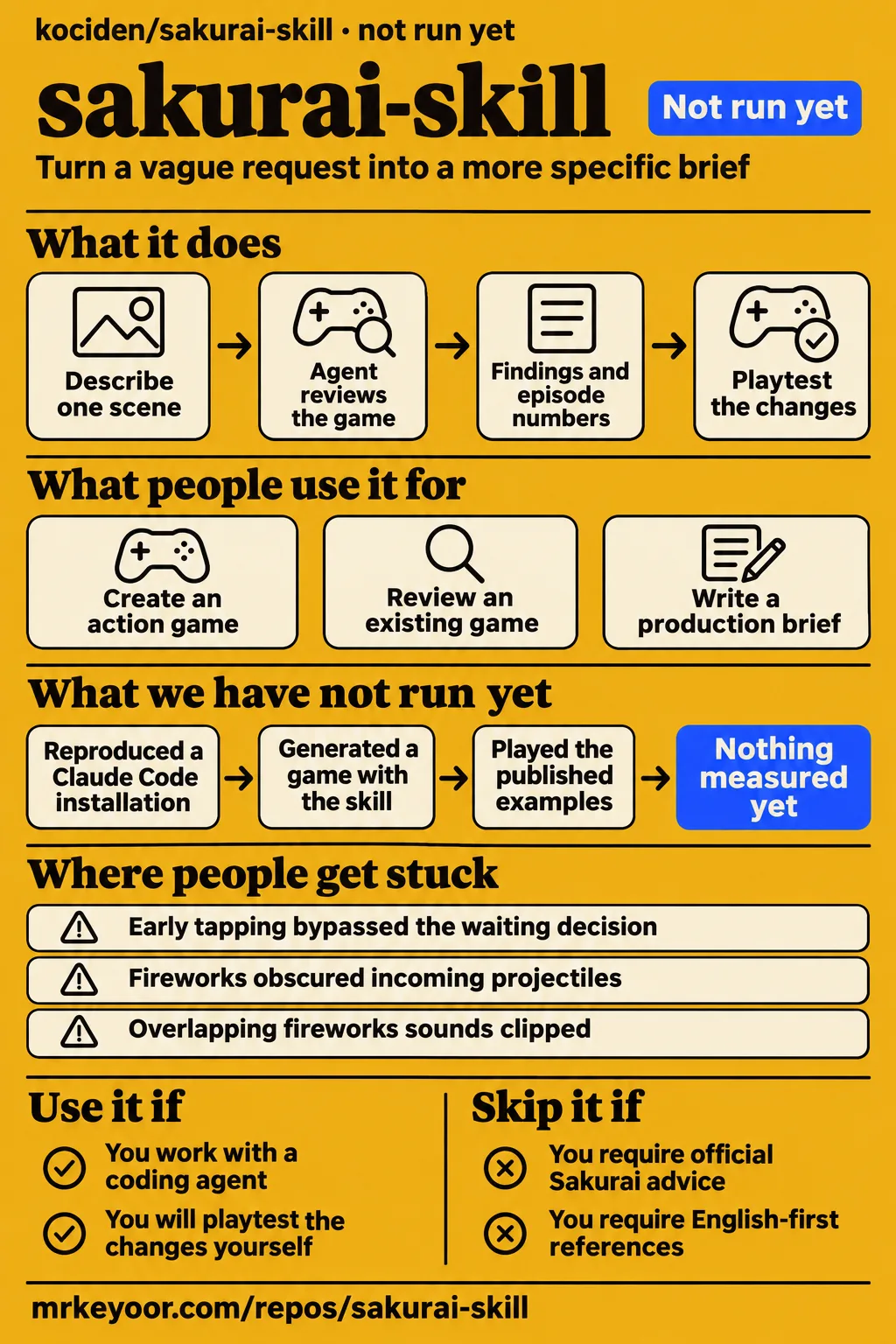
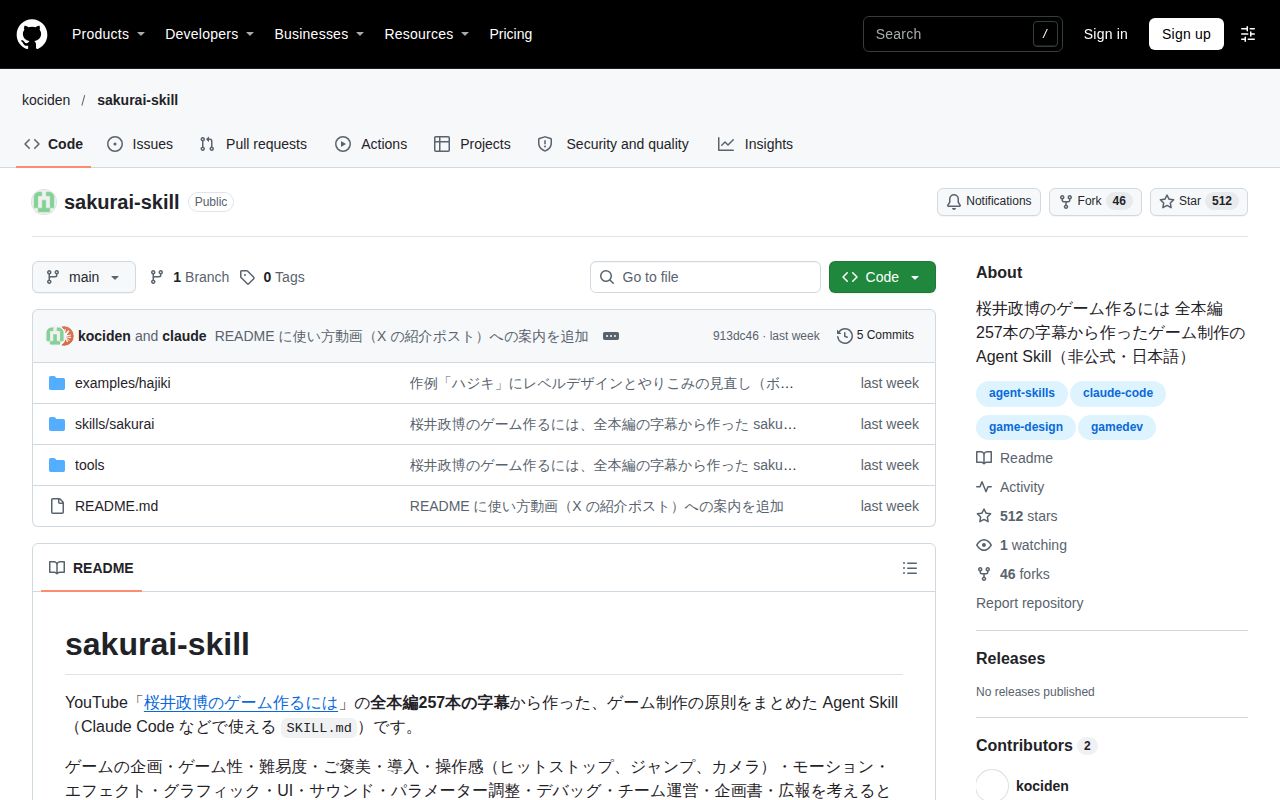
sakurai-skill is an unofficial Japanese game-development skill built from AI summaries of automatic captions for 257 episodes of Masahiro Sakurai's video series. Its best use is to turn a vague request such as better game feel into a brief with specific things to inspect, change and playtest, using the episode references in its README.
Use it if you already work with a coding agent and want design questions to guide a small game. Skip it if you require official Sakurai advice or source material you can read in English: this project is unaffiliated fan work, and its documentation and references are Japanese. Our sandbox recorded no supported execution path. The practical recommendation below rests on the project's structure and attributed game-making accounts, rather than a successful lab playthrough.
What people use sakurai-skill for
Published examples cover a new action game, an existing game's review and a fireworks game refined through several revisions. These are different jobs: finding what to build, identifying a weak mechanic and deciding whether a finished change actually helps. The useful common thread is a concrete request to an agent, followed by an observable result.
| Who used it | What they did | Reported outcome |
|---|---|---|
| Project author kociden | Used an agent loaded with the skill to create Hajiki, from concept through polish, title and icon. | A single-screen Godot action game where waiting longer before reflecting enemy bullets strengthens the counterattack, presented as an author demonstration. |
| Hiroyuki Tanaka, publishing as Hiro-kun on AI氣道 | Applied the skill to とりもどせ!エコたまご version 3. | Eight findings, including uniform scoring, unchanged pacing and repetitive sound, in Tanaka's account. |
| Tanaka and his AI-assisted minigame workflow | Put nine skill-derived requirements into the brief for ギリギリ花火, a fireworks minigame. | Seven requirements fully implemented in the first playable version, according to his production account. |
| Tanaka and the same workflow | Combined automated play patterns with short human feedback. | Revised rewards and visibility, produced 12 sounds, and reported all six images and 12 sounds loading after publication in his follow-up checks. |
Tanaka's existing-game review is especially useful if you already have something playable. The findings weren't abstract requests for polish: every collectible paid the same amount, the pace stayed unchanged and sounds repeated. Those are things you can ask an agent to locate in code or compare in a play session. His account then moves to a new game; it doesn't document repairing the older egg game.
The fireworks example gives the better starting brief. Waiting until a projectile approaches a cloud should earn more, while waiting too long should lose it. Ask the agent how rewards teach that decision before commissioning decorative effects. That is a design question you can evaluate even if you don't know the engine's implementation details.
What happened when we ran it
Our November 21, 2026 sandbox did not run commit 913dc46: the harness reported no supported ecosystem for Python and no Dockerfile. Its recorded configuration was 3 CPUs and 8 GB RAM, with image listed as n/a. These are configuration facts, not resource measurements from a running game or agent session.
| Attempt | What the record says | What it means |
|---|---|---|
| November 21 sandbox, commit 913dc46 | Not run: no supported ecosystem, language Python; no Dockerfile. | No install, build or test result to score. |
| November 22 hands-on attempt | Safety step FAILED because no Compose file existed. | The attempt stopped at the harness's Compose requirement. |
| November 22 cleanup | Teardown reported ok. | Cleanup completed; this is not a game-quality result. |
The later attempt reached its safety check and stopped. The exact reason was unsafe repo: none of compose.yaml, compose.yml, docker-compose.yaml, docker-compose.yml exists (rule: a compose file is required). Here, unsafe is the harness's classification for a missing required file. It isn't a finding of malicious code.
There is an inconsistency in the November 22 run summary, which says deployed with its own docker compose. The failed step provides the actual stopping point. Calling this a successful deployment would contradict that step.
The README describes copying a skill folder into Claude Code, so the absence of a container definition is not itself evidence of a broken product. A skill is a set of instructions and reference files an AI assistant reads. This harness expected an executable ecosystem or a Compose application and couldn't exercise that workflow. Actual runtime versions would require raw toolchain logs; the image entry supplies none.
Where people get stuck: the brief can miss the mechanic
Tanaka's first fireworks version let early tapping earn rewards intended to encourage waiting, according to his comparison of automated play patterns. The game was playable, yet its incentives weakened the central decision. That is a more useful warning than a generic claim that AI-generated games need polish.
His workflow tried aiming at the target band, tapping early and doing nothing. Early tapping unlocked every shape and completed some challenges. The next version changed the unlock and challenge requirements so that early tapping earned fewer unlocks and completed no challenges. The point is to test an easy strategy that avoids your intended mechanic, not just a successful playthrough that follows it.
| Reported problem | What changed in Tanaka's workflow | Status in his account |
|---|---|---|
| Early tapping bypassed the intended waiting decision | Tightened unlock and challenge requirements | Revised in version 2 |
| Exploded fireworks obscured incoming projectiles | Made fireworks fade, then improved the target band and projectile trails | Revised across later versions |
| A request for sound left the generator using simple electronic effects | Explicitly used Earshot components to make audio assets | Reworked in version 4 |
| Overlapping sounds clipped | Added limiting and reduced volume | Reported correction, with listening still assigned to a person |
| Images and audio sat outside the folder copied during deployment | Moved assets inside the deployed play folder | Changed in version 5 |
| The blog-publishing button stopped on an existing-article matching problem | Referred the problem to the workflow maintainer | No repair confirmed in the article |
These are Tanaka's workflow findings and changes, not defects demonstrated in the skill's own code. That distinction matters when you decide what to fix. A missing audio-production instruction belongs in the brief; assets outside a deployment folder belong in the publishing workflow. Installing a design skill doesn't automatically correct either.
There was also an earlier failure of scope. Tanaka asked how to use the skill, and the agent started acting. He stopped it. If you want advice, explicitly request an explanation without file edits. When you want implementation, identify the change you approve and the files or scene it may touch.
Japanese references include a route back to the videos
The README and skill content are Japanese, and the project presents no English documentation in its introduction. Each reference includes an episode number and title, making it possible to trace a recommendation back to the original video. For an English-speaking developer, that language choice is part of the adoption decision, even when the agent can translate a response.
The structure is straightforward: one SKILL.md introduces the principles and review procedures, while category files hold details for subjects such as gameplay, UI and sound. You can ask for the relevant category rather than treating every game-design principle as equally relevant to every change. For example, a confusing reward loop calls for gameplay reasoning before graphics advice.
Keep the episode identifier in the agent's answer. Translation can make the recommendation easier to read, but a translated answer doesn't replace the original explanation. If you are deciding to change an important mechanic, compare the recommendation with your intended players, genre and project size. The README itself asks readers to adapt ideas drawn from large, action-oriented projects rather than apply them literally.
Start with a review request before allowing edits
The documented installation copies skills/sakurai into ~/.claude/skills/, after cloning the repository. The README then suggests asking Claude Code to review the game's feel or consider how Sakurai would approach it. This is a folder-copy recipe for Claude Code, rather than a deployment of a game server.
You need an agent that can read the skill and access the game material you want reviewed. The installation recipe does not introduce a separate hosted service or project-specific API key. Access to the coding assistant and the tools used to build your game are separate requirements. Copy the reference files along with SKILL.md: the smaller category files are where the detailed examples live.
For a first request, describe one scene, who plays it and what feels wrong. Ask for prioritized findings with episode numbers and titles, and tell the agent to leave files alone. This is editorial advice based on the project's review purpose and Tanaka's scope problem, not a prompt reproduced in our lab. Once you choose a finding, ask for a bounded change and replay the scene to judge it.
Security depends on what the agent is allowed to do
SkillsLLM's listing explicitly says its automated checks are limited and do not constitute a security certification. Its third-party software notice is the useful part to read before treating a directory badge as permission to load instructions into a coding agent.
Read the skill before granting it access to a project, and use the agent's permission controls for file changes and commands. That recommendation follows from how this tool operates: its content influences an assistant that may already have development permissions. Tanaka's account of unrequested work is a concrete reason to separate explanation from execution, though it provides no evidence of a security exploit.
The same care applies to rights. Velox Data's review says the repository did not display a license, and the anonymous GitHub metadata checked on November 22 returned no identified license. A directory's open-source label doesn't answer whether you may redistribute the material commercially. Treat the licensing observation in Velox Data's review as a reason to resolve permissions before packaging the skill into a product.
sakurai-skill vs Sakurai-Skills and the original videos
Choose sakurai-skill for a single Japanese skill used in everyday consultation; choose kokuren333/Sakurai-Skills when you want task-specific routing and structured reviews. That distinction comes from both projects' documented organization, rather than a head-to-head quality result.
| Option | Documented approach | Pick it when |
|---|---|---|
| kociden/sakurai-skill | One Japanese skill with 14 reference files and episode numbers and titles | You want a compact entry point for discussing a game or one troublesome scene. |
| kokuren333/Sakurai-Skills | 24 task-oriented skills, routing, checklists and separate source, generalization and agent-guidance layers | You want reviews organized around production stages and can keep linked project material available to the agent. |
| Sakurai's original video series | The original explanations that the skill README directs readers to consult | Accuracy and context matter more than getting a quick indexed answer. |
| game-feel skill | Ebakssa's review suggests it for a narrower review of impact and feel | Your immediate problem is feedback on an action, rather than onboarding, rewards and the broader game. |
The sakurai-skill README describes its single-skill organization, while Sakurai-Skills documents its task routing and provenance layers. Ebakssa supplies the narrower game-feel suggestion. A known repository identity for that game-feel skill isn't established here, so use the linked review to investigate it rather than guessing a similarly named project.
Sakurai-Skills is English-first and also links a Japanese README. Its extra structure serves a real purpose when different reviews need different inputs, but the project still describes its SOURCE entries as secondary summaries. More files and validation machinery don't turn those entries into checked quotations from Sakurai. Choose the workflow you can maintain, and return to the original videos for consequential source questions.
What the other reviews get wrong
Newmade labels November 17, 2026 as the formal public release, but Ebakssa records checking installation and content on November 14. Those dated checks show earlier public availability; Newmade's listing supplies no separate announcement establishing a formal launch on the later date.
Two X promotions also need correction. The account nftjapannftsub describes receiving advice directly from Sakurai. The README explicitly calls the project unaffiliated fan work and says the contents are AI summaries rather than his actual statements. Treat it as kociden's interpretation aid, not a channel for contacting or consulting Sakurai personally.
KOF97AI's X post prints -/.claude/skills/ as the copy destination. The README uses ~/.claude/skills/. The tilde denotes the home directory in the documented shell path; a hyphen is a different character. These X posts are promotion and commentary, not installation instructions to copy without checking.
SkillsLLM also uses broad open-source and compatibility language. Its own security notice is much narrower than a safety endorsement. Prefer the primary project's description of what gets copied and where, then assess the agent permissions and rights for your intended use.
Questions people ask
You can use sakurai-skill to plan a game, review an existing one and turn specific feedback into revision requests, as Tanaka's minigame account illustrates.
What can I actually do with sakurai-skill?
The documented scope includes game concepts, difficulty, rewards, onboarding, controls, UI, audio and review. The README's Hajiki example shows an agent working from concept through title and icon. Ask about a concrete decision, such as whether your rewards encourage the intended action, so the answer gives you something you can inspect or play.
How should I use sakurai-skill, and where should I start?
Start with the README's Claude Code folder-copy instructions, then ask for a review of one scene with episode references. Keep that request separate from permission to edit. Tanaka's experience supplies the reason: an agent began working while he was still asking how to use the skill.
Is sakurai-skill an official project from Masahiro Sakurai?
No. The project README identifies it as unaffiliated fan work, unrelated to Sakurai and Sora. Its recommendations are AI summaries. They should be attributed to this project rather than presented as new statements or personal advice from Sakurai.
Can I use sakurai-skill without game-development knowledge?
Tanaka reports guiding revisions with short comments about missing audio and unclear visual differences, rather than engine terminology. His account demonstrates ordinary-language feedback. You still have to decide whether the result is understandable and enjoyable when you play it; explaining a problem plainly is enough to begin that conversation.
Can I use sakurai-skill outside game development?
Tanaka suggests adapting the method of putting expert criteria into a production brief for writing and other work. His article explicitly says the experiment covered games only. Borrow the briefing method if useful, while choosing expertise relevant to the new task instead of assuming game-design advice fits it.
Can AI finish the game without a human playtest?
Tanaka's workflow used automated play to find reward problems and human feedback to judge feel and sound. His description assigns those jobs separately. A completed automated playthrough answers whether that path worked; it doesn't tell you whether a sound is pleasant or a visual distinction is obvious to a player.
What should I do if the AI starts work I did not request?
Stop the work and clarify whether you want an explanation or implementation. Tanaka reports doing exactly that when his request for usage advice triggered action. Before continuing, state the desired output and whether the agent may change files, rather than leaving the next step implicit.
Can sakurai-skill guide a new game from the planning stage?
Yes: Tanaka reports putting nine skill-derived requirements into the fireworks game's initial brief, with seven fully implemented in its first version. His version history then follows revisions to rewards, visibility, audio and deployment. The practical sequence is a brief, a playable build and focused corrections.
Where can I play the game the AI has built?
The repository links Hajiki on unityroom, and Tanaka's article links the published fireworks game. Those are the examples their authors published. Copying the skill into an agent does not host a new game or create a public URL for your own project.
Will packaging expert game-design knowledge as agent skills become a standard approach to AI-assisted game development?
KOF97AI raises this as a question in an X post about sakurai-skill. The documented examples show one way to brief and review an agent's work. They don't answer an industry-wide adoption question, so treat the proposed standard as a prediction rather than a property of this repository.
What we have not tested yet
We have not reproduced a Claude Code installation, generated a game with the skill or independently played the published examples. The November 21 sandbox and November 22 blocked attempt provide no agent latency, token bill, game-quality benchmark or passing-test count. The runtime and operating-system versions are unknown without raw toolchain logs.
The most useful missing experiment is the same agent tackling the same brief with and without the skill, followed by comparable human playtests. Tanaka's account shows a workflow and reported corrections, not a controlled estimate of the skill's contribution. Its published asset-loading and playthrough checks belong to the publisher, not our lab.
Source fidelity also needs a separate audit. The README warns that automatic-caption mistakes can survive into summaries, and Sakurai-Skills likewise describes secondary notes that have not been checked against the videos. Neither a character count nor Context7's corpus token count measures the cost of an actual request. Codex CLI and ChatGPT installation and execution are also outside our demonstrated results.
No security audit or commercial-redistribution clearance accompanies this review. The research found no project-specific GitHub issue account or relevant Reddit usage discussion to establish support behavior. The Reddit thread discusses Sakurai's playing ability, while the YouTube and Bilibili search results do not demonstrate this skill in use. An unattributed X usage anecdote that predates the repository's reported creation cannot establish adoption either.
For your own evaluation, preserve the original brief, ask for episode-linked findings and record the changes you accept. Then play the revised scene and write down whether its intended decision became clearer. That would give you evidence about your game that a repository description cannot supply.