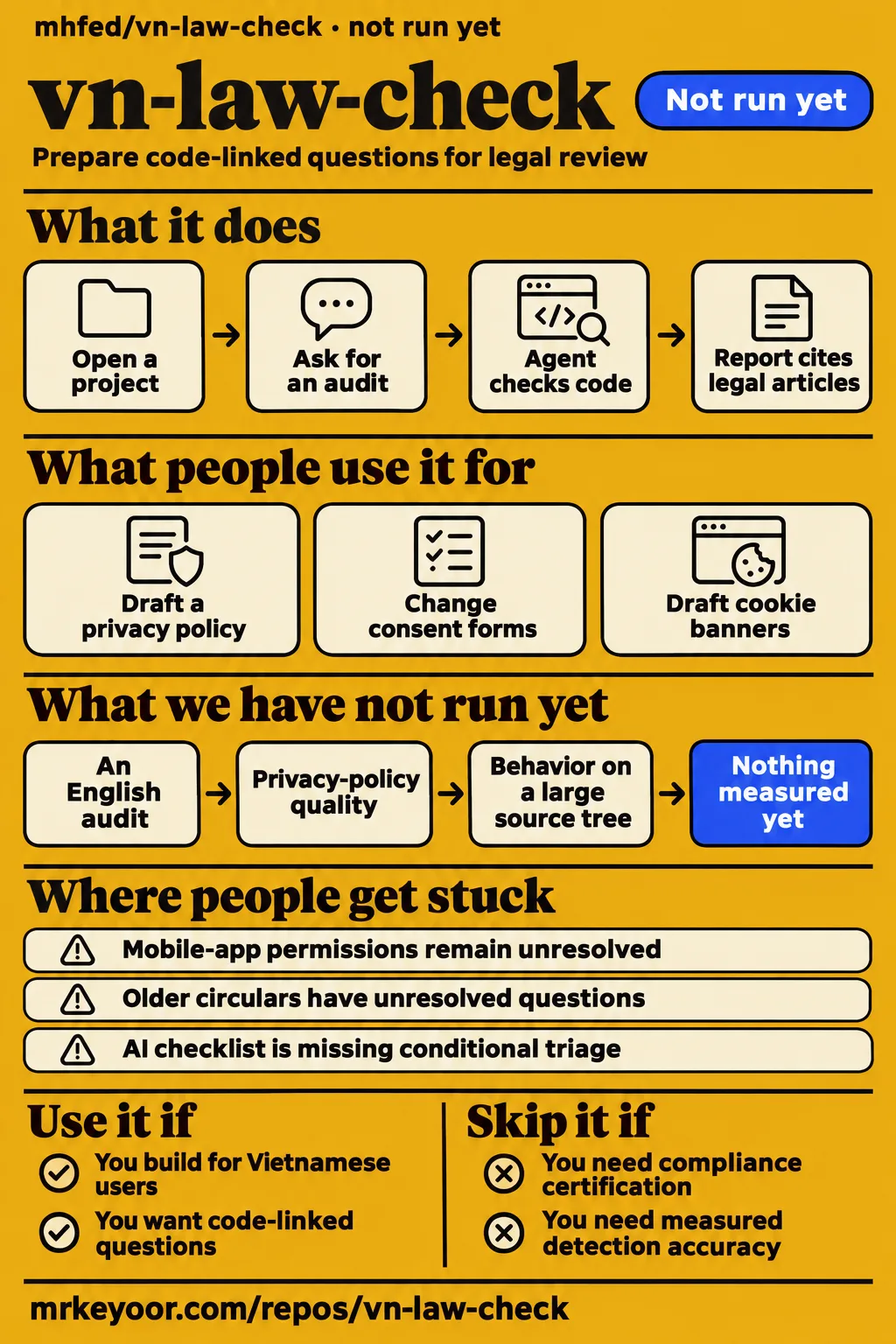
vn-law-check supplies Vietnamese-law checklists and scanner scripts for developers using AI coding agents. Choose it to prepare code-linked questions and proposed changes for legal review. Skip it if your deliverable is compliance certification. The English README describes a first-pass review tool, with findings tied to files, lines and legal articles. Our November 19 attempt at commit 964f519 stopped before an agent audit began; the useful evidence here is the documented workflow, the recorded failure and the maintainer's correction history.
What you can do with vn-law-check
The English README lists checks for consent, privacy policies, tracking, e-commerce, AI chatbots and mobile apps. vn-law-check gives a coding agent instructions and reference material for those checks. You open a project or give the agent a website URL, then ask for an audit against Vietnamese law. The documented report identifies the relevant code and cites the law and article behind each finding, so a developer can connect a recommendation to an implementation.
The README assigns four finding categories: fix now, should improve, OK and not applicable. It also describes different report lengths: a static site without forms or tracking gets a one-line verdict, while a shop with login, tracking or an AI chatbot gets a longer report. That triage is the useful organizing idea. A report should explain which feature triggered a check, rather than make every project work through the same undifferentiated list.
Privacy-policy drafting is another documented task. The agent uses the project's data collection and external services to draft policy text, consent forms and cookie banners. That connects a policy paragraph to something a developer can locate in code. A practical handoff includes the relevant file, the proposed wording and the business's answers about what it collects, why it collects it and which services receive it.
What people use vn-law-check for
The README demonstrates a fictional coffee-shop audit that recommends explicit consent where data is collected. Its sample report points to chinh-sach-bao-mat.html:12, quotes wording that treats continued use as agreement and cites Article 9(4)(d) of Law 91/2025. The proposed change is to remove that wording and request consent at collection. The example shows the shape of a finding: a file location, the disputed behavior, a legal reference and a proposed edit.
The same README documents prompts for drafting a privacy policy and changing consent forms. It also links ready-made Vietnamese prompts for tools such as Lovable, Bolt, v0 and Cursor. Those prompts cover an analytics banner, an unticked consent box with a Supabase consent log, a privacy-policy page and an account-deletion button. These are documented tasks a developer can request, rather than additional accounts of completed customer audits.
The fictional shop is useful because its finding is inspectable. A reviewer can read the original sentence, find the place where data is collected and compare the proposed change with the implementation. For a real project, that structure gives the developer and legal reviewer a shared artifact. The report's color alone conveys less than the file location and the explanation attached to it.
What happened when we ran it
Our November 19, 2026 run at commit 964f519 stopped before execution: the harness reported no supported ecosystem for the Shell checkout and no Dockerfile. The sandbox measurement recorded 3 CPUs and 8 GB RAM, with no image specified. These describe the configured environment. The recorded outcome is NOT RUN, rather than a failed product test or an audit report with findings to assess.
The hands-on safety step failed because the runner required a Compose file. Its exact error was unsafe repo: none of compose.yaml, compose.yml, docker-compose.yaml, docker-compose.yml exists (rule: a compose file is required). Here, unsafe repo is the runner's label for that rule failure. The error names the missing deployment files; it contains no scanner result or legal finding.
| Question | Answer | Verdict | Why |
|---|---|---|---|
| Did the build/test sandbox execute vn-law-check? | NOT RUN: no supported ecosystem for the Shell checkout; no Dockerfile | Blocked | The harness stopped before installation, build or tests |
| Did the hands-on safety step pass? | FAILED: none of the four accepted Compose filenames existed | Blocked | The runner required a Compose file before proceeding |
| Did cleanup complete? | Teardown returned ok | Cleanup completed | The teardown record reports its own outcome |
The hands-on run entry describes a Docker Compose deployment with every port bound to 127.0.0.1, while the safety-step record reports the missing-Compose rejection. The step record is the concrete execution outcome used here. The teardown entry says teardown: ok. Loading the checklists into a supported coding agent is the installation route described by the README; the lab attempted a container-oriented route.
Where people get stuck: corrected references and open questions
The maintainer reports legal-reference corrections through PR #19, while issues #6 and #12 ask unresolved questions about e-commerce circulars and mobile apps. The distinction is topic-specific: a correction to a penalty table answers that table's problem. It does not answer a separate question about a subscription renewal or the continuing validity of another instrument. The following map keeps the maintainer's reported repairs beside the questions that prompted them.
| Topic | What the issue says | Recorded resolution and practical consequence |
|---|---|---|
| Data-subject rights, #1 | Penalties needed clause-specific checking | mhfed reports replacing unchecked entries with clause-specific tables in PR #19 |
| Children's data, #3 | A broad range grouped different offenses together | mhfed reports separating penalty ranges by conduct in PR #19 |
| Breach notification, staffing and transfers, #2 | References required checks against the original gazette | mhfed reports a merged correction through PR #19 |
| E-commerce references, #5 | Four questions concerned repeal, certification, logos and platform obligations | mhfed reports resolving all four questions in PR #19 |
| Older e-commerce circulars, #6 | The issue asks whether two circulars still apply after the parent decree expired | The recorded thread is open with 0 comments |
| Mobile-app rules, #12 | The issue asks about location data, individual permissions and subscription renewal | The recorded thread is open with 0 comments |
In issue #1, mhfed describes replacing unchecked entries with clause-specific tables. In issue #3, mhfed describes separating penalty ranges by conduct. Both replies identify PR #19 and commit 98ff2c3. These are maintainer reports about reference repairs. Their practical value is that a reader can trace a changed checklist entry to the public discussion that explains the change.
Issue #2's response says the notification penalty does not apply to every incident. That condition belongs with the reference when a finding becomes a development ticket. Issue #5 reports all four e-commerce questions resolved through PR #19. The remaining questions have their own threads: issue #6 asks about the continuing validity of older circulars, and issue #12 asks about mobile location data, permissions and automatic renewal.
High-risk AI needs a conditional checklist
Issue #15 proposes a conditional high-risk AI checklist, and the maintainer invites a PR. The maintainer's reply explicitly supports avoiding a blanket high-risk label for education, health and fintech chatbots. The proposal asks about the system's purpose, decision authority, human approval, affected people and deployment context. Those questions distinguish the work an AI system performs from the mere presence of an AI API in a project.
Other legal-reference questions are recorded separately. Issue #8 asks which provision permits cancellation of a remote contract. Issue #9 asks about advertising rules for financial services, investment and cryptocurrency. Issue #10 reports conflicting numbering for the final clauses of Article 11. A useful audit ticket names the applicable activity and disputed provision, so its owner can follow the relevant question rather than infer an answer from another checklist's repair.
Scanner access and agent access are different
The repository README says the scanner scripts read local files or download public content from the target site. It says they do not read environment variables or credentials, modify user files or send data elsewhere. The documented URL limits are 15 linked pages and 20 JavaScript files. These are scanner behavior and scope statements, separate from the service through which a coding agent processes the material.
GitHub.Locker states that the AI agent processes content under its own service terms. Its explanation separates agent processing from scanner access. For a private repository, the relevant decision includes which agent account receives the files and the organization's rules for that service. A local shell read and a hosted assistant interpreting the result are separate operations, even when they form one audit workflow.
The optional installer also changes project instructions. Plugsday describes copying checklists and appending pointers to agent instruction files. The README documents a download-and-run shell command, while the alternative Claude Code route uses plugin commands. Reviewing a chosen checkout before installation gives the team a concrete revision to associate with its later report and any changes to AGENTS.md or CLAUDE.md.
Vietnamese is the default report language
Reports are written in Vietnamese by default, and the English README says to ask for English when needed. The English usage instructions give both project and URL audit prompts. An English-speaking developer can start there, request an English report and retain the original provision alongside a translated explanation when preparing questions for someone who reads Vietnamese law.
The repository also invites contributions from people who do not write code. Its README asks contributors to identify a wrong article, expired instrument, disputed penalty or classification error and include a link to the original legal text. It reports a correction from Article 39 to Article 38 for a household-business exemption. That public correction history gives users of older checklists a specific reference to revisit.
vn-law-check vs manual review, a lawyer and general agent skills
vn-law-check supplies Vietnamese legal checklists; OpenCode supplies a coding agent, and Superpowers supplies a development methodology. Their own descriptions answer different purchasing and workflow questions. The comparison below separates those jobs so a developer can choose the missing part of a workflow. Selecting an agent, selecting reference material and obtaining legal judgment are three decisions even when one project needs all three.
| Option | Why choose it | How it relates to vn-law-check |
|---|---|---|
| vn-law-check with an agent | You want preliminary findings linked to code and legal references | Its documented automated workflow |
| Manual reading of references/ | You want a team checklist without an automated agent audit | The repository README permits reading the checklists directly |
| A Vietnamese lawyer | You need legal judgment about your business and the applicable provisions | The English README directs consequential legal matters beyond the first-pass tool |
| OpenCode | You need a general AI coding agent | Its README describes an agent, rather than this Vietnamese checklist collection |
| Superpowers | You need a development methodology for coding agents | Its README describes a methodology built on composable skills |
OpenCode describes itself as an open-source AI coding agent. The OpenCode README documents build and plan agents. Superpowers describes a software development methodology built on composable skills. The Superpowers README describes design, planning, implementation and review workflows. Choose between those projects according to the agent or development process you need; use the Vietnamese references to frame the separate compliance questions.
What the other reviews get wrong
QAI records November 19, 2026 scanner changes, later than GitHub.Locker's November 13 last-push label. Its changelog names versioned JSON output, so the older directory date is a poor identifier for the scanner documentation discussed here. The lab checkout remains commit 964f519. A directory timestamp, a later README and the revision used by a runner should each retain their own identity.
Plugsday's secrets summary names OPENAI_API_KEY, but its detailed analysis says there is no credential access. That detailed statement agrees with the repository README's description of the scanner. QAI's missing-license finding concerns the skill metadata's license field; the English README states that code and structure use MIT. The narrower metadata finding and the repository's license statement can both be true.
HotRepo's statement that nothing is sent elsewhere needs the scanner-and-agent distinction described above. Its page describes manual checklist use and the agent requirement, while GitHub.Locker explicitly identifies the agent's separate service terms. Reading those descriptions together produces a more useful account of data handling than extending a scanner assurance to every service involved in an audit session.
FAQ
The English README documents installation in Claude Code and Cursor, URL-based audits, privacy-policy drafting and mobile-app checks. The questions below cover those entry points and the project's stated purpose. They distinguish what a new user can ask the agent to do from what the lab actually recorded. The installation commands are upstream examples, with their original repository name preserved.
Can vn-law-check replace a Vietnamese lawyer?
No. The English README calls vn-law-check a first-pass review tool rather than legal advice. Its useful role is to collect potential problems, point to implementation details and organize questions. For a developer, that means carrying a file location, the agent's explanation and the cited provision into legal review, rather than treating a red or green report label as a final legal decision.
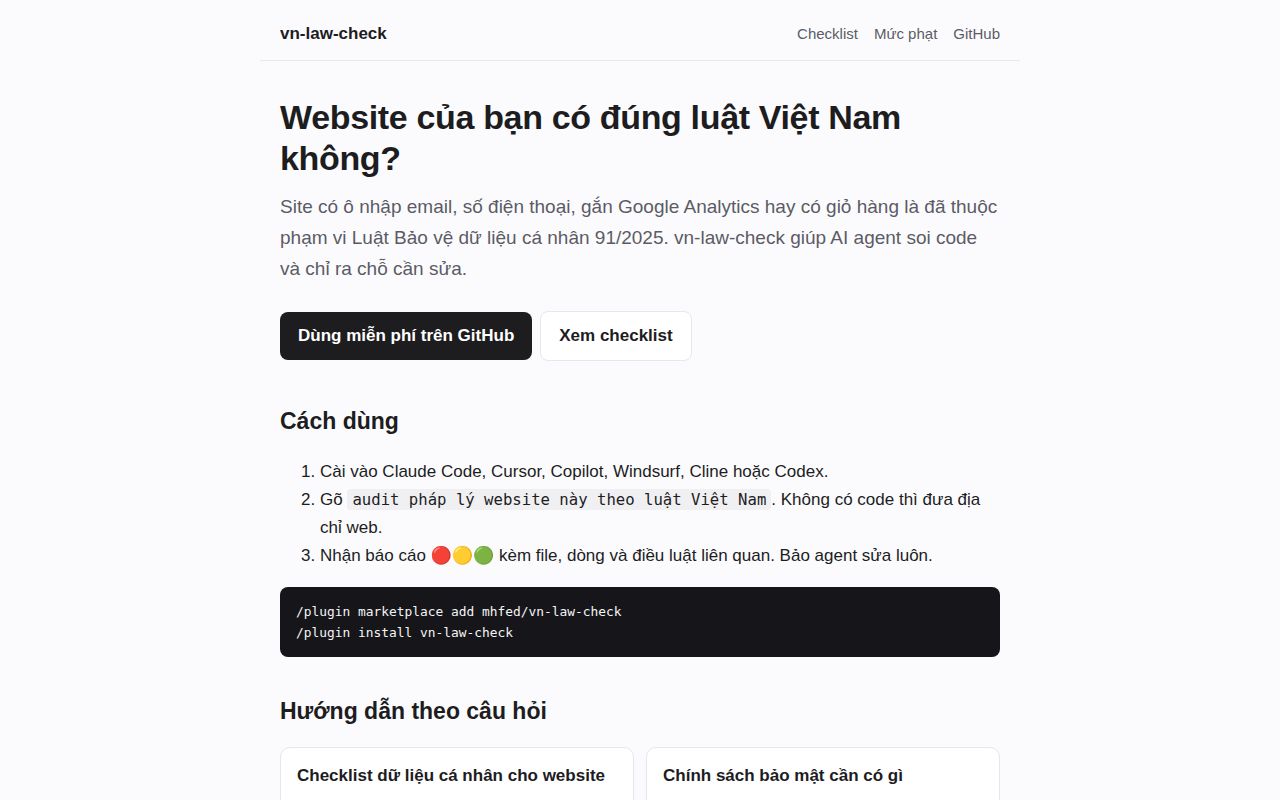
How do I install and run vn-law-check with Claude Code or Cursor?
Claude Code's documented installation uses two plugin commands, entered inside Claude Code. The English README's installation section also documents running install.sh from the project folder for Cursor and several other agents. After installation, its example prompt asks for an audit against Vietnamese law. These commands reproduce the documented Claude Code sequence, rather than a session performed for this review.
/plugin marketplace add mhfed/vn-law-check
/plugin install vn-law-check
Can I audit a website using only its URL, without source code?
Yes. The English README explicitly documents giving the agent a URL instead of source code. Its example is audit https://your-site.vn against Vietnamese law. That is an entry point for reviewing a public website. A project-directory audit gives the agent source files instead, so the choice depends on whether you own the implementation or are starting from the public-facing site.
Can vn-law-check draft a privacy policy from my project?
Yes. The English README says it can draft a privacy policy, consent form and cookie banner from what the code collects. The Vietnamese README explains that the draft follows the project's data and external services. A useful review of that draft compares each named collection purpose and recipient with the corresponding form, integration or account feature, then fills in the business-specific information that belongs in the policy.
What we have not tested yet
Commit 964f519 produced no completed installation, build, test or agent audit in our run. The Compose deployment wording in the run entry conflicts with the safety-step rejection, so it cannot support a claim of successful deployment. The 3 CPUs and 8 GB RAM are configuration values, not resource-use measurements. There are no execution timings, passing-test counts, runtime-version logs or detection-accuracy measurements to report.
The current README and the maintainer's PR #19 replies describe material beyond the blocked checkout; this review does not assign those later changes to commit 964f519 or claim to have tested release v1.7.1. We have not installed the skill into Claude Code or Cursor, generated an English audit, assessed privacy-policy quality, tested native Windows or measured behavior on a large source tree. The scanner's documented URL limitations include no browser execution and no server-side inspection.
Legal accuracy, completed customer outcomes and prompt-injection resistance also remain outside this evaluation. The original gazettes were linked by the maintainer, rather than independently audited here. The issue extracts support reported corrections without exposing every resulting answer; issue #15 supports a proposal rather than a merged implementation. QAI explicitly describes static checks without executing the skill or following its external links. Use the correction map to prepare focused questions, and preserve the checklist revision with the report handed to counsel.