php-src is the interpreter, not a PHP application starter
PHP describes php-src as the source code for its general-purpose scripting language. The tree contains the interpreter, bundled extensions, build machinery, and the suite used to check language behavior. It is the right download when a change belongs inside PHP itself. Someone deploying WordPress or writing a Laravel service usually wants a distribution package, a Windows binary, or an official installation path instead. The repository README makes that distinction early, which prevents a common source-build detour.
Our checkout at commit a6b1a9e contained 27,570 files, about 1,408,833 lines of source, and occupied 143.2 MB before a successful build. Those figures explain why this feels different from pulling an application dependency. GitHub classifies the primary language as C, and the repository exposes 13 CI workflow files plus a tests directory. There is no Dockerfile at the root, so the source tree does not promise one container recipe for all supported configurations.
A minimal Git build needs 3 named generator tools
The README names autoconf, bison, and re2c as requirements for a minimal build from Git. A default configuration also needs libxml2 and libsqlite3. Ubuntu, Fedora, macOS with Homebrew or MacPorts, and Windows each receive a distinct path. That is useful documentation, but it also tells you what kind of project this is: native packages and platform details are part of the work before PHP compiles.
Development starts with ./buildconf, followed by ./configure --enable-debug and make. The README recommends matching make -j to the machine's core count. Production configuration drops the debug flag, and make install may require elevated permissions depending on the prefix. None of these steps needs a hosted credential. Optional extension choices can introduce more libraries, so the 3-tool minimum should not be mistaken for a complete package list for every intended PHP build.
What happened when we ran it
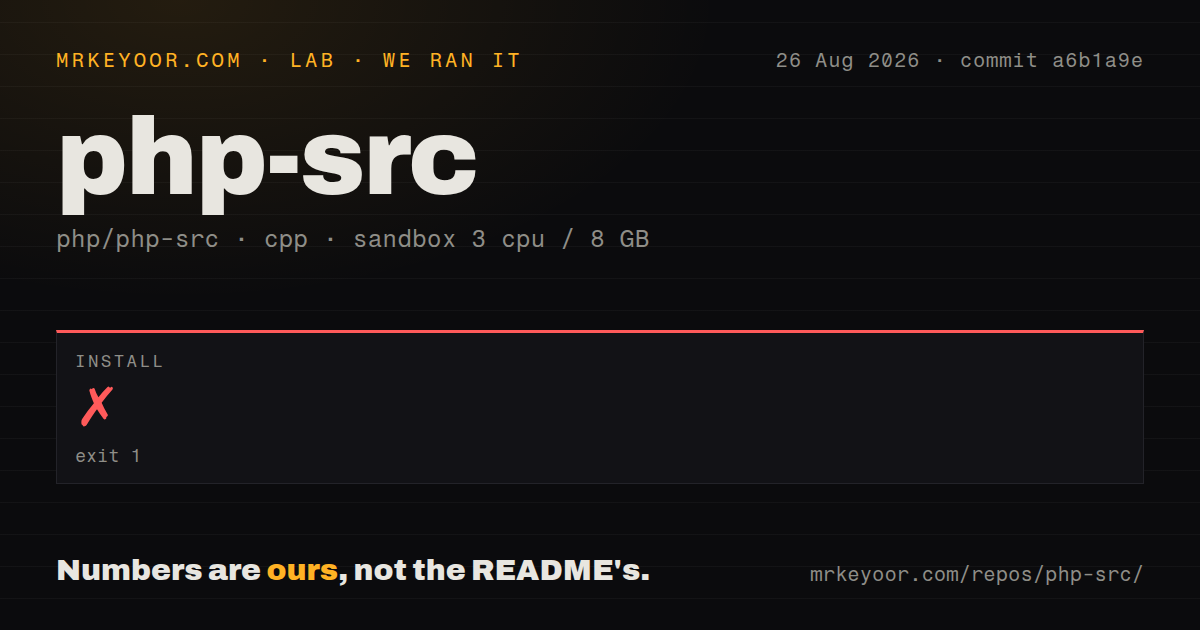
Our sandbox reached configure and failed after 16 seconds. The log found bison 3.8.2 and accepted that version, then reported that re2c was missing. Configure stated that re2c 1.0.3 or newer is required to generate the PHP lexers. This is a direct missing-tool result from commit a6b1a9e in an unprivileged Debian container with 3 CPUs and 8 GB of RAM.
Because configure stopped, we did not obtain a build result or a test result. It would be wrong to turn that absence into a compiler or test-suite judgment. The useful finding is narrower: a fresh lab-cpp:1 image did not include every generator php-src requires, even though it had a working compiler and bison. Installing the documented re2c requirement is the next setup step, after which the build has to be assessed on its own evidence.
The test runner can narrow work by directory
After compilation, PHP's documented check is make test. The runner uses as many as 10 detected logical processors by default, while TEST_PHP_ARGS=-j4 caps it at 4 jobs. Contributors can also set TESTS=tests/lang/ or another path to avoid running unrelated areas during a short edit cycle. This is practical for a source tree with 1.4 million measured lines, though a focused run does not replace the complete suite before a runtime change ships.
The contribution process is stricter for language design than for a routine bug fix. New features require an RFC, discussion, acceptance, and a developer vote. Bug fixes do not require an RFC, and the README explains how to reference current GitHub issues or old bugs.php.net tickets in commit messages. That split gives an experienced contributor a clear route, but it makes php-src a poor place for speculative syntax patches that have not passed the project's design process.
PHP 8.5.9 was a security release, and work continued in August
GitHub reported 40,314 stars and 2,014 combined open issues and pull requests when fetched on August 26, 2026. The latest activity list included same-day pull requests touching MySQL connections, tests, memory management, streams, and PostgreSQL behavior, plus an updated JIT crash issue. The repository's last push was also August 26. The combined open count is not a count of confirmed bugs, but the dated issue and pull request activity shows that the tree was being worked on.
The latest GitHub release was PHP 8.5.9, published July 30, 2026. Its release note calls it a security release and tells all PHP 8.5 users to upgrade. That matters for anyone considering a private source build: tracking the supported release line and security updates becomes your responsibility. A one-off successful compile is not a maintenance policy, especially when the runtime sits beneath public web applications.
Packagers should build it; application teams should install PHP
php-src earns high marks for documentation and maturity because the README separates binaries, source builds, tests, extensions, and contribution governance. Our 16-second failure still lowers setup ease for the exact environment tested. The missing re2c requirement was documented, so this was not a mysterious code failure. It was proof that a generic compiler container did not match the project's stated toolchain.
Choose php-src for interpreter development, distribution packaging, extension compatibility work, or a build that must be controlled at the source level. For ordinary deployment, the README's prebuilt route is the better engineering decision. It reduces local toolchain work and makes updates easier to consume. Teams that do build from source should pin the commit, record configure flags, install the named generators, run the relevant tests, and follow the security release stream.