This repository is for building Ruby, not installing an app dependency
ruby/ruby contains the CRuby interpreter and the language's core implementation. The README describes Ruby as an interpreted, object-oriented language with classes, mixins, singleton methods, closures, exceptions, garbage collection, native extension loading, and broad platform support. Those features explain the project. They do not explain why most Ruby application developers should clone its source.
The normal application path is a release package or version manager. The README sends users to the official downloads page and mentions third-party tools such as RVM. The Git tree is for people changing the runtime, testing a patch, producing platform packages, or inspecting the behavior behind a language feature. That distinction saves a lot of unnecessary compiler setup.
A Git build needs an existing Ruby and a C toolchain
The documented source build starts with more than Git. You need a C compiler, Autoconf 2.67 or later, Ruby 3.1 or later, and Git 2.32 or later. RubyGems support also needs OpenSSL or LibreSSL, libyaml 0.1.7 or later, and zlib. libffi and GMP are recommended for particular capabilities. Rust 1.58 or later is optional when building YJIT.
From a Git clone, autogen.sh generates the configure script. The guide then recommends a separate build directory, an explicit install prefix, configure, Make, tests, and make install. Miniruby is built first because the full interpreter depends on it during the build. This is a conventional runtime-toolchain process, but it is not the one-command experience of adding a gem to an application.
The install prefix matters. Building into a user-owned directory avoids replacing the system Ruby and lets several versions coexist. Extension libraries installed outside standard locations need configure flags. Windows has a separate build document, while Unix-like development can use the main guide. People debugging the VM get Make targets for GDB and LLDB, plus instructions for AddressSanitizer and an unoptimized debug configuration.
What happened when we ran it
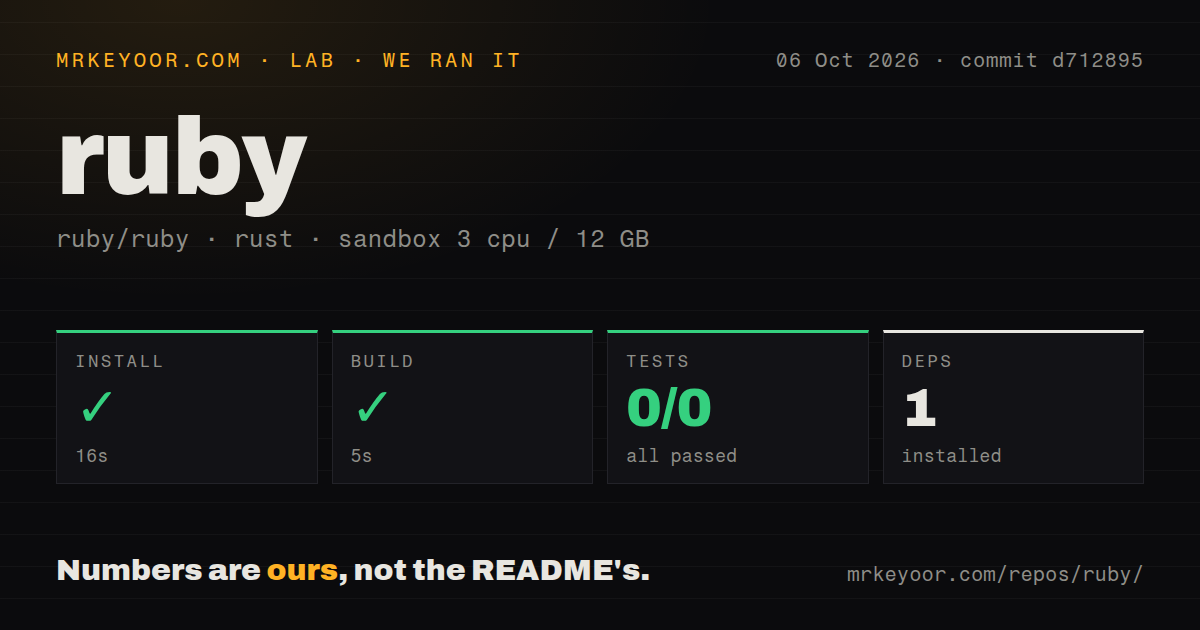
Our sandbox checked commit 078029f and detected a Rust ecosystem path. It installed 1 package in 14 seconds, then completed the measured build in 4 seconds. cargo test finished in 3 seconds and reported 0 passed, 0 failed, out of 0 discovered tests. The unprivileged container had 3 CPUs, 12 GB of RAM, and no secrets.
That result must stay in its lane. CRuby's documented build uses Autoconf, configure, and Make, and its documented test suite is reached through Make targets. Our Cargo-oriented run did not compile the complete interpreter or execute Ruby's main tests. A green command with 0 tests is only proof that the detected Rust target completed without test cases. It is not a quality score for a language runtime with 39 CI workflow files and a tests directory.
The checkout itself was substantial: 11,619 files, about 1,963,348 lines of source, and 74.1 MB. The small 1-package install reflects the Rust component our harness selected, not the dependency surface of every native extension or platform build. Anyone reproducing a Ruby patch should follow the project's build document and run the Make suites relevant to that change.
Ruby 4.0.6 is maintained through focused patch releases
The latest GitHub release was 4.0.6, published July 14, 2026. Its notes list fixes for crashes, memory-safety defects, Ractor behavior, floating-point operations, IO::Buffer state, regular expressions, signals, and parser or JIT cases. That mix is what a mature runtime patch release looks like: changes touch language semantics and low-level VM failure modes, so version pinning and upgrade tests matter even when the source stays compatible.
The repository was pushed on August 26, 2026. GitHub listed 676 open issues and pull requests, with recent work on 3.3 and 3.4 backports, ZJIT specialization, IO::Buffer, allocator interfaces, Ractors, memory reduction, and documentation. GitHub's count should not be called 676 bugs, and Ruby's own issue tracker remains the designated place for bug reports. The combined signals show daily maintenance across current and older branches.
The documentation assumes serious runtime work
The main README is short because it routes contributors to dedicated documents. The build guide explains prerequisites, out-of-tree builds, parallel Make jobs, Miniruby, debugger targets, sanitizer configurations, and platform-specific branches. Separate English and Japanese language documentation is linked, along with contributing and issue-reporting guides. That is good information architecture for a runtime, even if a newcomer must follow several pages.
Testing also has more shape than a single cargo test. The build guide links a dedicated test document and gives make test-all -j8 as one parallel example. A contributor changing the garbage collector, parser, JIT, or C API needs to find the appropriate suite and configuration rather than trusting a generic command. Our 3-second result is a warning about automated ecosystem detection, not a weakness in the documented process.
Choose CRuby source only when implementation control matters
Use this repository if a production failure requires a backport, a C extension needs validation against master, or you intend to contribute to Ruby itself. The source, specifications, core library, and build machinery are all in one place, and activity through August 26 shows that maintainers are still landing fixes.
For running an ordinary Rails app or script, clone avoidance is the sensible choice. Install Ruby 4.0.6 from an official channel, keep application dependencies in Bundler, and move to source only when a concrete interpreter problem demands it. JRuby is the better fit for JVM integration, TruffleRuby for GraalVM work, and Crystal when static compilation matters more than running Ruby code.