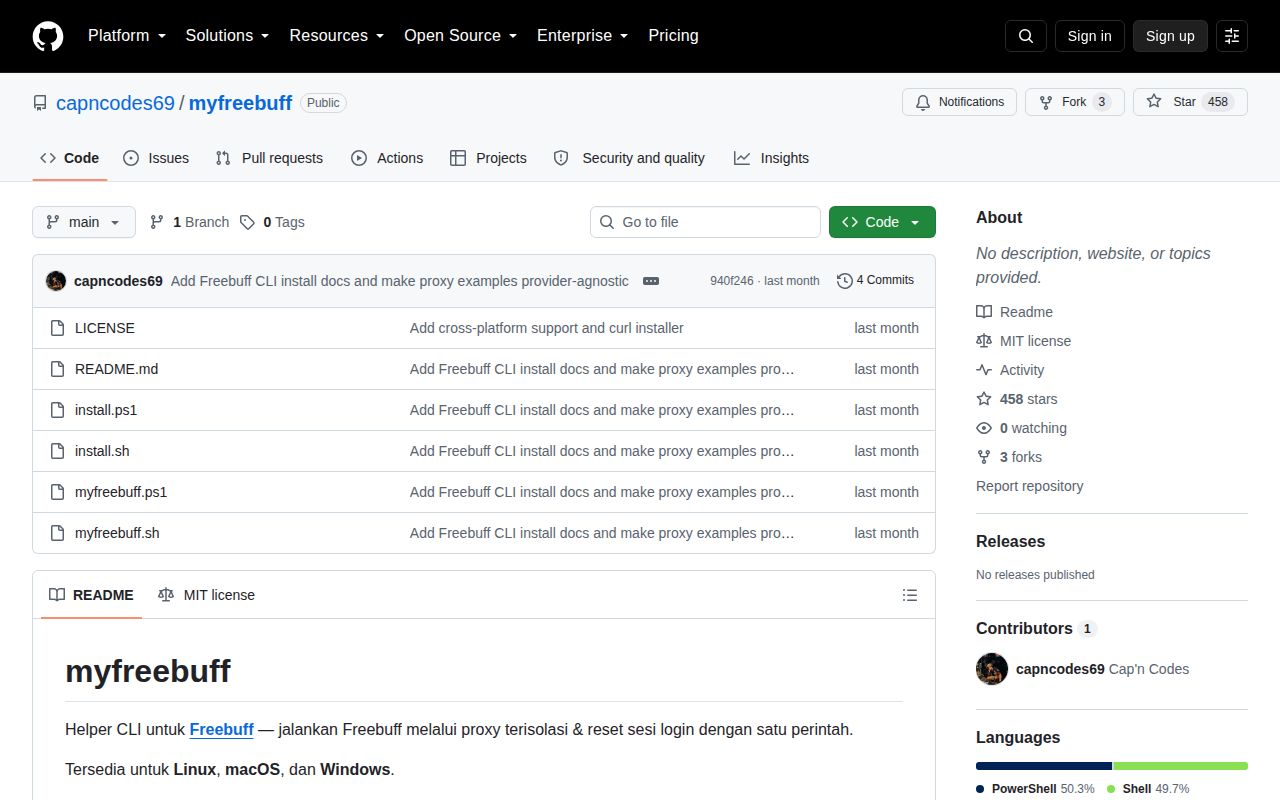
Version 1.1.0 exposes 2 commands: proxy and reset
The 6-file myfreebuff repository gives proxy and reset parallel Bash and PowerShell implementations plus 2 installers. proxy launches the Freebuff CLI with proxy environment variables, while reset terminates Freebuff and removes saved login state. It does not provide a coding agent of its own. Every useful action still depends on the separately installed Freebuff CLI and the service behind it.
myfreebuff 1.1.0 sets 6 uppercase and lowercase HTTP, HTTPS, and ALL proxy variables before starting Freebuff. It also excludes localhost through uppercase and lowercase NO_PROXY. That is a cleaner design than changing the operating system's global proxy. The values remain scoped to the wrapper and its child process, but the user still has to ensure that Freebuff permits the connection and that the proxy is authorized.
A 2-step suspension recovery is a reason to walk away
The README's 2-step post-suspension sequence deletes local session state, then tells the user to obtain a new sticky proxy IP and log in again. It says Freebuff binds a login to its IP and warns that a changing address can suspend the account. That goes beyond ordinary corporate routing. It offers a practical path around an enforcement outcome, so we would not recommend the tool for that use.
Freebuff's own page says the service has 2 access modes, full and limited, and that VPN use can affect which mode is available. A wrapper does not change those service rules. If Freebuff rejects a session or limits access, use its supported mode or contact its operator. Repeatedly changing identity, account state, or egress IP risks another suspension and may violate terms that this repository neither quotes nor analyzes.
What happened when we ran it
Our lab has 0 install, build, test, timing, dependency, or vulnerability results for commit 940f246. The supplied result says the PowerShell repository had no supported ecosystem in our sandbox and no Dockerfile. We therefore cannot confirm the Windows script, Bash script, installers, Freebuff launch, proxy behavior, IP lookup, or reset behavior from an independent run.
commit 940f246 contains 6 files, no tests directory, and no CI workflow. Small code can still remove the wrong state or expose a password. A useful test would need disposable Freebuff credentials, an authorized proxy, Linux, macOS, and Windows hosts, process inspection, a fake config tree, and confirmation that only the intended child inherits the proxy. We performed none of those checks.
Six proxy variables keep passwords outside the masking boundary
myfreebuff masks the proxy password only when it prints the URL. Internally, the full URL remains in 6 proxy environment variables inherited by Freebuff. The README also suggests placing MYFREEBUFF_PROXY in a shell profile, which stores the username and password as plain text. Shell history can retain a URL passed on the command line as well. Display masking does not protect either location.
The IP check has a 15-second timeout and sends the proxy request to ipinfo.io, then prints the returned IP, city, country, and network organization. That confirms an exit location, but the sticky warning is only a string heuristic based on words in the URL. The README admits this. Repeating an IP lookup shows short-term consistency; it does not prove how long a provider will hold the address.
Reset force-stops Freebuff and deletes 2 files
On Linux and macOS, reset looks under a manicode configuration directory, searches for credentials.json and freebuff-instance-owner.json, uses a process-name pattern to stop Freebuff, and deletes those 2 files. PowerShell follows the same file model and force-stops processes named freebuff. Those paths are implementation details of another product, not a public compatibility contract quoted from Freebuff documentation.
A FREEBUFF_CONFIG_DIR override can redirect deletion to a caller-supplied location. The scripts limit deletion to 2 fixed basenames, which is better than removing a directory, but there is no confirmation prompt or backup. An upstream filename or process-layout change could also turn reset into a partial cleanup. Do not keep this action in a team wrapper unless losing that session state is explicitly acceptable.
The 114-line Unix installer tracks mutable main
The 114-line Unix installer and 104-line PowerShell installer download platform scripts from GitHub's raw-content host. By default they follow main; the repository has no tags or releases to pin by name. Unix checks that the download looks like a Bash script, while PowerShell checks for a marker and parses syntax. Neither verifies a published hash or signature before installing.
GitHub showed 458 stars, no open issues or pull requests, and a last push on September 4, 2026. All 4 commits were made that day, and no public issue history shows how the wrapper behaves after Freebuff updates. If an authorized proxy wrapper is genuinely required, pin commit 940f246, review its 271-line Bash or 267-line PowerShell implementation, and install from the inspected file. Leave suspension recovery out of it.