Git makes Aider's edits inspectable and reversible
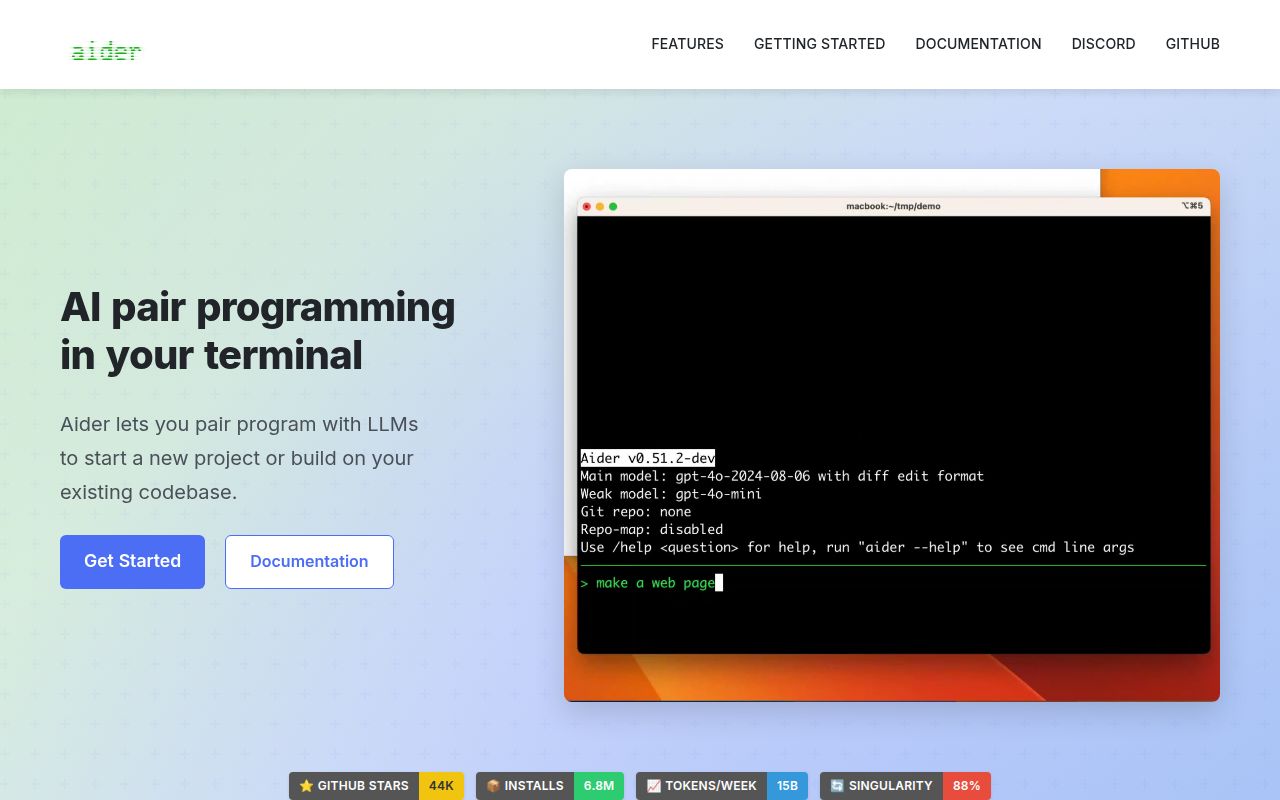
Aider runs inside a repository, chats about requested changes, edits files, and integrates with Git. Automatic commits give each accepted edit a boundary that familiar diff, log, revert, and branch tools can inspect. That suits developers who want an AI collaborator inside their existing shell rather than an editor replacement. It also makes accidental changes easier to isolate, provided the user reads the diff instead of treating a commit as approval.
The interface covers more than chat. Aider builds a map of the codebase, supports more than 100 programming languages according to its README, accepts images and web pages as context, watches editor comments, and can run linters or tests after edits. Model access is separate from the tool: users bring a provider key or configure a local model. That freedom is useful, but output quality, price, privacy, and rate limits follow the chosen model.
The 772 MB install is heavy for a terminal client
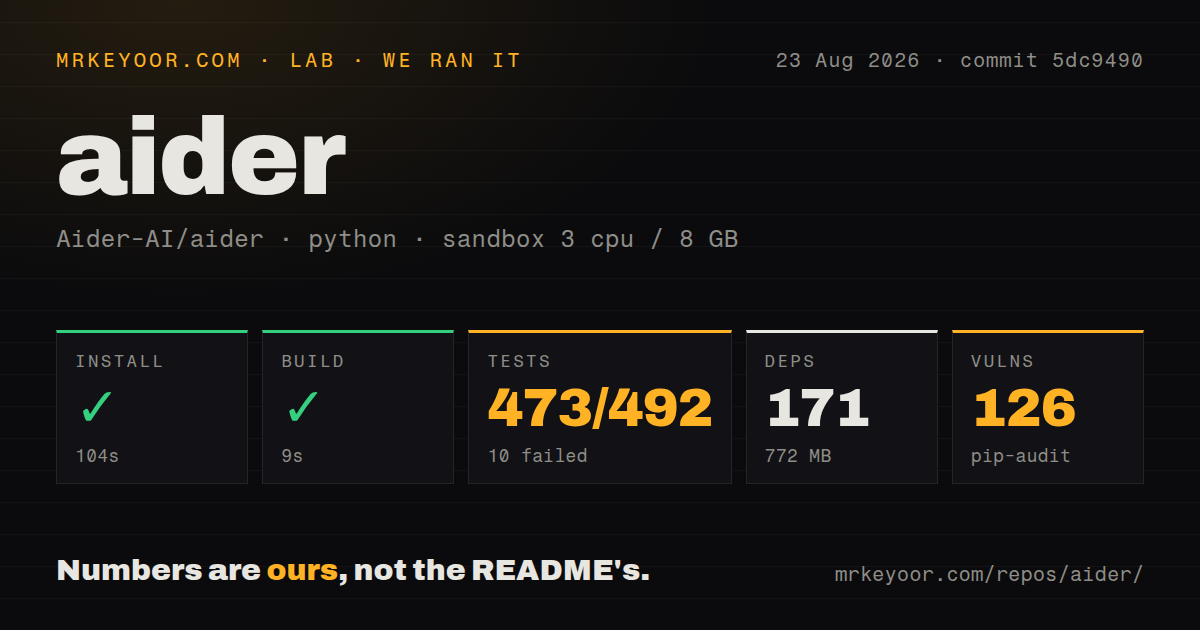
Our clean Debian container installed commit 5dc9490 in 104 seconds. The process added 171 Python packages and occupied 772 MB on disk. The checkout itself contained 685 files, roughly 42,721 lines of source, and 77.7 MB. Aider is still simple to invoke, but its dependency footprint looks more like a full Python application than a small command-line utility.
The documented setup uses aider-install, then starts Aider inside a project with a model name and API key. The README gives examples for DeepSeek, Anthropic, and OpenAI, while separate documentation covers many other hosted and local models. Teams should standardize model names, environment-variable ownership, spending limits, and which repository files may enter prompts before they make it a daily tool.
What happened when we ran it
Our run built successfully in 9 seconds after the 104-second install. Tests then ran for 658 seconds and exited with code 1. Pytest reported 473 passed, 10 failed, 1 skipped, 9 collection or setup errors, and 67 passing subtests. That is substantial successful coverage, but it is not a passing suite.
The log identifies several environment-specific failures without proving one shared cause. Playwright could not find its Chromium headless executable. A web test failed to retrieve content from self-signed.badssl.com. Four repository sanity tests raised getpwuid(): uid not found: 1000, and five help tests exceeded their 120-second timeout. These findings show what the checked-out commit expected from a fresh container; they do not tell us which failures reproduce on a normal developer account.
Pip-audit reported 126 known vulnerabilities in the installed packages. That count is the largest adoption concern in our run, even though it does not say that Aider itself is directly exploitable. Owners need the advisory list, affected versions, reachable code paths, and available upgrades before accepting the environment. The repository had 10 CI workflow files, no Dockerfile, and a tests directory.
Project .env files can change which provider receives code
Open issue 5622 reports that Aider loads dotenv files with override enabled, allowing a repository's .env values to replace provider keys, proxy settings, and API base URLs already exported in the shell. The report points to commit 5dc9490 and the load_dotenv call in aider/main.py. If confirmed in your setup, entering a clone and starting Aider could send code to a different compatible endpoint than the operator intended.
Until that behavior changes or is disproved, inspect .env, .aider.conf.yml, and repository instructions before launch. Print the effective provider and base URL through a safe configuration check that does not reveal secrets. Security teams should also review open issue 5621, which reports raw provider exception text entering opted-in PostHog telemetry. The report notes that some exception URLs may carry keys or internal hostnames; this is an open report, not our sandbox measurement.
Exit code 0 is unsafe evidence for unattended runs
Aider can take a message non-interactively, which makes it tempting to place in scripts. Open issue 5552 documents a malformed API endpoint, exhausted retries, a printed connection failure, and process exit code 0. A scheduler that equates zero with completed work may record that run as successful even though no useful model response arrived. The issue remained active in August 2026.
Automation should therefore check the expected diff, test result, output marker, or artifact instead of trusting the process status alone. It should also bound retries and cost, isolate credentials, and refuse unrelated file changes. Those controls are useful for any coding model, but the reported zero exit code makes them directly relevant here. Aider's strongest workflow remains interactive pair programming with a human watching the session and Git state.
Active issues outpace the latest release tag
GitHub showed 48,521 stars, 1,825 combined issues and pull requests, and a last push on May 22, 2026. New issue reports and discussion were active in August 2026, so the community has not gone quiet. The combined count is not a defect total, though it does signal a large support and contribution queue around a widely used tool.
The latest GitHub release was v0.86.0 from August 9, 2025. Its notes added model support, adjusted undo output, fixed settings replacement, and updated LiteLLM. A stale release tag alone does not prove abandonment, especially with later pushes and fresh issue activity. It does mean teams should decide whether to pin the release or a later commit, then reproduce our 10 failures and triage all 126 audit findings on that exact choice.
Aider earns a controlled trial because the terminal and Git workflow is practical, the documentation is deep, and most of our tests passed. The 772 MB environment, audit result, and current automation reports keep it out of the install-and-forget category. Start in a disposable branch, restrict credentials, review every diff, and make the repository's own tests the acceptance gate.