A visual flow can become an application endpoint
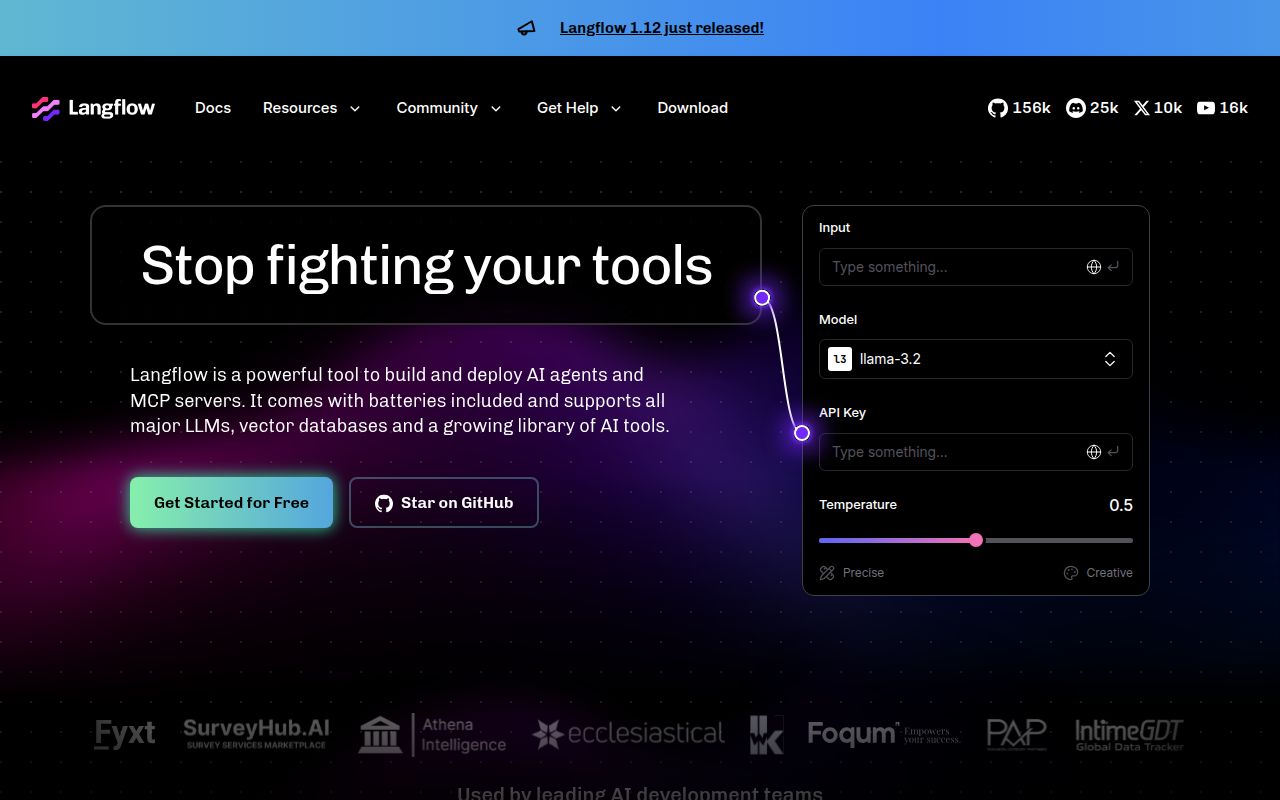
Langflow's Simple Agent template connects an agent to chat input and output, with Calculator and URL tools attached. You can inspect its steps in the playground, then call the same flow through an HTTP endpoint. That handoff is the reason to consider it: a diagram your team can discuss becomes something your application can use. The official quickstart shows both the canvas and the request, including a Langflow API key.
Python customization gives the canvas an escape route when a supplied component falls short. The README also describes JSON export and tracing integrations with LangSmith and LangFuse. Those are useful options for a developer willing to own the resulting code. Expect a substantial project behind the editor: the measured checkout contained 10,392 files, roughly 1,266,657 source lines, and occupied 222.2 MB. Choosing Langflow means adopting its runtime as well as its authoring interface.
What happened when we ran it
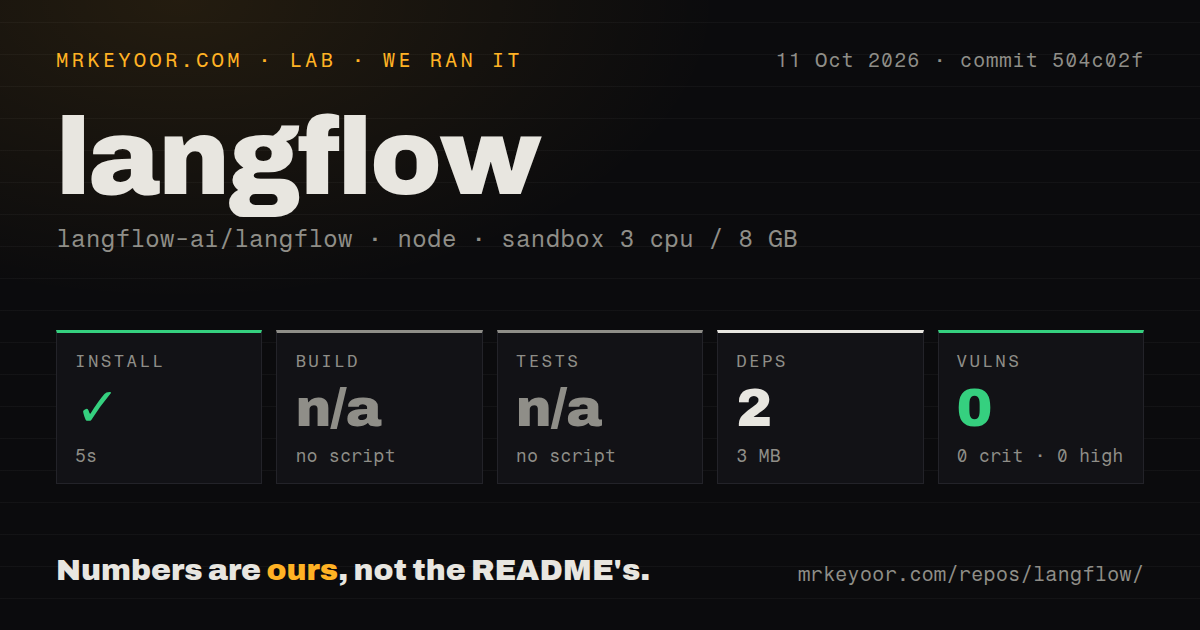
Our run installed 2 npm packages in 5 seconds and recorded 3 MB on disk after installation. We cloned commit 504c02f on October 11, 2026, into a fresh, unprivileged Debian sandbox using the lab-node:22 image, with 3 CPUs and 8 GB of RAM. The container had no secrets. Installation succeeded, but those results describe the detected npm route and do not establish that the application could serve a flow.
Build and tests were skipped because the detected route had no build or test script or target. Our harness found 50 CI workflow files, no Dockerfile, and no tests directory. Treat those as scan results with limited scope. They don't establish that the whole repository lacks container support or upstream checks, and skipped steps provide no passing build or test evidence. There was no failed command in the supplied measurements to diagnose.
The npm audit reported 0 known vulnerabilities, including 0 critical, high, moderate, or low findings. Its coverage belongs to the npm environment that installed 2 packages. The supplied run contains no Python dependency audit, model-quality evaluation, or request-latency measurement. A clean result from this route cannot settle whether the application environment is safe or whether a particular agent answers correctly. The useful finding is the boundary of the measurement.
The documented runtime is Python, with separate model credentials
Langflow's README requires Python 3.10 through 3.14 and recommends uv for the local package route. It starts the server with uv run langflow run; contributors use make run_cli from the checkout. That explains why the 3 MB npm result is a poor guide to deployment size. Follow the Python and Docker instructions for an application trial, then check your actual environment before allocating production resources.
The quickstart asks for an OpenAI key with permission and credit to call the selected model, plus a Langflow API key for external requests. It also documents connecting to a local or remote Ollama instance. Your chosen retrieval flow can bring another service and its credentials. Desktop covers Windows and macOS; Linux users need the Python or container path. Keeping Langflow on your server still leaves you responsible for where each component sends data.
MCP exposes flows as tools and adds an access boundary
Langflow's MCP server guide requires a Chat Output component before a flow can become a tool. Projects automatically enter the MCP configuration unless you disable that behavior, and you can select which flows are exposed. This is convenient when an assistant needs a repeatable document or retrieval task. Our 3-CPU, 8 GB sandbox result offers no evidence about concurrent tool execution, so size that service around the workload you actually intend to expose.
Authentication can use API keys or OAuth. Tool names and descriptions also need care because clients use them to choose actions. Release v1.12.5, published October 6, includes credential redaction, authenticated execution policy, and restrictions on built-in code execution to administrators. Those fixes show why sharing the editor and publishing a tool require deliberate permissions. Give callers access to the specific flow they need, and review Python components before running them with service credentials.
Legacy file ingestion needs a content check
Open issue 15702 reports that Read File turns Windows-1252 smart quotes and euro signs into invisible control characters without an error in v1.12.5. It concerns the current file-reading component, and PR 15714 proposes a correction. The report remains separate from our lab findings. Even with 50 CI workflow files detected, our skipped test step provides no evidence about this behavior. For document retrieval, compare extracted text with the input before trusting generated answers.
October activity supports a trial, with version discipline
The repository's last push was October 13, 2026. GitHub listed 155,563 stars and 1,151 open issues and PRs, while recent activity included file-decoding work and documentation changes. Together with the October 6 patch release, those dates show active maintenance. The combined queue is not a count of confirmed bugs, and popularity doesn't verify your flow. Pin a release and keep representative input documents when reviewing an upgrade.
The 5-second npm install leaves the adoption decision to an application trial. Choose Flowise if your team prefers a JavaScript or TypeScript visual builder, Dify for an application workspace with document pipelines, or LangGraph when workflow control belongs in code. I'd try Langflow when colleagues need to inspect and change the same flow. Before putting that flow behind an API, make it handle a real document correctly and check exactly who can invoke it.