One chat prompt becomes a queued group of video clips
Infinite Livestream connects 2 distinct programs. The streaming-client/ watches Twitch or YouTube for !prompt messages, checks a prompt, expands it into a scene group, and sends the group to fast-h3/. The model builds clips with video and audio, then a pacer feeds frames to ffmpeg for RTMP output. Idle prompts keep the queue occupied when viewers are quiet. This is a working broadcast design, not a single text-to-video command with a loop around it.
The separation is useful. FastH3 exposes a generation queue and a playout queue, while the client decides what should play next. A viewer request can become 1 scene or as many as 6 short clips under the default configuration. Metadata carries the requester and scene position through the queue, allowing the overlay and scheduler to identify a clip without maintaining a separate join table. Queue order, filler eviction, and playback remain client decisions.
Four B200 GPUs put this outside hobby hardware
The nested model README names 4 NVIDIA B200 GPUs as its tested default, CUDA 13, and a weight bundle of roughly 148 GB. The top-level project table describes the deployed model side on 8 B200s. Either description places the generator in rented-cluster or lab territory. The streaming client can run on an ordinary machine with ffmpeg, but it still needs a reachable model service doing the expensive work.
Clip shape is narrow by design. FastH3 produces 768p output with synchronized audio, accepts 4 documented aspect ratios, and generates independent clips rather than a continuing shot. The longest documented clip is 14.375 seconds. Subjects, framing, and voices can shift at the next cut even when prompts repeat. A preset can restate the desired style in every scene; it cannot give the checkpoint memory that the model does not have.
What happened when we ran it
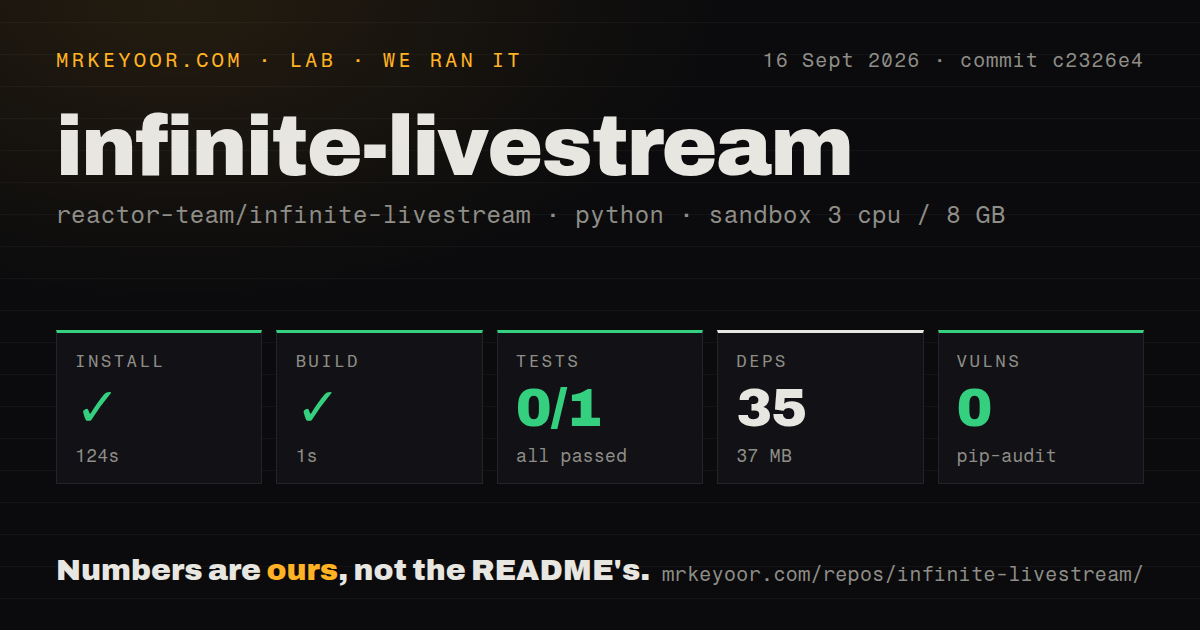
Our sandbox targeted the fast-h3/ project at commit c2326e4. Installation succeeded in 124 seconds with 35 packages and 37 MB on disk, and the build completed in 1 second. The repository checkout had 48 files, about 7,354 lines of source, and a size of 0.4 MB. Those modest source numbers describe the wrapper and contract, not the separately downloaded model weights.
Pytest stopped after 2 seconds while collecting tests/test_fasth3.py. It reported 0 passed, 0 failed, and 1 collection or setup error because the test module imported NumPy and the environment did not have numpy. The log does not show a failed assertion or a model error, since no test reached execution. It shows that the measured install did not provide everything the checked-in structural test needed.
Our pip audit found 0 known vulnerabilities in the installed set. The scan found a tests directory, no Dockerfile, and 0 CI workflow files. That combination does not make the code unsafe or untested. It means the repository does not show an automated GitHub workflow or a container recipe that reproduces its stated checks, and our fresh Python 3.12 environment did not complete them.
Prompt moderation does not inspect the generated frames
The client checks raw viewer text with the OpenAI moderations API before sending it to the scene-expansion model. If that request errors, the client rejects the prompt. Operators can disable moderation with a setting, and the program warns at startup. The upsampler itself can use any OpenAI-compatible endpoint, but the moderation endpoint may need separate credentials because many inference gateways do not expose that API.
The documented policy stops at the source prompt. Open issue 2 proposes a second gate that would inspect generated frames and fall back to approved filler when a clip cannot be certified. That proposal is evidence that output rating is not part of the current broadcast path. A public channel whose rules depend on what viewers actually see needs a review stage before playout, or a human who can cut the feed.
RTMP continuity has been considered, model continuity has not
The Python client keeps a 24 fps video cadence and 48 kHz audio cadence even when model output arrives in clip-shaped bursts. It restarts ffmpeg after an encoder failure and keeps the sink alive across Reactor reconnects. Twitch chat can be read anonymously, while YouTube chat needs a video ID and Data API key. An RTMP stream key is still required for the chosen broadcast destination.
A new Reactor session does not recover model-side queues from the old one. The client keeps chat prompts that have not yet been submitted, but clips already queued and unplayed disappear with the old session. The project documents that tradeoff instead of hiding it. For a never-ending channel, an operator still needs alerting, restart policy, budget controls, and a decision about what viewers see during a model outage.
A September 2 push is recent, but there is no release line
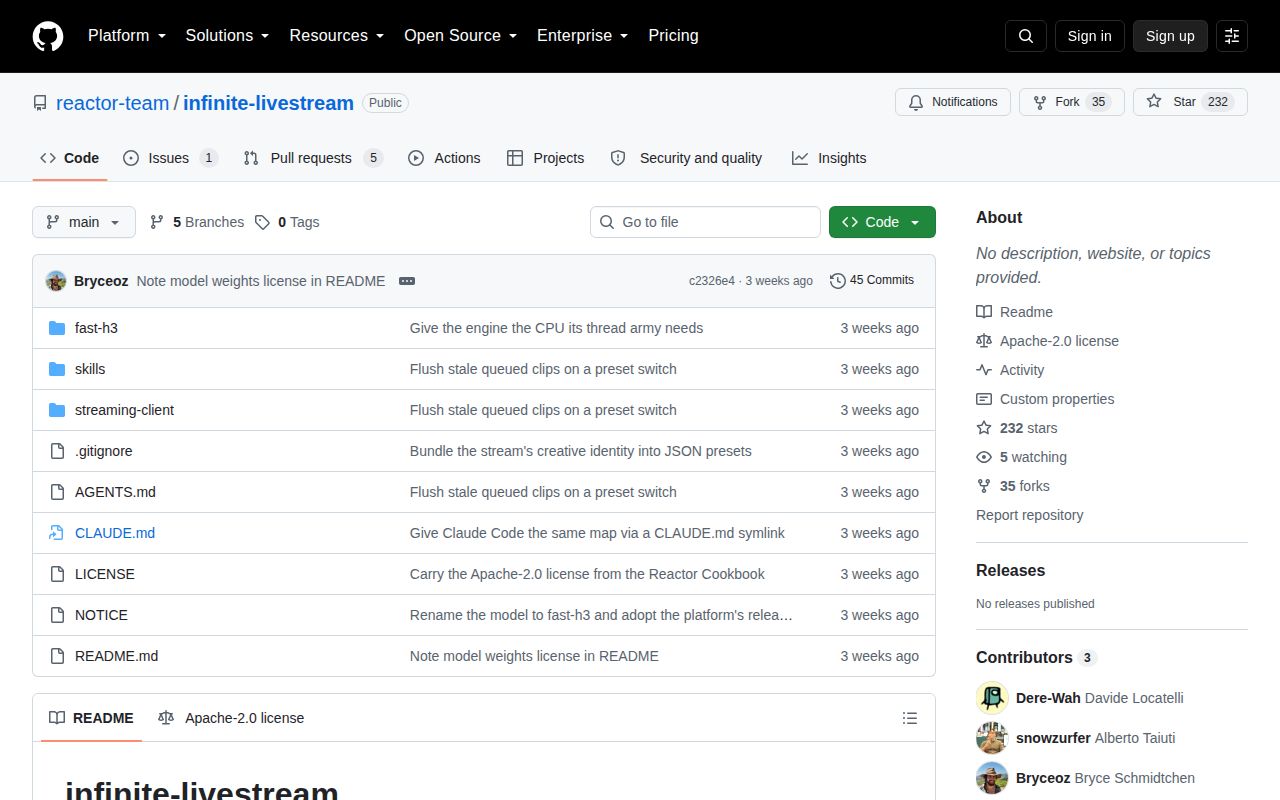
The repository was created on August 30, 2026, and GitHub recorded its last push on September 2. It had 232 stars and 6 open issues and pull requests when fetched, with 1 visible open issue after pull requests were excluded. GitHub returned no latest release. Those dates describe a very young project with early attention, not an abandoned one or a versioned platform.
Infinite Livestream is valuable as an architecture to study because its queue, filler, overlay, and RTMP pieces address real live-broadcast failure modes. Our 1-second build is encouraging, while the collection error keeps the measured checkout from earning a clean test result. The deciding cost is the model side: once 4 B200 GPUs and a 148 GB weight set are acceptable, the remaining Python client is the easy part.