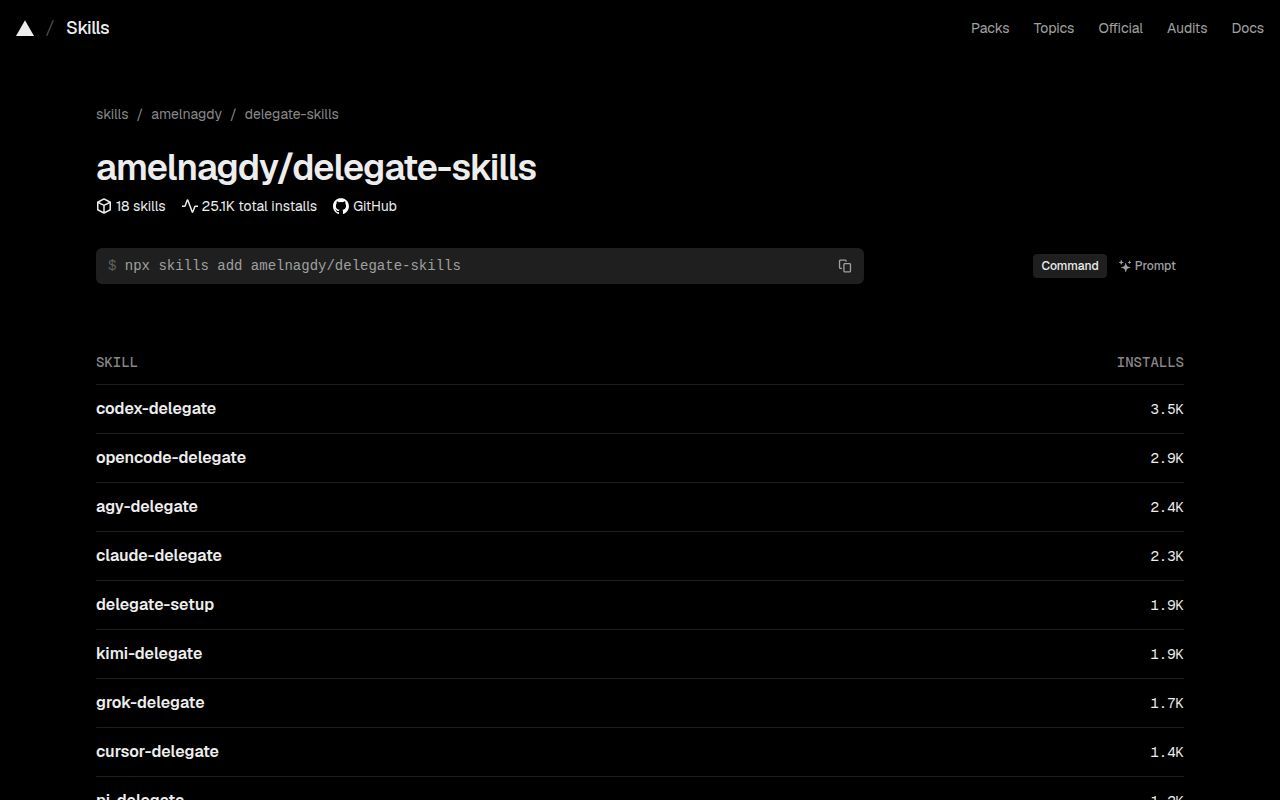
Seventeen relays put different coding CLIs behind one result shape
delegate-skills packages 17 implementer relays plus a setup skill. The list spans Codex, Claude Code, Cursor, Aider, OpenCode, Copilot, Warp, and Cline. Each relay accepts a self-contained brief, launches the CLI, and writes a delegate-relay.result.v1 report with status, exit information, touched files, the agent's final message, and a session identifier where available. The orchestrator reviews the diff and runs the project's checks before committing.
Fleet configuration adds named lanes such as feature, tests, or UI. A lane binds one category of work to an implementer and optional settings such as model or effort. Project fleet files require explicit approval and are tied to their approved content, so edited or cloned settings fail closed until approved again. Direct dispatch remains available for one-off tasks. The routing is useful, though it does not make 17 permission systems behave alike.
The relay standardizes reports, not security boundaries
The README's permission table is the page to read before installation. Codex can use a workspace-write sandbox, Claude Code exposes an explicit tool surface, and several CLIs offer plan-style read-only modes. Kimi and Warp have no relay-enforced read-only path. Pi has full local tools, while Grok's read-only option is described as best effort. For those tools, the relay can flag Git-visible changes after exit, but the flag is evidence for review rather than containment.
Git status has limits regardless of which of the 17 relays runs. The touched-file list cannot reveal ignored files, edits later reverted by the implementer, or writes outside the repository. Some CLIs accept full-access or permission-bypass flags, and the docs label those choices. A worktree isolates branch state, while an OS sandbox or container is still needed when a process must be unable to touch anything beyond a target directory.
What happened when we ran it
We did not execute commit b19180c. The lab classified the repository as JavaScript, an ecosystem that this harness run did not support, and found no Dockerfile fallback. There is no measured install time, build result, test count, dependency count, disk footprint, or vulnerability audit for this page. The repository documents its own relay verification, but we cannot present those maintainer results as ours.
Our lab container would have provided 3 CPUs and 8 GB of RAM without secrets, but no supported execution route was available. We did not substitute an ad hoc command because that would make this review incomparable with the stated harness. The README records live and contract tests for individual relays, including exact CLI versions and operating systems. Those results were not reproduced on our box.
Node 18 is the easy requirement; provider setup is the real work
The shared base requires Node 18 or newer, Git, shell access, and an orchestrating agent that can read files. Installation goes through the Skills CLI and can add the package, delegate-setup, or one relay. Pinning uses a Git release tag, yet GitHub's latest-release endpoint returned no published release. Users who care about reproducibility should pin a reviewed commit rather than assume a stable release channel exists.
Each of the 17 implementers brings its own binary, account, authentication, model access, and platform quirks. The relays launch tools already configured on the machine. Copilot's documented CLI needs Node 22 or newer even though the relay base is Node 18. ZCode is found inside its desktop application, and several native Windows or Linux paths are listed as contract-tested or unverified.
Fresh dispatches lose context unless the brief carries it
Every implementation process starts without the orchestrator's conversation history. The writing guide asks for a brief with the goal, workspace, allowed files, constraints, acceptance checks, and report format. Open issue 69 describes the project-context gap: copied background can drift, while missing background leaves a later implementer acting on stale assumptions.
Resume support helps when a CLI exposes a session ID, but it is not shared memory across all 17 relays or future orchestrator sessions. Project files such as AGENTS.md can hold durable constraints if they stay current. The reviewer still has to compare the brief with the live repository before dispatch and check the returned diff against the same scope afterward.
Timeouts can preserve edits while losing the report
The relays bound output, timers, and process cleanup, then record failure states in result.json. Open issue 89 identifies a problem in agy-delegate 0.4.2: its watchdog uses wall-clock time, so a process that keeps logging authentication work after generation stalls can consume the full timeout. The reported agy 1.1.13 case saw no generation calls for 16 minutes before manual intervention.
A stalled CLI may leave useful edits in the tree even when its final summary never arrives. Inspect the working tree, compare it with the brief, rerun every relevant gate, and treat the report as a convenience rather than proof. delegate-skills provides exit status and touched files, but it cannot turn an interrupted model session into a trustworthy patch.
Active development comes without a stable release marker
GitHub showed 1,456 stars, 14 combined issues and pull requests, and a last push on August 26, 2026. Open pull requests were updated on August 30, including Codex logging and Cursor clarification work. The project has no published latest release, so a fleet configuration should record the exact source ref alongside the relevant CLI versions.