Codex works directly in a local repository
Codex CLI is a terminal coding agent. You point it at a working directory, describe an outcome, and let it inspect files, propose edits, and run relevant commands. The local process gives the agent access to repository context and tools according to sandbox and approval settings. This is closer to collaborating with a command-line developer than asking a chat window for a code snippet, because the useful result is a reviewed change in the actual worktree.
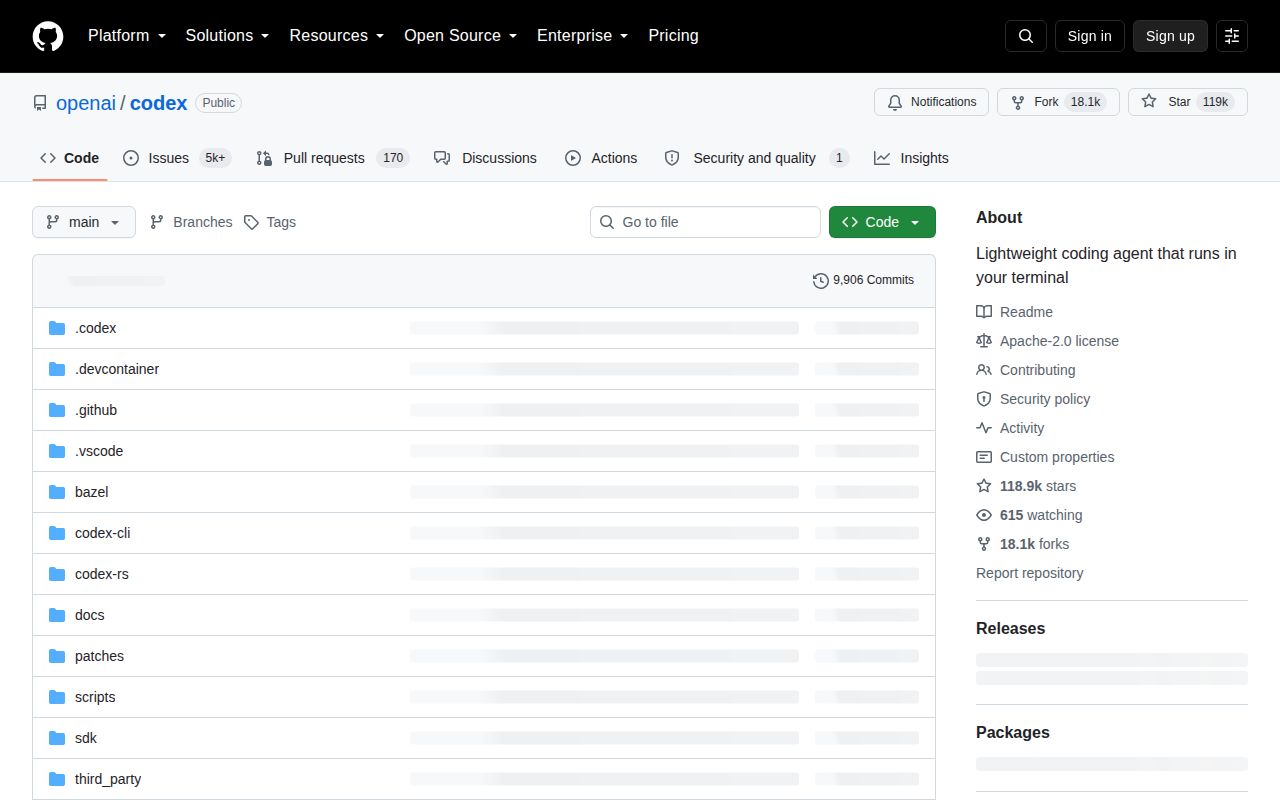
The repository is primarily Rust, despite the npm installation option. GitHub showed 118,894 stars and 14,016 open issues and pull requests combined when fetched. The last push and release 0.150.1 both landed on August 27, 2026. That pace signals active engineering and a large user funnel, while the combined queue warns that behavior changes and platform-specific reports are common. Pinning versions is sensible for team automation.
The installer is short; the trust decision is not
The README offers standalone shell and PowerShell installers, npm install -g @openai/codex, Homebrew, and downloadable binaries. Running codex then starts the sign-in flow. OpenAI recommends ChatGPT sign-in for eligible Plus, Pro, Business, Edu, or Enterprise plans. An API key is another route, with separate configuration and billing. Those options make first launch easy for an existing OpenAI customer.
A coding agent can read source and execute commands, so setup includes policy as well as installation. Decide which repositories it may access, which commands require approval, whether network access is allowed, and how secrets appear in the environment. A 21-second package install does not answer those questions. Teams should begin in a disposable branch, inspect diffs, keep tests authoritative, and avoid placing production credentials in a workspace the agent can read.
What happened when we ran it
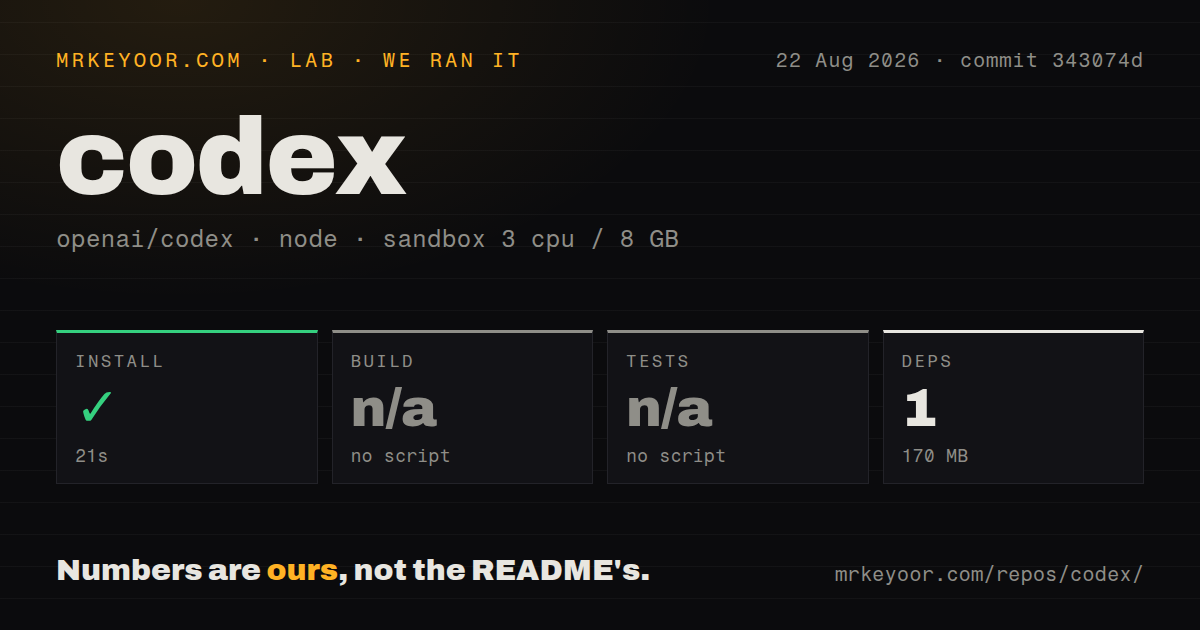
Our sandbox cloned commit 343074d into a fresh unprivileged Debian container with 3 CPUs and 8 GB of RAM. The checkout measured 65 MB, contained 6,446 files, and held about 1,529,062 source lines. The detected pnpm install succeeded in 21 seconds, adding 1 package and occupying 170 MB on disk. No secrets were available.
The harness found no build script or target, so it skipped the build. It also found no test script or target and skipped tests. The scan saw 27 CI workflow files, no Dockerfile, no tests directory, and monorepo workspaces. These facts describe the generic Node path at commit 343074d. They do not show that the Rust CLI compiled, that its own test suites passed, or that an authenticated agent session completed.
This distinction changes the buying conclusion. One installed package sounds tiny, while the repository contains roughly 1.5 million source lines across CLI, application, protocol, and support work. Users installing a published binary can ignore most contributor machinery. Anyone changing Codex itself should follow the repository's source-build guide and project-specific checks rather than treating our skipped generic targets as a pass.
Sandboxing limits commands, while review remains mandatory
Codex exposes approval and sandbox controls so a developer can decide how freely it reads, writes, runs commands, and reaches beyond the workspace. That boundary is a product strength because agent-generated commands are not inherently safe. It is also configuration that teams must understand. A broad approval profile can turn a mistaken instruction into a real system change, while a narrow profile can interrupt ordinary package installation or integration tests.
Version control is the practical safety layer. Start from a known status, preserve unrelated edits, and review the resulting diff before merging. Tests catch behavior regressions but do not catch every unwanted edit, credential exposure, or scope expansion. For noninteractive jobs, use a dedicated checkout and a limited identity. Codex can accelerate repository work; the person or pipeline accepting the patch still owns the result.
MCP and configuration can widen the agent's reach
The official documentation covers configuration and MCP connections, which let Codex use additional tools and data sources. That can turn a local coding session into a workflow spanning issue trackers, documentation, browsers, or internal systems. Each connection also adds permissions and credentials. Give an MCP server only the access its tools require, and separate read-only research from tools that can publish, delete, or deploy.
Skills and repository instructions can make repeated work more consistent, but they should be reviewed like executable process documentation. A stale instruction may send a correct agent down the wrong path. Teams adopting Codex across 20 repositories should maintain a small shared baseline for tests, formatting, secrets, and deployment boundaries, then keep repository-specific commands close to the code. The agent follows what it can see; contradictory instructions increase review work.
Fast releases reward pinning and staged updates
Release 0.150.1 fixes remote compaction so retained images count toward the token budget, trimming older images when necessary. That is a narrow change, but it shows how conversation state behavior can shift between releases. An automated workflow that depends on context retention should test a pinned version before updating. Interactive users can upgrade faster, provided they can roll back when a platform regression appears.
The current issue list includes Windows startup, WSL transport, macOS authentication, connector, and desktop-history reports. Some concern desktop surfaces rather than the terminal CLI, so they should not be treated as one CLI defect count. They do show the breadth now housed in this repository. Codex is easiest to recommend as an interactive terminal agent with human review. Fully unattended use needs stricter permissions, pinned versions, isolated credentials, and an independent acceptance test.