The checkout leaves out the signing code
Open demo.py and the first obstacle is already visible: it imports Argus, Ladon, and Gorgon from a signer package absent from the repository tree. The README advertises those TikTok request-signing components, but supplies neither their implementation nor instructions for obtaining them. That gap is enough to reject this as a ready-to-use tool. Anyone adopting it would begin by finding out what the published example actually needs.
Our measured checkout contained 2 files and about 249 source lines. One file is the README, the other the demo. Small projects can be useful, but this one's shortness leaves important questions unanswered. There is no dependency manifest in the inspected tree and no explanation of the external signing code. You can read the script quickly. You cannot infer a complete operating procedure from what is present.
What happened when we ran it
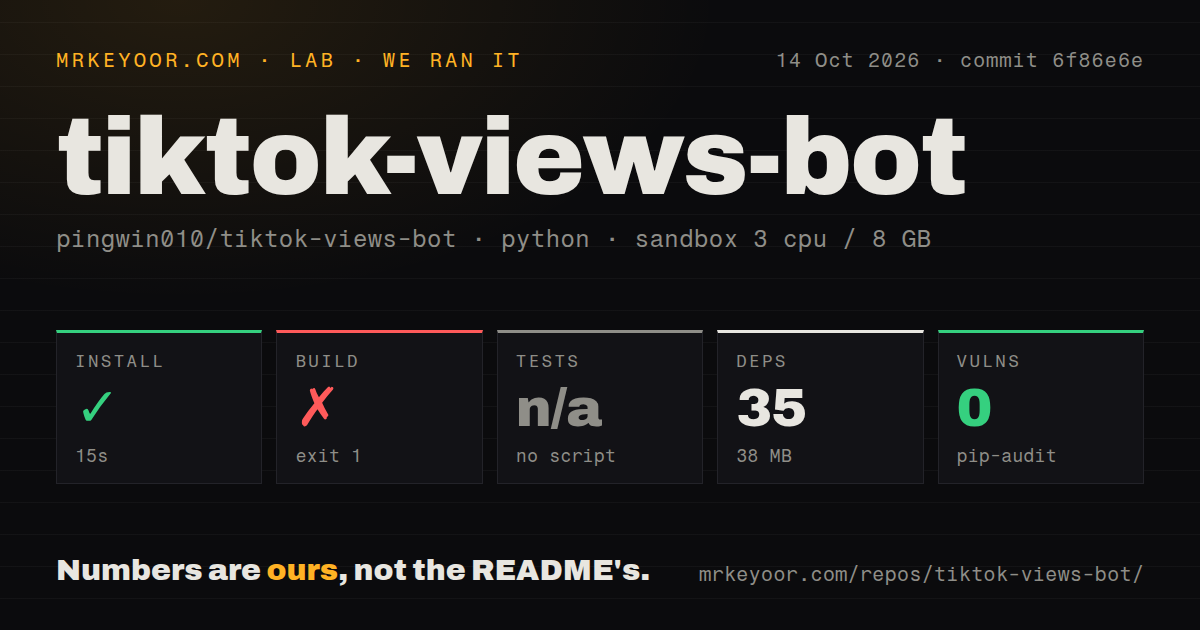
Our sandbox installed commit 6f86e6e in 15 seconds, adding 35 packages and occupying 38 MB on October 14, 2026. The build then failed with exit 1 after 3 seconds. The supplied measurement contains no error log for that step. Missing imports are visible in source inspection, but assigning the recorded build failure to those imports would claim a causal link the log does not establish.
The run used a fresh Debian Python 3.12 container with 3 CPUs, 8 GB of RAM, no secrets, and no elevated privileges. No tests script or target was available, so tests were skipped. Pip-audit reported 0 known vulnerabilities. That audit says something about known advisories in the installed environment. It does not establish that the source is complete, starts successfully, or performs its advertised job.
Our scan found 0 CI workflow files, no Dockerfile, and no tests directory. These absences leave no visible automated route for checking the demo before a change reaches users. More fundamentally, the supplied run reports no successful view-count operation. The install result should not be read as a demonstration that TikTok accepted traffic or changed a video's statistics. Those outcomes were never measured in this block.
Private playback requests are the entire product proposition
The README calls this a TikTok private API project and lists signing headers such as X-Gorgon and X-Argus. In demo.py, the request payload contains a playback increment field and targets a video statistics endpoint. That explains what the author is trying to do. It supplies no evidence about whether those requests count as genuine views, whether the service accepts them, or how a creator should assess the result.
The 38 MB installed footprint is almost beside the point for a creator choosing software. A larger counter would still leave the business question unanswered: did anyone actually watch and respond to the video? This repository documents no publishing workflow or audience analysis. I would not choose it as a growth tool because its advertised action does not provide evidence of interested viewers. A scheduling or analytics workflow serves a different, more useful purpose.
Configuration is embedded in an unfinished example
The source contains hardcoded cookie fields and a sample video identifier. It also refers to proxies.txt if its proxy mode is selected, while the public tree supplies no such file. The README does not explain credential ownership, refreshing request state, or recovering from server rejection. These are source observations, separate from our build result. They make the demo difficult to hand to someone who expects an ordinary configurable command-line application.
With only 2 files in the measured checkout, there is also no separate operator guide to resolve those omissions. The code catches some request failures without providing an actionable report, and its asynchronous requests sit inside a threaded launcher. A reader can study that structure, but I would avoid extending it before understanding how work stops and how failures reach the caller. The repository offers no documented lifecycle contract to rely on.
A recent push does not fill the documentation gap
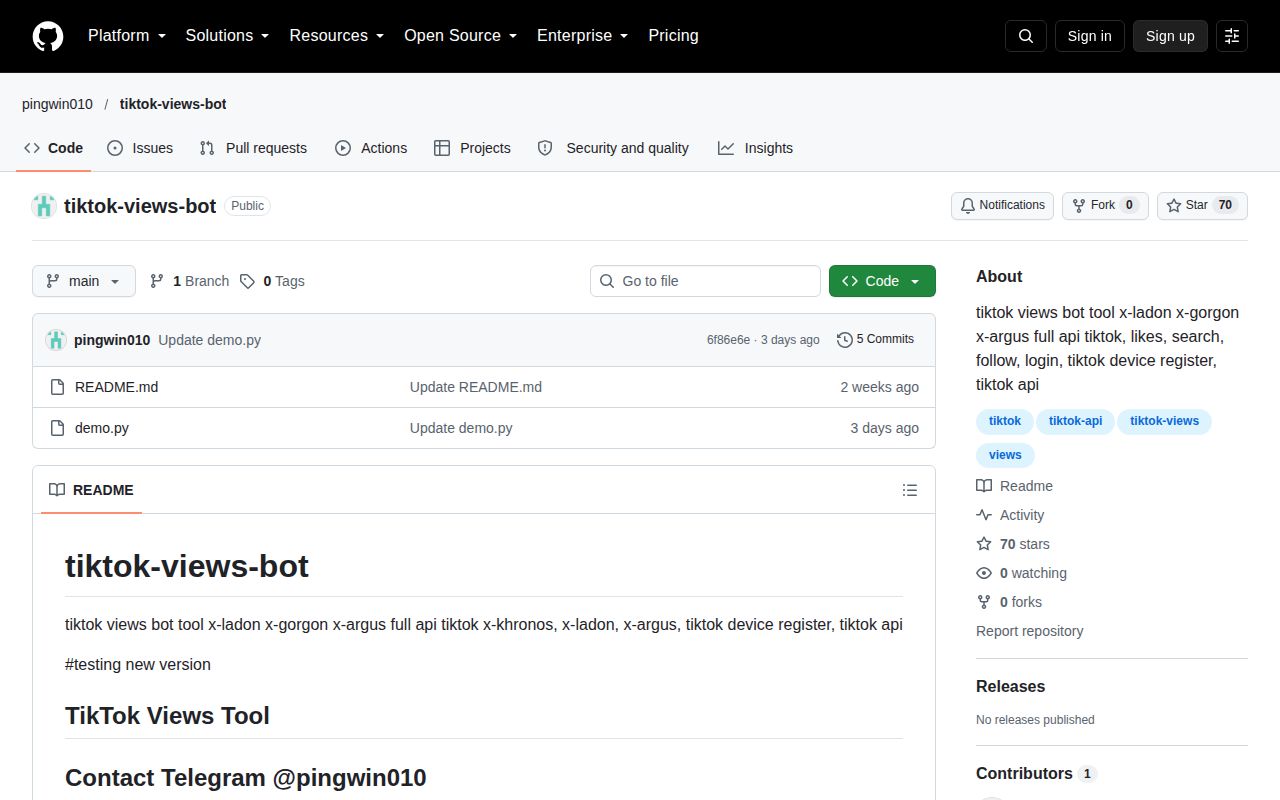
GitHub recorded the last push on October 12, 2026, with 70 stars and 0 open issues and PRs. The issue listing contained no discussion, and the latest-release endpoint returned no published release. The push is recent, so calling the project abandoned would be wrong. The available evidence instead shows a recently updated repository without a public support conversation or a release history that explains what changed.
The lab's 3-second build failure matters more to an adoption decision than that recent push date. There is no troubleshooting section against which to compare it, and the README's practical next step is a Telegram contact. That may suit someone already speaking with the author. It leaves a reader without the information needed to assess the public checkout independently. GitHub also reports no license, which complicates reuse of even this small example.
Choose a tool that matches the legitimate job
Postiz is a candidate for managing social publishing, while TikTok-Api addresses unofficial retrieval of TikTok data. Neither is an equivalent view generator, and that distinction matters when choosing an alternative. If you need to publish consistently or examine video information, start with software designed for that task. If you need a reliable reusable Python component, this demo's missing modules and undocumented configuration give you concrete reasons to walk away.