Digital-goods sellers get one console for accounts and delivery
Ydisks Xianyu Helper connects a seller's Xianyu accounts to a Go service and React dashboard. It collects messages, product records, orders, and inventories of codes or other delivery content. Chinese is the primary community language, but the default README and operational wiki are available in English. For a small seller repeatedly answering questions and sending digital goods, the useful feature is keeping those tasks beside the relevant order.
The 1,566-file checkout contains about 281,630 source lines, so this is a substantial application to operate. Account connections, credential renewal, delivery rules, and database migrations all have their own code. That scope fits someone consolidating several accounts. It is harder to justify if your only need is a default chat reply and you're otherwise happy working in Xianyu's own interface.
What happened when we ran it
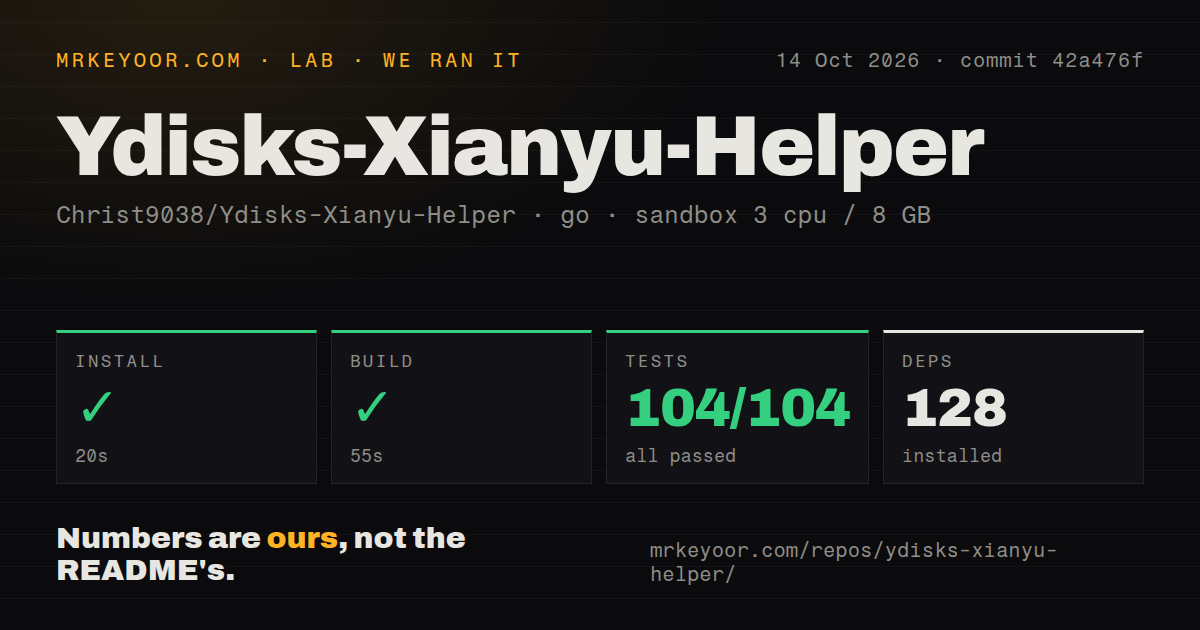
Our sandbox installed Ydisks commit 42a476f in 20 seconds, adding 128 packages, and completed the build in 55 seconds. The test step succeeded in 620 seconds, with 104 passed and 0 failed out of 104. We ran it on October 14, 2026, using the golang:1.24-bookworm image with 3 CPUs and 8 GB of RAM. The Debian container was unprivileged and contained no secrets.
The checkout occupied 20.3 MB. Our scan found 5 CI workflow files and a Compose file, with no Dockerfile or tests directory. A missing directory named tests plainly doesn't mean absent tests here: the Go test run passed. These findings establish that the measured repository completed its checks. They don't establish that a real account stays online or that a paid order receives exactly the intended delivery.
Compose still needs a database password and a durable encryption key
A 20-second dependency step leaves the operational setup ahead of you. The recommended Compose route starts PostgreSQL alongside the application. You must configure database credentials, a connection URL, an administrator password, and XIANYU_DATA_KEY. The last value protects stored credentials. Losing it means restoring the original key or signing accounts in again and re-entering protected values. Back up the key with the database before an upgrade.
Source users also need the React frontend tooling and Chromium system dependencies. The current README specifies a newer Go toolchain than our Go 1.24 container image, so the passing run should not be read as a supported compiler floor. Its supplied log doesn't identify toolchain selection. Disabling the browser removes fingerprint and token-slider capabilities, and browser-enabled containers need writable browser storage. A compiled server alone leaves those requirements unresolved.
QR login keeps account access in the Xianyu app
The client currently supports QR login only. You scan through Xianyu and complete any face or security verification through the official flow. The README warns that frequent service restarts request credentials repeatedly and can trigger risk controls. It also says not to run an account in multiple instances. Those limits matter if your usual response to a container alert is an automatic restart.
Our 104 passing tests came from an environment without account secrets, so they can't settle that login experience. The project is explicit that Xianyu and Alibaba have not authorized it, and the author may remove or archive it if asked by the platform. That makes it a poor dependency for a business requiring official integration guarantees, regardless of whether its local software checks pass.
Delivery content and shipment confirmation are separate actions
Ydisks supports text, batches of codes, images, and API-backed delivery. Its automation guide separates sending the content from marking the platform order shipped. Product associations and account switches determine which actions run. I'd verify the buyer's message and the order status independently before expanding a rule across an inventory. A buyer receiving a code doesn't itself demonstrate that the shipment state is correct.
Release v1.0.13 added clearer manual-intervention notifications and changed how staged bargain orders proceed to delivery. That's useful attention to uncertain outcomes. The same guide warns against immediate retries when delivery status is unclear because duplicate content may be sent. When an order reaches that state, someone has to inspect its history. The console gives that person a place to work, but unattended operation remains a separate claim.
Open reports describe stopped reconnects and missed reviews
Issue 80 reports that v1.0.13 can stop an account's runtime after a failed WebSocket reconnect during a network interruption. The reporter says the account stays offline even after connectivity returns. Issue 81 describes receipt-confirmation data being parsed into an incorrect order record, leaving automatic reviews unexecuted. These are specific user reports about current account and order behavior, separate from our sandbox results.
The 620-second passing test run therefore supports a supervised trial more strongly than a promise of uninterrupted selling. If automatic reviews matter to your workflow, inspect the open report before relying on them. If availability matters, verify account status as well as application health. A responsive management page cannot establish that its Xianyu connection is still handling messages.
September code activity has an October support queue
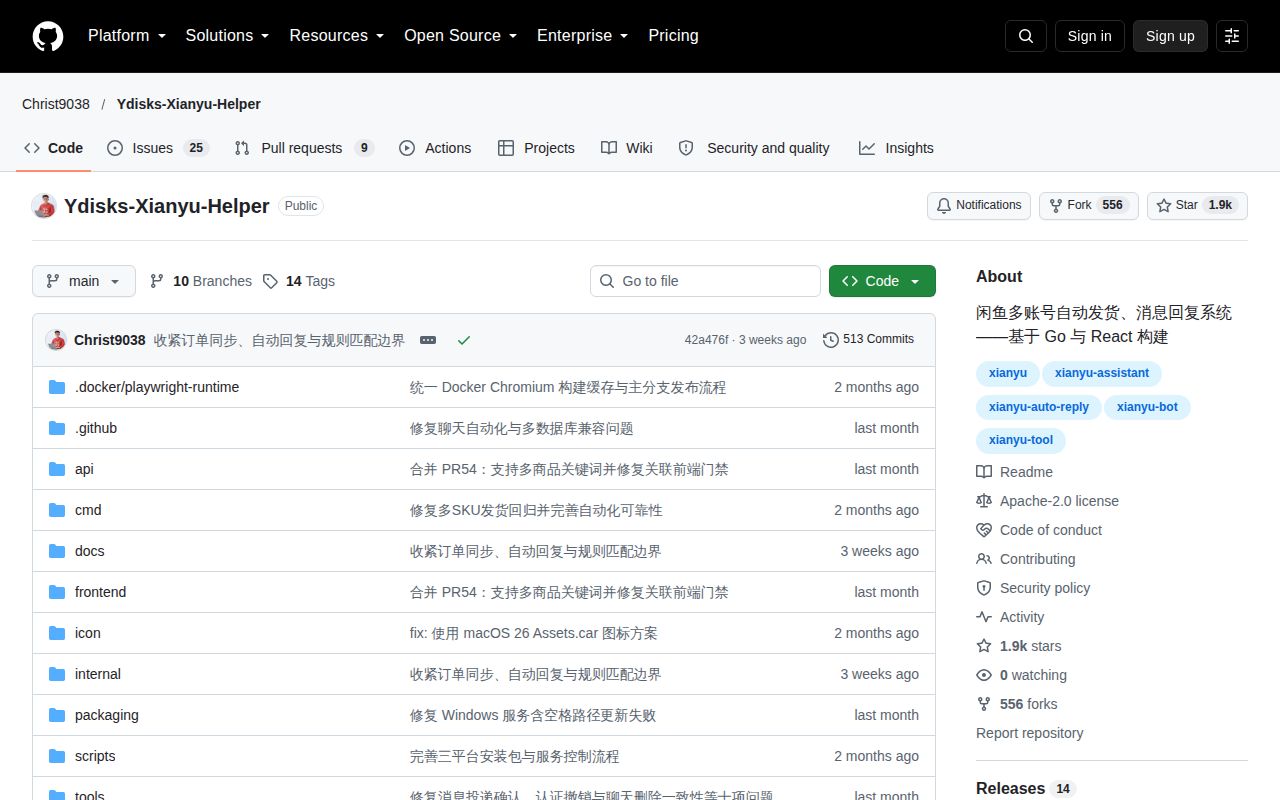
The last push was September 21, 2026. GitHub showed 1,872 stars and 34 open issues and PRs, with reports and proposed fixes updated through October 13. Release v1.0.13 shipped on September 17. Those dates show continuing discussion after the release, while the reconnect and review reports remain unresolved in the inspected queue. A recent release is useful context, not a reason to discount the reports.
XianyuAutoAgent from shaxiu suits a narrower prompt-based customer-service experiment. The separate jiali-shuai project adds product manuals and a sales-to-support conversation flow using FastAPI and MySQL. I'd trial Ydisks when the inventory and order console are the main attraction. Its 104 passing tests justify that trial, while the current account-runtime reports make exception notifications and an available human operator conditions of my recommendation.