The MCP server hands your agent instructions
Genspark-Claw packages research, report-writing, slide-outline, browser, and call-preparation instructions with a local installer. Its MCP server exposes list_skills, get_skill, and validate_skill. Reading those handlers reveals the important boundary: they return skill text or validation results. They do not conduct research, control a browser, or dial a telephone themselves. Your existing agent supplies the capabilities and decides how to follow the retrieved instructions.
Our checkout was small enough to inspect without committing to a new platform: 24 files, roughly 1,059 source lines, and 0.4 MB before installation. That makes the pack appealing as something to vendor and adapt. Read the workflow you want, compare it with your agent's actual tools, and change the assumptions before copying it into a shared skills directory. The payoff is reusable task guidance with little package machinery around it.
What happened when we ran it
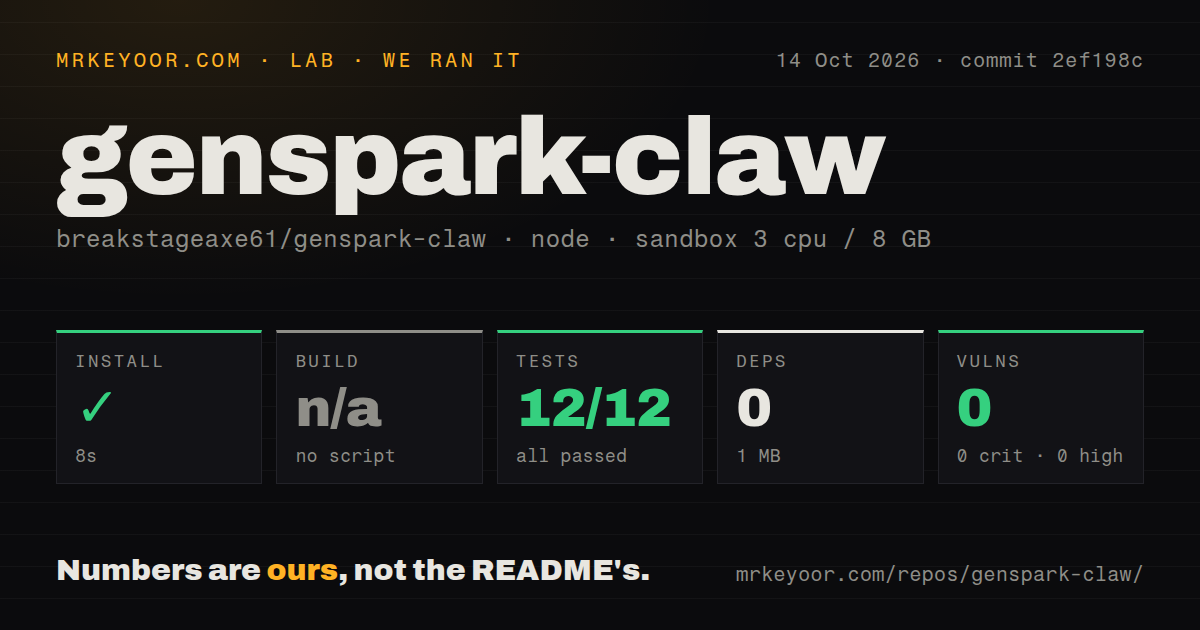
Our sandbox installed commit 2ef198c in 8 seconds and passed all 12 node:test cases in 3 seconds, with 0 failures. Installation added 0 packages and used 1 MB on disk. The October 14, 2026 Debian run used lab-node:22 with 3 CPUs and 8 GB of RAM, without secrets or elevated privileges. Npm audit reported 0 known vulnerabilities across all reported severity levels.
No build script or target was available, so the harness skipped that step. It found a tests directory, no Dockerfile, and 0 CI workflow files. That last finding conflicts with the README's CI badge and cross-platform CI claims. The measured local suite passed, but our evidence does not confirm the advertised automation on the other operating systems. Check the upstream workflow files before adopting that claim as part of your release policy.
A 1 MB local setup still needs a capable host agent
The 1 MB footprint is a welcome result for an instruction installer, especially if you are avoiding another service to maintain. The README requires Node.js and documents target directories for OpenClaw, Hermes, Claude Code, and Cursor. It also provides a workspace target and a dry-run option. Start with a project-local directory so the proposed instructions can receive the same review as the rest of your agent configuration.
No Genspark account is required just to use the pack, according to the FAQ. That does not make an actual research or calling task account-free. Your chosen runtime still needs model access and whatever search, browser, or telephone facilities the skill expects. The local MCP configuration points your client at an absolute server path. It is suitable for a desktop process, while a hosted remote connector would require infrastructure this package does not document as its delivery mechanism.
The validator catches named patterns and cannot certify agent behavior
The validator source checks frontmatter, the instruction body, and selected command patterns. It rejects familiar forms of piped remote scripts, decoded payloads, and destructive filesystem commands. Those are useful checks for an obvious mistake in a skill file. They do not establish that arbitrary natural-language instructions are trustworthy or that an agent will refuse a harmful action described another way.
Our 12 passing tests and clean npm audit should stay attached to their actual scope. Neither result turns a Markdown workflow into an enforced permission system. The README's security language goes further than I would rely on for deployment approval. Review the skill's requested tools and limit the host agent's authority separately. In particular, the MCP validation handler accepts a filesystem path, so its local process should have only the file access you intend it to use.
Call preparation expects a separate phone tool and explicit approval
The call-prep file declares phone-call and web-search tool requirements. It asks the agent to verify the callee, define the objective and fallback, write a script, and seek user approval before dialing. That is a useful preparation checklist for a runtime that already supports calls. Installing it in a text-only assistant will not create a telephone integration, and its compatibility list is narrower than the research and report skills.
The passing 3-second suite therefore supports trying the package mechanics, not promising a successful booking. A phone conversation has facts and decisions that the installer cannot test for you. Preserve the approval checkpoint, inspect the proposed number and constraints, and keep the runtime from agreeing to charges outside the user's request. For a developer expecting a turnkey calling product, this boundary is a reason to choose something else.
A September push and an empty issue queue leave limited field evidence
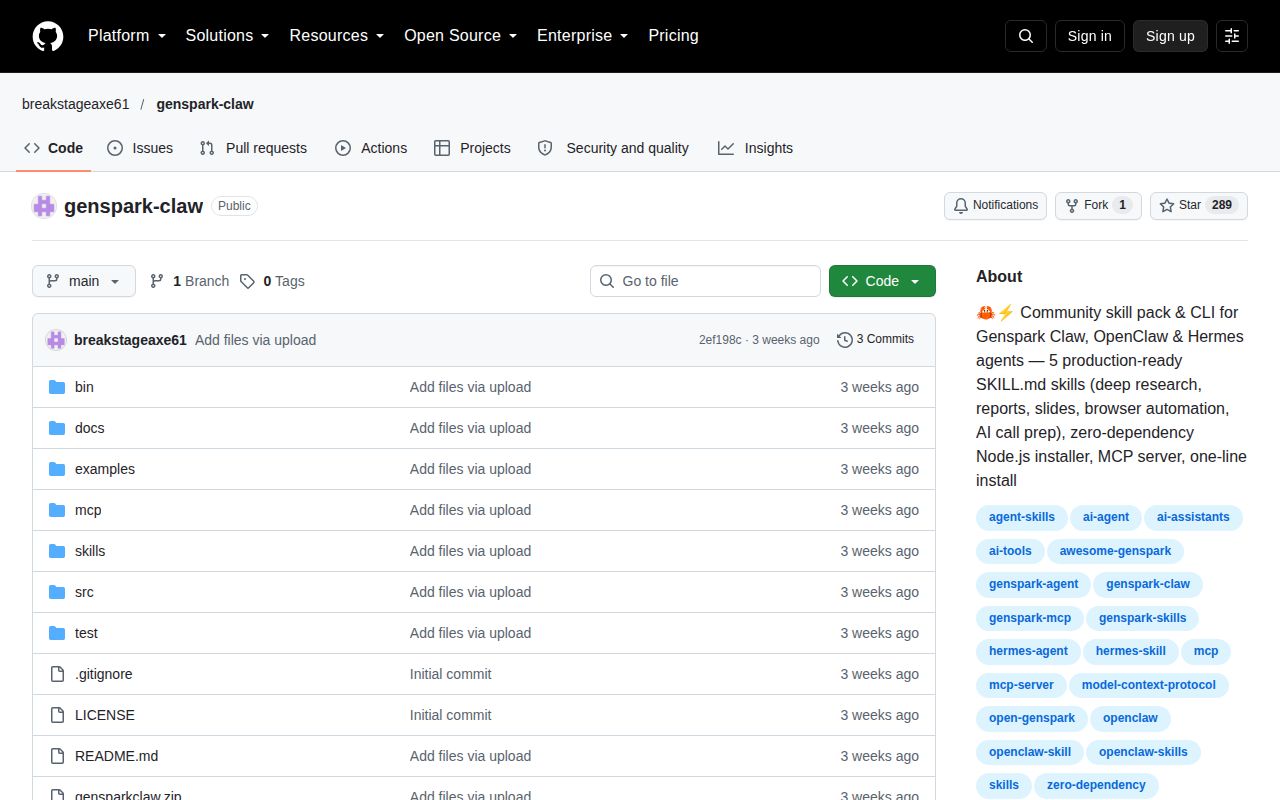
GitHub reported 289 stars, a last push on September 26, 2026, and no open issues or PRs on October 15. The recent issue endpoint returned no discussion, and there was no latest release. The push is recent enough to avoid an abandonment claim, but the empty queue provides little evidence about real installations across the advertised runtimes. Our local result is firmer evidence than the README's descriptions of production readiness.
Anthropic's skills repository is a better starting point when you want examples maintained by the Claude vendor, especially for document tasks. OpenAI's skills catalog is the closer alternative for Codex workflows. Choose Genspark-Claw when its specific research or call-preparation instructions fit an agent you already operate and you value the small installer. Read the chosen skill before installing the entire pack, then require the host runtime to prove the task with its actual tools.