Short answer
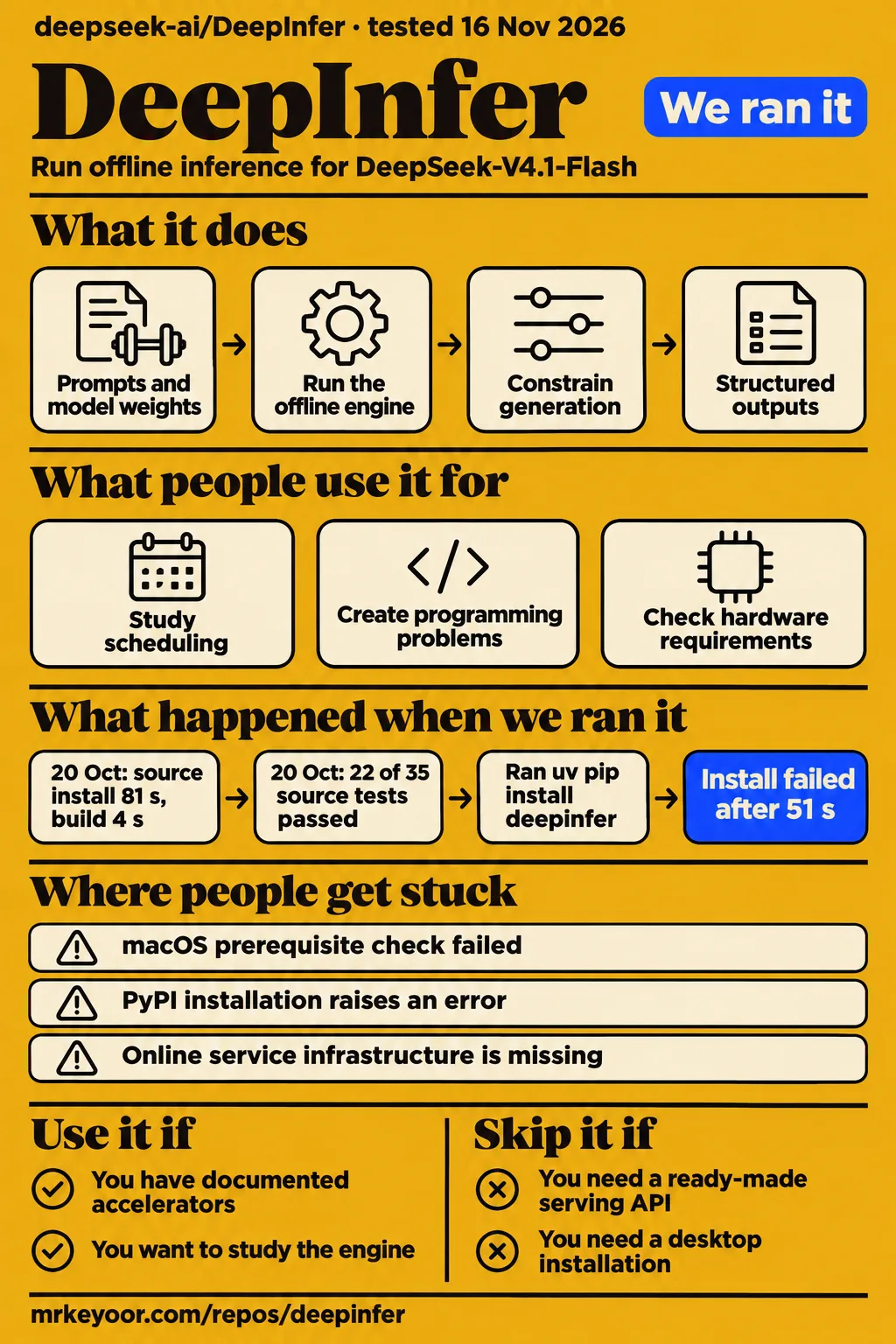
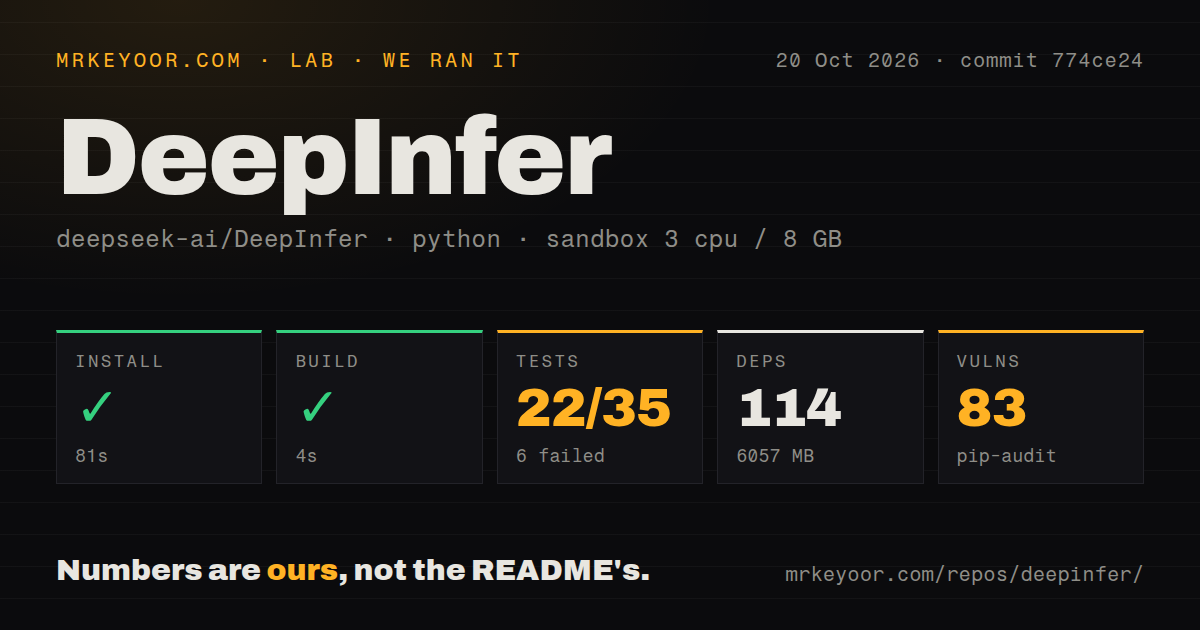
DeepInfer fits accelerator-equipped inference teams prepared to integrate an engine; API users and desktop users should choose another route. Our October sandbox installed it in 81 seconds and built it in 4 seconds, then ended with 6 failed tests and 7 collection/setup errors. The separate November PyPI attempt stopped during installation. Start the adoption decision with hardware eligibility and the service components your team will own, rather than a throughput ranking.
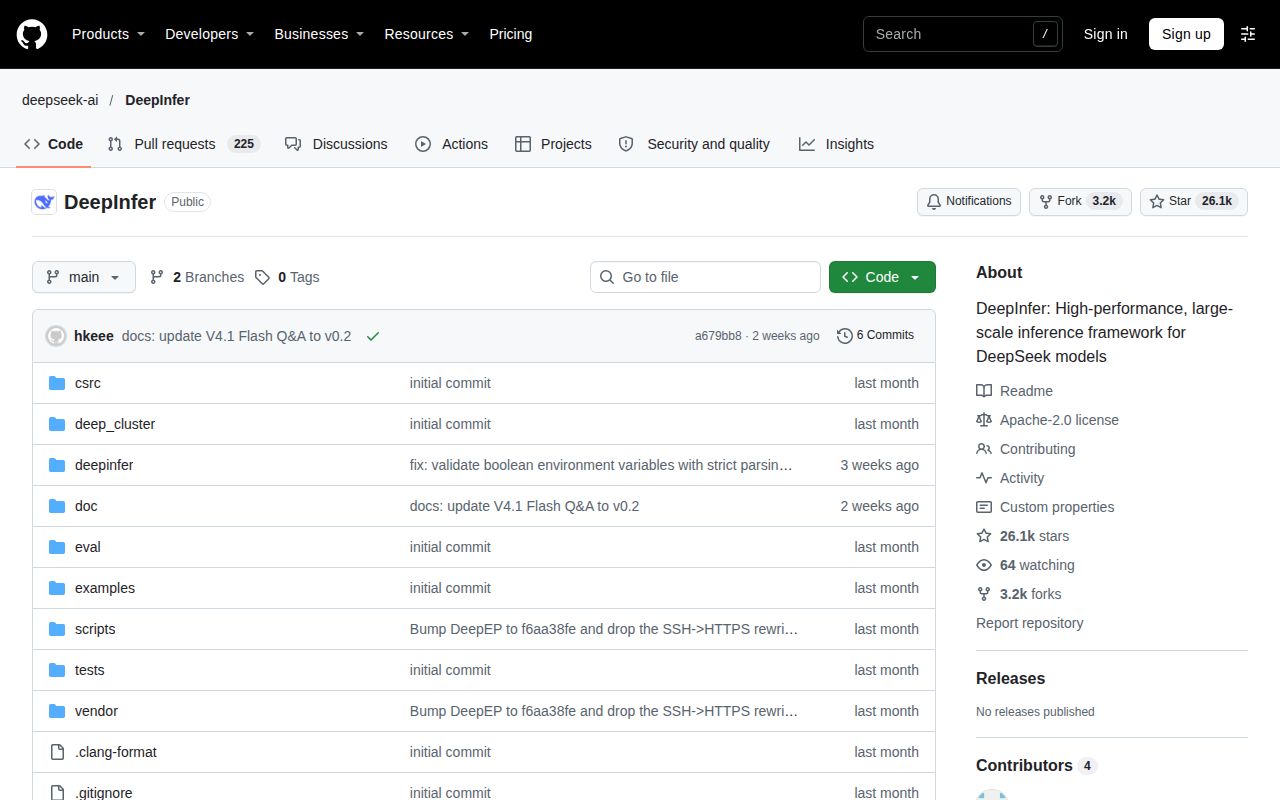
DeepInfer's public release provides offline inference for DeepSeek-V4.1-Flash. The README lists NVIDIA SM100 GPUs and Huawei Ascend 950 NPUs. DeepSeek describes the framework as powering its own large-scale production services, while excluding several service components from the public release. The existing MrKeyoor DeepInfer release article covers the announcement; this review addresses operator fit, configuration and the recorded setup outcomes.
Offline V4.1-Flash includes structured and deterministic outputs
DeepInfer documents structured outputs and NVIDIA deterministic sampling alongside its offline V4.1-Flash runtime. Its feature list includes optimized kernels, expert parallelism, asynchronous scheduling and batch-invariant inference. Structured outputs can constrain generation to a regular expression, JSON schema or EBNF grammar. Researchers can use those features to choose an implementation path to examine: scheduling, sampling and output constraints are separate parts of the engine described in DeepSeek's README.
The documented NVIDIA deterministic-sampling recipe combines DEEPINFER_BATCH_INVARIANT=1, DEEPINFER_ENABLE_MTP_VARLEN=0 and a fixed seq_seed passed to SamplingParams. Keep all three settings together when following that recipe. The README describes variable-length verification separately, with DEEPINFER_ENABLE_MTP_VARLEN=1. A configuration copied from that verification path therefore needs a deliberate change before it matches the deterministic-sampling instructions. The two recipes address different execution choices.
What people use DeepInfer for
DeepSeek reports production use, real_deep_ml describes educational exercises, and WebFV records a prerequisite check. For an operator, these suggest three starting points: inspect the production-derived engine, study its implementation through exercises, or establish whether a machine meets the requirements before downloading weights. The public release's offline workflow is the practical starting point for engine integration; the other examples offer ways to learn about the project or screen a proposed host.
| Who used or examined it | What they did | Recorded outcome |
|---|---|---|
| DeepSeek | Used the framework behind its large-scale services | DeepSeek reports production use. DeepSeek production-use account |
| X account real_deep_ml | Added programming problems based on DeepInfer | The author describes learning through building. DeepInfer educational-problems post |
| WebFV | Checked a macOS/Apple Silicon machine against the prerequisites | The author stopped before dependency installation or model download. WebFV prerequisite report |
The r/artificial user pingzawa162 asks whether a coding-agent vendor has publicly adopted DeepInfer or deepseek-recipe. Their goal is official-API behavior without renting GPUs or debugging CUDA, and their stated fallback is the official DeepSeek API. A reader with that requirement should begin with the coding client and endpoint they intend to buy. Operating DeepInfer introduces the accelerator and infrastructure work that this user explicitly wants to avoid. Coding-agent adoption question.
What happened when we ran it
Our October run reached a failing test suite; the separate November run stopped at PyPI installation. The October 20, 2026 repository harness used commit 774ce24, with a recorded configuration of 3 CPUs, 8 GB RAM and image label ghcr.io/astral-sh/uv:python3.12-bookworm. Installation and build completed before the failed test command. We measured the installed environment and checkout separately, so their disk figures describe different things.
| October harness step or observation | Recorded result | How to read it |
|---|---|---|
| Install | Succeeded in 81 seconds | The installation step completed. |
| Dependencies and disk | 114 dependencies; 6,057 MB on disk | Installed environment footprint. |
| Build | Succeeded in 4 seconds | The recorded build command completed. |
| Tests | Exit 1 after 404 seconds | 22 passed, 6 failed, 1 skipped and 7 collection/setup errors. |
| Dependency audit | pip-audit: 83 known vulnerabilities | Aggregate dependency-audit result. |
| Repository scan | 342 files, about 61,562 source lines, 4.8 MB checked out | Source-checkout footprint. |
| Automation signals | 0 CI workflow files, no Dockerfile, tests directory present | Signals recorded for this checkout. |
Three tests timed out after more than 120 seconds: test_batch_invariant, test_kl and test_sampler_correctness, each targeting deepseek-ai/DeepSeek-V4.1-Flash-1017. The short offline-inference test reported missing cpu/short PPL goldens; the long offline-inference test reported missing cpu/long PPL goldens. Both referenced tests/models/offline_decode_ppl.json. PPL goldens are stored regression references used to compare a workload's numerical results. The supplied log names absent references as the failure condition.
The vision-encoder batch-invariance test reported Model regression failed: exitcode=1. The log tail also names errors in test_eplb_policy.py, test_state_cache_ops.py and test_userbuffer.py. Its final pytest summary reports 397.67 seconds, while the outer test step records 404 seconds. The harness records 35 under its total field alongside the separate pass, failure, skip and error counts. Those recorded categories describe the outcome more accurately than a calculated pass percentage.
The November 16 run used the quickstart-lib recipe associated with checkout a679bb86ce36. Its fresh unprivileged container had 2 CPUs, 4 GB RAM, no published ports and no secrets. The November clone step took 1 second. The November installation step attempted uv pip install deepinfer into a fresh virtual environment and failed after 50.7 seconds with exit 1.
The recorded exception was TypeError: expected str, bytes or os.PathLike object, not NoneType. The installation finding includes a hint about the package or build environment, and container teardown completed successfully. The November run configuration describes a latest-version PyPI route. Keep that package-installation outcome separate from the October source-checkout installation, build and test results when estimating the work ahead.
Where people get stuck: hardware and configuration come first
The README requires Linux, GCC 13 or later, Python 3.12, and CUDA 13 on NVIDIA or CANN 9.2 on Ascend. It asks readers to activate an empty Python 3.12 environment before building and keep DEEPINFER_ACCELERATOR exported where the engine runs. Inventory the host before downloading the checkpoint. WebFV's prerequisite report follows that order: its macOS/Apple Silicon check led the author to stop before dependency installation or model download.
| Symptom or decision | Evidence-backed next action | Status of the advice |
|---|---|---|
| macOS host or unsupported accelerator family | Match the Linux and SM100/Ascend 950 requirements before building | Documented prerequisites |
| Local checkpoint variable seems ignored | Inspect explicit --model_name; it takes precedence over DEEPINFER_HF_MODEL_DIR |
Documented argument precedence |
| Deterministic sampling is required | Enable batch invariance, disable MTP varlen, and pass a fixed seq_seed |
Documented NVIDIA recipe |
| Missing PPL goldens | Measure and review the appropriate platform/workload baseline before accepting it | October log and upstream baseline procedure |
Multi-node candidate baseline requested with --output |
Use the default baseline path for coordinated per-node updates | Documented cross-node file-lock procedure |
PyPI installation raises the recorded NoneType error |
Preserve the traceback and compare the package route with upstream's source-build instructions | Diagnostic next step |
The upstream examples documentation says baseline refreshes follow confirmation that a numerical change is expected. Its multi-node procedure updates each node's own ranks under a cross-node file lock; a candidate file written with --output is a single-node option. For checkpoints, an explicit --model_name selects the model or local directory. The environment variable points the default model at a local copy and leaves that explicit argument in control.
Serving at volume needs cache infrastructure outside the engine
DeepSeek excludes a service KV cache system, VE/prefill/decode disaggregation and replica load balancing from this release. These are integration responsibilities for a complete service. A platform team choosing DeepInfer needs to assign ownership of each subsystem alongside ownership of model execution. That division determines the adoption workload: an existing distributed-service platform has a different starting point from a developer seeking a server command. DeepInfer release scope.
Engine-local KV state still exists. The upstream benchmark documentation says decode reuses shared prefix KV produced by prefill, while the Learn DeepInfer walkthrough traces cache ownership and request lifetimes. The production-gap article describes 64 prefill plus 64 decode GPUs as the smallest efficient unit and also calls a 1P + 1D configuration deployable. Treat the former as an efficiency recommendation when planning capacity, rather than a universal minimum deployment size.
Security review starts with 83 dependency findings
Our October pip-audit result reported 83 known vulnerabilities. The harness recorded 114 scanned and reported packages, with 5 vulnerable packages and 0 skipped packages. An operator's next task is to obtain the advisory list, identify the affected installed versions and assess their place in the intended deployment. Include that dependency review in the adoption work alongside building the engine and acquiring model weights; installation completion alone is only one setup outcome.
The public quickstart runs offline inference. An online deployment adds choices about authentication, quotas, access controls and storage for prompts and outputs. Assign those responsibilities while designing the surrounding service, then document where model files and request data live. Reviewing the source-build script in an isolated environment is another practical preparation step. These tasks belong in the operator's implementation plan alongside the cache, disaggregation and routing components listed by upstream.
DeepInfer vs vLLM, SGLang, Dynamo and llama.cpp
vLLM documents an OpenAI-compatible API server, Dynamo coordinates inference engines, and llama.cpp supports local CPU and GPU execution. SGLang's supplied README describes an inference framework with serving and orchestration integrations. Choose first by the layer you need to operate: model execution, an API service, cluster coordination or local experimentation. That choice gives the comparison a practical purpose before throughput enters the decision, because each project supplies a different starting point.
| Candidate | Why to choose it | Decision boundary |
|---|---|---|
| DeepInfer | Study or integrate DeepSeek's V4.1-Flash engine on its documented accelerators | Supply the excluded service components. DeepInfer README |
| vLLM | Start with an OpenAI-compatible server and multiple model architectures | Choose a model and hardware configuration from its supported paths. vLLM README |
| SGLang | Evaluate a serving framework and its model-specific cookbook | The supplied V4.1 comparison describes an October 20 preview recipe. Dated SGLang comparison |
| NVIDIA Dynamo with a supported backend | Coordinate engines with routing, disaggregation and tiered KV caching | Select the inference backend as well as the orchestration layer. Dynamo README |
| llama.cpp | Run a supported local model on CPU, Mac or consumer hardware | Choose a model supported by that runtime. llama.cpp README |
The October 20 SGLang comparison describes an API, PD disaggregation, HiCache and a router, with V4.1 support then using preview Docker images. For a serving deployment, start with SGLang's model-specific cookbook and its hardware requirements. Dynamo's supplied primary README lists SGLang, TensorRT-LLM and vLLM as engine backends, making backend selection part of the orchestration decision rather than an interchangeable detail.
llama.cpp's README describes Apple Silicon optimization through ARM NEON, Accelerate and Metal, alongside CPU and GPU backends. That makes it relevant to readers whose goal is local inference. The LlamaBuilds guide also proposes smaller distilled R1 models for home experimentation. A smaller R1 model is a different choice from V4.1-Flash. For readers sharing pingzawa162's preference to avoid accelerator operations, a hosted API addresses the operating model they requested.
What the other reviews get wrong
The purported hands-on guide's bundled-gRPC claim conflicts with DeepInfer's documented offline release scope. Naveen Malothu's guide describes launching an endpoint in minutes; the upstream README directs readers to offline inference. The supplied synthesis also records Python 3.10+, CUDA 12.1 and a DeepSeek-7B/A100 recipe in that guide. Use the upstream requirements for installation planning: Python 3.12, CUDA 13 on NVIDIA, V4.1-Flash and SM100 or Ascend 950 hardware.
Tiaforge's walkthrough calls the production stack open-sourced as-is. DeepSeek's service exclusions make that description too broad for deployment planning. Its deterministic-mode summary also omits disabling MTP varlen, which the primary README includes. The synthesis records a historical correction as well: an October 20 article's three-commit count is a launch snapshot, while the supplied October 23 upstream capture shows six commits. Neither historical count describes the repository's continuing state.
The deepinfer.net vLLM comparison says there is no public head-to-head. SemiAnalysis subsequently reports that vLLM matched DeepInfer's published results on the same benchmark. That report changes what readers can say about published benchmark reproduction. For capacity planning, also keep the 128-GPU efficiency layout separate from a minimum-hardware requirement: the supplied production-gap coverage explicitly describes a smaller 1P + 1D configuration as deployable. SemiAnalysis benchmark report.
Search results also include a separate medical-imaging DeepInfer toolkit, whose guide describes 3D Slicer, and an innohood-lab README mirror. This review concerns deepseek-ai/DeepInfer. Check that repository identity before following requirements or installation advice. The medical-imaging guide's model-store and Slicer workflow belongs to another project, while the mirror reproduces material identifying DeepSeek's upstream repository.
FAQ
DeepInfer is DeepSeek's offline inference framework for V4.1-Flash, with NVIDIA SM100 and Huawei Ascend 950 listed in its hardware matrix. The supplied questions cover hardware, external attempts, benchmark comparisons and serving choices. A recurring practical distinction is whether the reader wants to operate the engine or use an existing endpoint. The Italian-language r/IA_Italia question below concerns external benchmark results; it is a country-specific discussion, rather than measured worldwide English search demand.
What is DeepInfer?
DeepInfer is DeepSeek's inference software for V4.1-Flash. Its README lists model execution, sampling, parallelism and scheduling features, followed by the components required for a complete inference service. DeepSeek releases the code under Apache License 2.0. Start with its offline-inference workflow when evaluating the engine, and include the separately listed service subsystems when estimating an online deployment. DeepInfer project and licence.
Which hardware can run DeepInfer, including mixed NVIDIA GPUs or an RTX 5090?
The official hardware matrix lists NVIDIA SM100 GPUs and Huawei Ascend 950 NPUs. Match that accelerator requirement alongside Linux, GCC 13 or later, Python 3.12 and the appropriate accelerator software before beginning the build. WebFV's prerequisite check stopped on macOS/Apple Silicon before installation. Its report provides a useful example of screening a host before committing to dependencies and weights. DeepInfer hardware requirements, WebFV host check.
Has anyone tried DeepInfer outside DeepSeek's cluster, and do its benchmarks hold up?
WebFV records an external prerequisite check, while our two runs record a failing suite and a failed installation route. The Italian-language r/IA_Italia user artistic56 asks whether the published benchmarks hold outside DeepSeek's cluster. SemiAnalysis separately reports vLLM matching the published benchmark. For an operator, the setup records describe preparation work and stopping points; the SemiAnalysis post supplies the attributed benchmark-reproduction report. Italian benchmark question, SemiAnalysis report.
Have any coding agent vendors publicly adopted DeepInfer or deepseek-recipe?
The supplied r/artificial record contains a request for vendor adoption announcements and an empty comment array, despite metadata reporting two comments. Its author wants a coding agent using V4.1 Flash 1017 with behavior like the official API and wants to avoid operating GPUs. Readers with that purchasing requirement should ask a client vendor to identify its endpoint and model configuration before taking on an engine installation. Coding-agent vendor question.
Can I get official DeepSeek API behavior in a cheap coding agent without operating GPUs?
The official DeepSeek API is the fallback explicitly requested by pingzawa162. Their post explains that renting GPUs and debugging CUDA are outside the job they want to do. For that reader, the next step is selecting a client and endpoint combination, then checking its model and pricing configuration. Installing DeepInfer creates an infrastructure task with documented accelerator requirements and service components to assemble. Hosted-API preference.
Why is DeepInfer not included in InferenceX?
SemiAnalysis attributes the exclusion to offline, single-turn scope and missing serving components. Its post says building those components would add too many assumptions to the comparison. The same post reports vLLM matching DeepInfer's published benchmark. For a deployment decision, use the exclusion explanation to understand the system boundary InferenceX compares, and use the matching-results statement as SemiAnalysis's report about the published benchmark. SemiAnalysis InferenceX explanation.
Is DeepInfer faster than vLLM?
SemiAnalysis reports that vLLM matched DeepInfer's published results on the same benchmark. An operator choosing between them should also decide whether the requirement is engine integration or an existing API service, since vLLM's README documents an OpenAI-compatible server. Use that service distinction to shortlist an implementation, then define the workload and latency target for any performance comparison relevant to your deployment. SemiAnalysis benchmark report, vLLM serving documentation.
Is DeepInfer faster than SGLang?
The supplied October 20 SGLang comparison says the published figures use different configurations. It proposes matching model, hardware and workload before interpreting throughput. For an adoption decision, compare the serving recipe and documented engine features: the article describes SGLang's API, disaggregation, HiCache and router, while DeepInfer's README describes its offline engine and NVIDIA deterministic configuration. Start with the combination that supplies the service responsibilities your team needs. Dated SGLang comparison.
Can DeepInfer replace vLLM for an OpenAI-compatible API?
DeepInfer's public release provides offline inference, while vLLM documents an OpenAI-compatible API server. Replacing the serving layer therefore means building or integrating service infrastructure around DeepInfer. A platform team prepared to own routing and cache services can include that work in its adoption plan. A developer whose immediate need is an API endpoint has a direct documented starting point in vLLM's server. vLLM README, DeepInfer release scope.
Can DeepInfer run under NVIDIA Dynamo?
KranenKyle's supplied October 22 post describes DeepInfer integration interest and a hoped-for disaggregation PR. Dynamo's primary README lists SGLang, TensorRT-LLM and vLLM as engine backends and describes the routing, cache and scaling layer above them. For a cluster plan, choose the backend and orchestration layer together, and distinguish the proposed DeepInfer work from the backend paths documented in Dynamo's README. DeepInfer integration discussion, Dynamo README.
Can llama.cpp run DeepSeek-V4.1-Flash?
llama.cpp documents local inference across CPU and GPU backends; DeepInfer is a separate engine for V4.1-Flash. For local experimentation, start with the model and hardware supported by the chosen runtime. The supplied local-runtime comparison recommends llama.cpp for supported GGUF models on Macs, consumer GPUs or CPUs. That gives a local user a model-selection path distinct from installing DeepInfer's accelerator-specific engine. Local-runtime comparison, llama.cpp README.
What we have not tested yet
Neither recorded run demonstrates inference on SM100 or Ascend 950. Supported-accelerator setup time, throughput, answer quality, deterministic output, structured-output correctness, distributed cache behavior, hosted-API parity and recovery under production load remain outside the measured results. The October image label records configuration rather than actual interpreter or operating-system versions. Detailed collection exceptions and advisory-level assessment of the 83 dependency findings require underlying logs beyond the supplied summaries; that aggregate is not a count of remotely exploitable DeepInfer flaws.
The November checkout identifier does not pin the package selected from PyPI. Its traceback excerpt identifies neither which path became None nor a demonstrated remedy; the October timeouts similarly provide stopping conditions without causes. The supplied research also leaves successful independent external deployment, operational reliability, coding-agent vendor adoption, reproduced Ascend performance, merged and supported Dynamo integration, and V4.1-Flash compatibility in llama.cpp unresolved. The underlying configuration and logs for vLLM's reported matching result have not been assessed here, and the records supply no independent complete-service speed winner.
A useful next experiment would hold checkpoint, hardware, input and output lengths, cache policy and latency target fixed, then record accepted output tokens and elapsed time. The upstream benchmark documentation uses full-acceptance accounting regardless of true draft acceptance and warns against deriving throughput from profiler steps. The configuration recipes in this review come from documentation and were not executed for this correction. Rendered layout, resolved links, recommendation modules and template behavior also remain outside this text-and-evidence review.