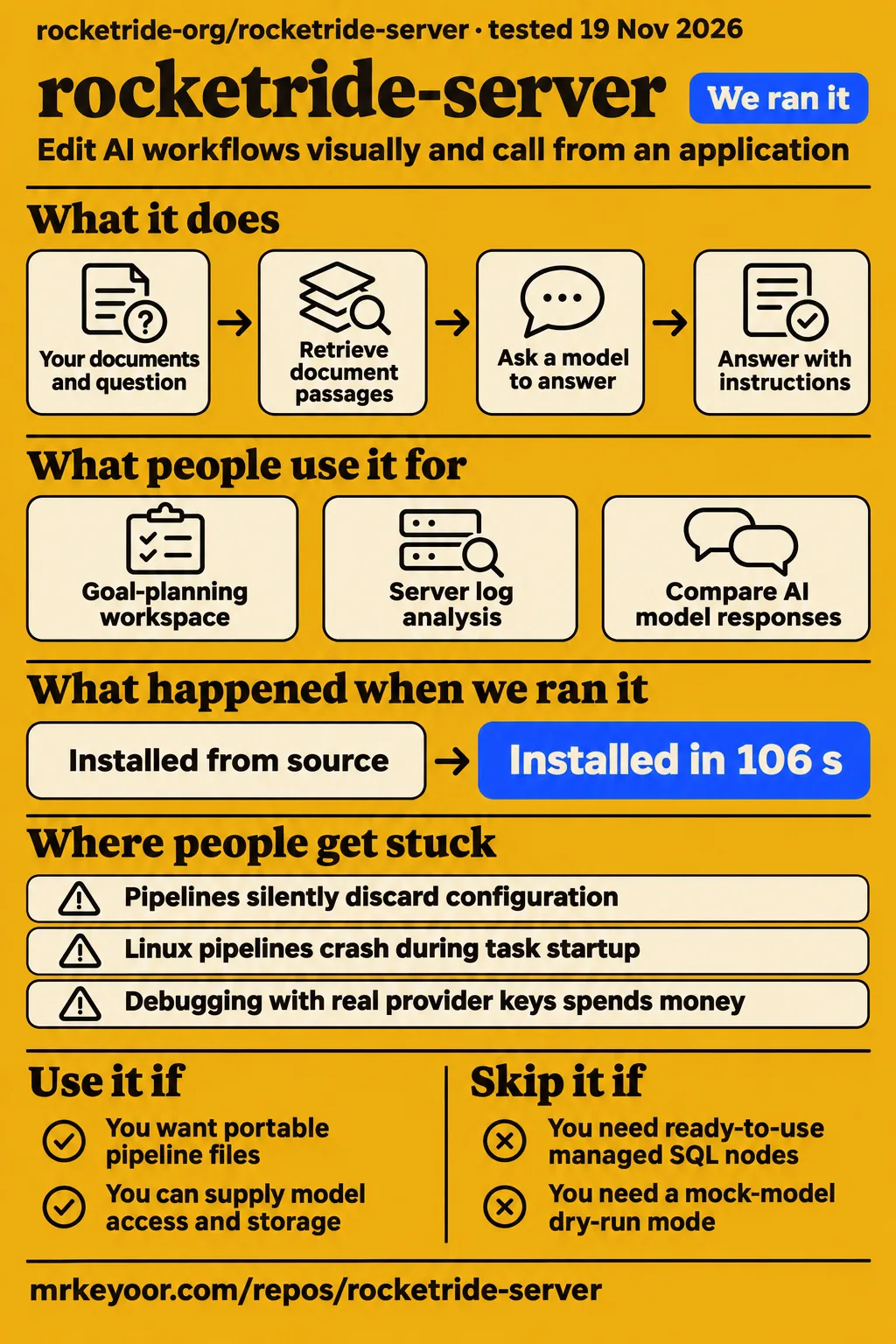

RocketRide gives you a workflow file you can keep beside your application code, a visual editor and a runtime you can host yourself. Use it if that combination solves a deployment problem you actually have. Skip it if your launch depends on ready-to-use managed SQL or graph nodes: issue #2203 reports missing broker wiring and trusted task identity. Our dependency install succeeded, but the later deployment attempt stopped before a working application.
What people use rocketride-server for
The clearest usage examples are contributor projects and demonstrations, including a goal-planning workspace, a server-log analyzer and custom retrieval connectors. Arya Mehta calls his workspace a demo, and iamkairav describes future use on their own servers. The most informative custom-node report also records the configuration failures encountered while building. Read these examples as concrete starting points for your own workflow, rather than named production deployments.
| Who built it | What they did | What you can take from it |
|---|---|---|
| Arya Mehta | Reported shipping a Next.js demo with step traces, timing, recent runs and a final Markdown artifact. | The project includes pipelines/goal-planning-agent.pipe; the web interface also contains seeded demo rows. |
| iamkairav on X | Built Server Pulse, a Linux server log analyzer, and credited RocketRide with handling the AI pipeline. | Using it on their own servers was a future intention in the post. |
| rishinaren, author of issue #1989 | Built seven custom nodes, four pipelines and a custom audio-embedding node with an AI assistant. | Silent configuration mistakes led them to write a validator against the live service catalog. |
| The Confluence/Azure Boards video presenter | Combined runbooks and work items into an answer about payment-webhook failures. | The presenter said both connector PRs were still unmerged. |
The last demonstration is especially useful if you're evaluating retrieval-augmented generation, or RAG: searching your documents before asking a model to answer. The presenter asked how to handle a payment-webhook failure. The pipeline retrieved an existing work item and incident-runbook instructions, then combined them into one response. In the same video, a GitHub assistant retrieved PR state, authorship, commits and changes through a connected account, with the presenter running a downloaded release engine locally.
That is a sensible starting point for your own evaluation: one question whose answer lives in two systems you already use. It exercises the connectors, retrieval and answer generation together, without confusing a successful model call with a useful application.
What happened when we ran it
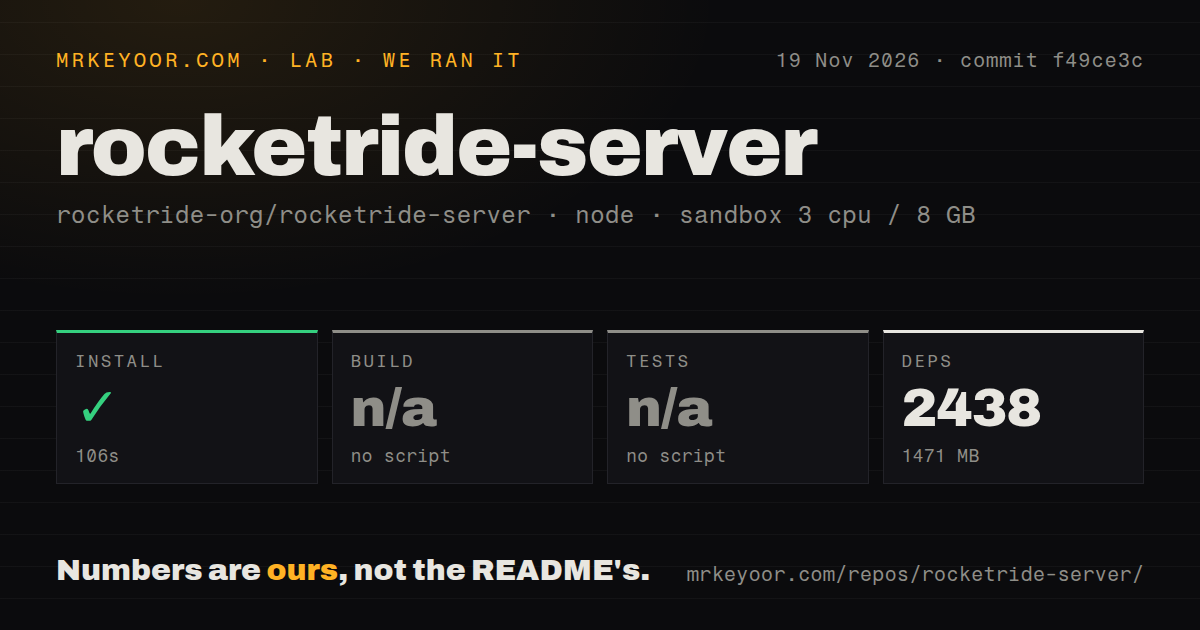
Our November 20 hands-on attempt failed to start deployment at the Compose-file safety check; the separate November 19 source-workspace run installed dependencies successfully in 106 seconds.
The deployment attempt reached this error: unsafe repo: none of compose.yaml, compose.yml, docker-compose.yaml, docker-compose.yml exists (rule: a compose file is required). That is a requirement of our lab procedure, not proof that RocketRide cannot run in a container. The teardown step reported success. There was no application task to score after that stop.
| November 19 source-workspace check | Recorded result |
|---|---|
| Commit and configured resources | f49ce3c; 3 CPUs and 8 GB RAM |
| pnpm dependency installation | Succeeded in 106 seconds |
| Dependencies recorded | 2,438 |
| Dependency footprint | 1,471 MB on disk |
| Build | Skipped: no build script or target detected |
| Tests | Skipped: no tests script or target detected |
| Checkout | 5,808 files, approximately 1,197,077 source lines, 209.7 MB |
| Repository signals | 30 CI workflow files, a tests directory, monorepo workspaces; no Dockerfile detected |
Our sandbox configuration used image label lab-node:22. Our pnpm dependency installation succeeded in 106 seconds and occupied 1,471 MB on disk. That footprint describes the workspace dependencies, rather than memory used by a running engine. The configured image label also isn't a runtime-version report. A tests directory and CI files can coexist with a harness that finds no top-level test target. Our build and tests were skipped because no script or target was detected for either.
We installed 2,438 dependencies in the source-workspace run. For someone contributing to the repository, that completed setup step is useful, and the checkout is substantial. For someone choosing a production runtime, the decisive result is still missing. Our harness checked pnpm dependency setup and searched for build and test targets; it produced no document-processing or model-serving performance result.
Where people get stuck: configuration can fail silently
The author of issue #1989 reports configuration being discarded when a profile was set, alongside provider-name mistakes that surfaced later as misleading failures. That is a serious drawback if your plan is to have an assistant write the pipeline JSON.
Their example used store_pinecone, following a documentation example, where the engine expected the protocol name pinecone. They also reported a mandatory preconfig field described as optional. The editor's form prevented some mistakes, but an assistant editing files couldn't use that form. A plausible-looking pipeline could therefore survive authoring and fail when it tried to do real work.
| Symptom and reporter | What the discussion says to do | Recorded status |
|---|---|---|
| rishinaren's silent profile and provider errors, #1989 | Use engine-backed configuration resolution and pipeline validation. | Three requested tools shipped on develop through #1880 and #2082; node reload and configuration asymmetry were split out. |
| Linux parser startup crash, #2676 | Follow the native-library repair, rather than relying only on a text-splitter version change. | Closed thread describes rebuilding 7-Zip-JBinding with the engine toolchain. |
| CPU-only deployment pulling GPU packages, #1697 | Separate local inference requirements from a remote-model-server deployment. | CPU-wheel resolution and an opt-in flag are discussed in the open issue. |
| Paid calls while debugging wiring, #1693 | A mock model node is proposed before an engine-wide dry-run mode. | Open feature request. |
The #1989 follow-up distinguishes the older client MCP package from the newer engine-embedded authoring tools. MCP, the Model Context Protocol, lets assistants call external tools. An integration that can invoke an existing pipeline is different from one that can validate or scaffold a new pipeline. Look for validate_pipeline, resolve_config and scaffold_node on the engine you intend to use, rather than assuming the presence of an MCP package covers authoring.
Issue #1693 requests a mock LLM node and a dry-run mode because debugging with real provider keys spends money before the wiring is settled. A contributor proposes starting with the mock node, rather than changing engine execution first. The request stays open. Tracing a paid call after it happens and preventing that call during development are different capabilities.
Parsing, splitting and embedding need a compatible release
Issue #2676 describes a Linux startup crash on engine 3.4.0.564 before any document was processed, on an engine combining parsing with text splitting or embeddings when torch was installed. The client error was RuntimeError: Received terminal system signal.
The contributor's investigation followed the failure into the native archive library loaded through Tika, the document parser. Their analysis says changing langchain-text-splitters could avoid one trigger, while a pipeline adding an embedding node still crashed. The proposed repair was to build 7-Zip-JBinding with the engine's own toolchain. That makes an exact engine build and node combination more useful to your evaluation than a general claim that Linux is supported.
The same contributor reports a separate RAR extraction fix in PR #2677: the parser class had been left outside the active build. Keep that repair separate from the startup crash. A repaired archive parser and a compatible set of native libraries answer different questions when your input is a folder of customer documents.
More threads and more connections are different bets
The #2053 performance discussion retracts the claim that client connections multiply document admission. Adding client connections is therefore not the throughput shortcut an earlier comment in that same thread suggested.
The report begins with mixed-size document batches leaving CPU capacity unused and small documents waiting behind larger ones. A maintainer asked for the corpus because the document-size distribution mattered to reproduction. Later, the explanation shifted: an initial batch-versus-individual comparison was set aside, and a maintainer corrected their own admission-width advice after running a local benchmark. The subsequent discussion continued to question why parsing stopped benefiting from additional threads.
There is another correction worth reading before you size hardware. The maintainer withdrew embedding conclusions after discovering inference had run on a GPU rather than the assumed CPU. The thread is a useful account of performance investigation precisely because the participants correct themselves. It isn't a stable headline benchmark to lift out of context.
For a document service, record the exact engine, corpus mix, thread setting and inference device together. Include the time a small document spends waiting behind a large one. A throughput average alone won't tell you whether the person uploading a short contract gets an acceptable wait.
Security: a portable file doesn't authorize a database
Issue #2203 reports that cloud SQL and graph nodes lacked broker configuration and trusted task identity, so moving the pipeline file was insufficient to make those nodes work on staging and production. A broker here is the service that supplies the database connection details for the right tenant. The reporter separated two problems: reaching that broker and carrying the signed-in tenant's identity into the task. Supplying the broker URL cannot repair a missing identity. Nor should a tenant identifier written by a pipeline author become authority to retrieve somebody else's connection details.
The thread's later containment correction is sharper: the provisioner accepted a shared bearer token and resolved whichever tenant identifier appeared in the request body. That invalidated an earlier proposed safeguard based on a separate scoped token. The open discussion contains enablement plans and security gates, rather than a completed rollout result.
For self-hosting, the current README says an engine started without an API key accepts any non-empty client key. Its Docker example binds the port to localhost. Set an actual engine key and decide how clients reach it before making the service accessible beyond that machine.
rocketride-server vs LangGraph, CrewAI and LlamaIndex
RocketRide's vendor-authored comparison recommends choosing by workflow control and what your team will operate, with LangGraph for explicit state, CrewAI for delegation and LlamaIndex for retrieval-heavy applications. Read that as a selection framework from a competing vendor.
| Candidate | Why you would evaluate it | Why RocketRide stays on the shortlist |
|---|---|---|
| LangGraph | Explicit graph state and checkpoint-based recovery are central to your application. | You want a portable workflow artifact with an integrated runtime choice. |
| CrewAI | The work naturally divides into specialist agents and delegated tasks. | You prefer expressing the workflow as a pipeline file that also opens on an IDE canvas. |
| LlamaIndex | Retrieval over enterprise data is the main engineering problem. | You want retrieval steps inside the same pipeline runtime as the rest of the workflow. |
These distinctions follow the RocketRide-authored framework guide. LangGraph's own documentation describes workflows as graphs of shared state, nodes and edges. CrewAI documents structured Flows controlling collaborating Crews. Neither choice is simply an alternative model provider: you're choosing how application execution is expressed and controlled.
The practical comparison is to build the same small application around each candidate. For example, the payment-webhook question above needs connectors, retrieval and an answer tied to existing instructions. Decide who owns credentials, interrupted work and the endpoint your application calls. RocketRide's appeal is strongest when keeping that workflow as reviewable JSON inside the development workspace is valuable to you.
What the other reviews get wrong
Heatdrop's October 8 editorial calls RocketRide Cloud “coming soon”, while RocketRide's documentation describes pipelines running in Cloud and the newer overview describes an available managed service. Don't use that editorial's availability claim to choose a deployment route.
Its node and provider counts are also an older snapshot. Heatdrop lists 50+ nodes, 13 LLM providers and eight vector databases; the Marketplace lists 100+ nodes, 15+ LLM providers and nine vector databases. Those are catalog descriptions, not a count of integrations our lab exercised. The useful correction is that the smaller list is dated, rather than that a larger catalog proves a better product.
Heatdrop does correctly label the project's performance results as vendor benchmarks. Keep that distinction when comparing its architectural argument about C++ with the corrected measurements in #2053. A compiled runtime is a design choice; the document workload you need still deserves its own run.
The docs and Marketplace disagree about settings
The VS Code documentation places pipeline preferences on the connected server, while the Marketplace still lists them as VS Code configuration options. This is a concrete place where following the wrong page can waste your setup time.
The docs say VS Code holds connection, local-engine and diagnostic settings. Pipeline defaults, app paths and agent integrations belong in the RocketRide Settings page and follow the server workspace. The documentation also says there is no welcome-page setting, conflicting with the Marketplace's rocketride.welcomeDismissed entry. Use the documented Settings page when you're looking for pipeline preferences.
There is a second qualification to the docs' “one click, no setup” local connection description: the Marketplace names required Linux system libraries. On Ubuntu or Debian it gives sudo apt install -y libc++1 libc++abi1 libgomp1 and says the extension detects missing libraries. If you don't have permission to add system packages, settle that requirement before choosing the downloaded local engine.
Questions people ask
To run RocketRide locally, install the IDE extension and choose Local; Linux users also need the system libraries named above.
How do I run RocketRide locally?
The documented local route uses the IDE extension's Local connection. You can alternatively run the container image or download a standalone engine from the Deploy page. Choose the path you will actually operate: installing repository dependencies and running the downloaded engine are separate tasks.
What does a RocketRide RAG pipeline require?
The documented RAG example needs an LLM key and a vector database, with Qdrant offered as a local database option. RAG means retrieving relevant document passages before generating the answer. The pipeline file represents the processing steps; you still supply the model access and storage those steps use.
Can the same pipeline run on-premises and in RocketRide Cloud?
Yes: RocketRide documents portable JSON pipelines for laptops, your servers and Cloud. That portability concerns the workflow definition. The cloud-database issue shows why credentials, service availability and tenant identity need separate attention when changing environments.
What license does RocketRide use?
The engine is MIT licensed. The overview describes no separate enterprise edition or code paywall, alongside an available managed service. Your infrastructure and any external model services still have their own costs; an open-source engine license doesn't supply API credits.
How do I build my first pipeline and connect it to my application?
Create a .pipe file, connect typed node lanes and run from the source node in the IDE. Python and TypeScript SDKs connect applications to the engine. Start with a documented example before introducing custom nodes, especially if an assistant will edit configuration directly.
Can I process documents locally without external API keys?
Yes: the README's document-processor example uses local models without API keys. That answer applies to the example, not every pipeline. Adding a hosted LLM changes the credentials and data path, and the documented RAG example separately calls for an LLM key and a vector database.
How can I compare AI model responses and latency without building an evaluation framework?
Josh from RocketRide demonstrates a chat source branching to Anthropic, Gemini, OpenAI and Grok, with answers and traces visible together. He checks simple expected answers and inspects latency. Use the pattern to inspect your own prompts, rather than treating the walkthrough as a model leaderboard.
Should I choose RocketRide, LangGraph, CrewAI or another agent orchestration framework?
The vendor guide puts RocketRide's portable artifacts beside LangGraph's state control and CrewAI's role delegation. Choose by the application you need to express and operate. For a retrieval-first application, include LlamaIndex in the comparison rather than assuming every problem needs a general agent framework.
Is LangGraph production-ready, and what does async execution change?
The RocketRide-authored guide describes LangGraph as usable in production by teams assembling the surrounding application. RocketRideAI's X post warns about blocking calls in asynchronous servers. That is a competitor's warning about execution design, not a failure we reproduced or a reason to reject every LangGraph application.
Why does parsing stop scaling when I add more threads?
Issue #2053 reports a parsing ceiling and revises several proposed explanations. It stays open. The discussion supports investigating the exact parser workload and thread setting, rather than promising that another thread increase fixes the ceiling or assigning one settled cause to every pipeline.
Does adding client connections increase document admission or throughput?
The maintainer's correction in #2053 says connections do not multiply admission. An earlier comment had said they did. Read the correction before copying a client-pool workaround: the later local benchmark changed the advice, and the issue's parsing investigation continued.
Why does a CPU-only RocketRide host install CUDA dependencies?
The #1697 discussion identifies an explicit shared torch configuration after correcting an earlier transitive-dependency diagnosis. A contributor proposed an opt-in CPU-wheel flag. A maintainer then argued that remote-model pipelines shouldn't need torch at all. First decide whether inference belongs on that host.
What we have not tested yet
Our successful dependency install and blocked deployment attempt leave runtime performance, answer quality and production operation unassessed. We have not tested a complete pipeline, repeat startups, document batches, GPU inference, multi-tenant isolation, the new authoring tools or a managed-cloud rollout. The sandbox image label does not establish the actual Node or operating-system version; that requires the raw toolchain logs.
The November 20 run header says it deployed with its own Docker Compose file, which conflicts with the failed safety step. We use the actual failed step as the deployment outcome. There are no recorded application answers or screenshots to support a successful hands-on claim.
Release boundaries also need work. The closed parser issue describes a native-library repair without identifying the fixed release, and the authoring-tool thread identifies changes on develop. The CPU-only dependency discussion and mock-model request don't demonstrate deployed fixes. These are the specific follow-up checks for the engine you intend to adopt.
Borehole's November 8 code survey says its branch excluded the newest server release. Its timeout, HTML-sanitization and health-probe observations are leads for a release-specific review, not vulnerabilities we independently confirmed. The contributor examples establish demonstrations and reported builds, rather than broad production adoption. The next useful result is one complete run of your real pipeline on the exact engine and services you plan to operate.