Dynamo coordinates several inference engines instead of replacing them
Dynamo sits above vLLM, SGLang, and TensorRT-LLM. It provides a frontend, request router, worker discovery, caching components, and a planner so several engine workers behave like one serving system. Both documented request paths expose an OpenAI-compatible API. One uses Dynamo's own frontend and router; the other plugs into Kubernetes Gateway API through an endpoint picker before requests reach worker sidecars.
The project is aimed at multi-GPU or multi-node deployments. Prefill and decode can run in separate pools, allowing each phase to scale and use suitable hardware. KV-aware routing considers cached prompt state when choosing a worker. A block manager can move cache data through GPU, CPU, SSD, or remote storage. These mechanisms matter when redundant prompt work, uneven phases, or slow replica startup affect fleet capacity.
One GPU should stay on its inference engine alone
The README gives unusually clear negative guidance: if one model runs on one GPU, the engine by itself is probably enough. Dynamo adds a distributed control layer, network paths, cache state, routing decisions, release compatibility, and more failure modes. A small vLLM server gains little from an operator designed to coordinate several pools.
Backend support also differs. Disaggregated serving, routing, multimodal requests, tool calling, cache management, LoRA, speculative decoding, and migration do not have identical combinations across SGLang, TensorRT-LLM, and vLLM. A platform team should start from the published feature matrix for its precise engine and mode, then test the interaction. Selecting Dynamo does not erase backend-specific flags, CUDA requirements, model quirks, or response semantics.
What happened when we ran it
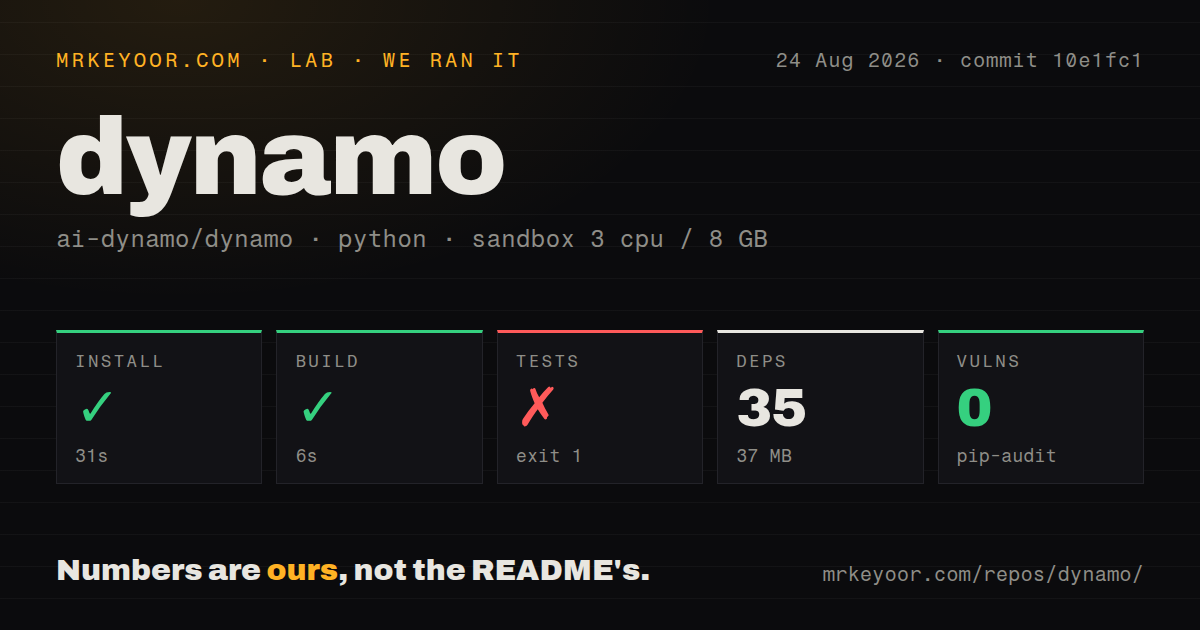
Our sandbox cloned commit 10e1fc1 and installed 35 Python packages in 31 seconds. Dependencies occupied 37 MB. The build succeeded in 6 seconds. The checkout was much larger than that environment suggests: 5,359 files, roughly 1,217,646 source lines, and 120.2 MB. It included 41 CI workflow files and a tests directory, but no Dockerfile at the repository root.
Tests failed with exit code 1 after 6 seconds, before test collection produced a pass count. Pytest raised PytestConfigWarning while applying warning filters because it could not import the pydantic module named in a filter for a Pydantic deprecation warning. The supplied log does not show a model, GPU, or service starting. Pip-audit found 0 known vulnerabilities in the installed Python environment. Our run therefore validates a narrow package build, not distributed inference.
Production means Kubernetes, GPUs, and pinned backend versions
The fastest documented trial pulls a prebuilt NVIDIA container, starts a frontend and worker, and loads a small model on a GPU. Python installation supports SGLang or vLLM extras; TensorRT-LLM needs an additional NVIDIA package index. Production guidance recommends the Dynamo Platform on Kubernetes, with model, backend, hardware, and latency objectives expressed in a custom deployment resource.
Release v1.4.1 pins distinct versions of SGLang, TensorRT-LLM, vLLM, NIXL, UCX, and several companion components. CUDA 13 variants are listed for the three main backends in that release. Those pins are part of the product, because a mismatch can affect routing events, object transfer, or request parsing. Upgrade review should include container digests, drivers, CUDA, engine behavior, operator changes, and API regression tests.
File discovery removes two services from a local trial
Dynamo can use file-based discovery for local development, so etcd and NATS are not mandatory. Kubernetes uses native custom resources and EndpointSlices for discovery, and TCP carries requests between components. KV-aware routing can operate without NATS through prediction-based routing. Slurm or other distributed environments may choose etcd or NATS JetStream-backed modes when their topology calls for them.
This flexibility prevents a simple trial from requiring a full control plane. It also creates several supported topologies that must be documented internally. Operators should record which component owns discovery, whether KV events are enabled, how workers advertise readiness, and what happens when event state is stale. A local file setup proves process wiring; it does not represent failure recovery across a cluster.
Open bug reports touch output correctness and wasted work
Issue 13602 reports that documented SGLang Kubernetes manifests pass a flag that disables the grammar backend, allowing a structured-output request to return HTTP 200 with content that does not satisfy its JSON schema. That is more serious than a visible request failure because a client may trust the status code. Any system using constrained generation should validate returned structure independently during evaluation.
Issue 13691 reports that an SGLang prefill job can continue after a client disconnects before the first token, leaving new work queued behind a request nobody will receive. Issue 13830 describes a standalone endpoint picker failing a large tokenization request after a hardcoded 5-second timeout instead of falling back to load-only routing. These reports are specific configurations, but they belong in capacity and cancellation testing.
Release 1.4.1 is current, with a very busy project queue
GitHub showed 7,869 stars, 1,316 combined issues and pull requests, and a push on August 26, 2026. Release v1.4.1 arrived August 22 with classify and pooling endpoints plus fixes for a stuck router overload mark, log-probability token IDs, and vLLM-Omni object transfer. The activity is unmistakable; the combined open count is not a defect count in a repository that tracks design work and many automated changes.
Dynamo deserves evaluation when an inference team can name the cluster problem it needs to solve: redundant prefill, independent phase scaling, cache movement, topology-aware placement, or coordinated cold starts. The failed pytest startup in our 3-CPU sandbox is a packaging warning to clear first. The decisive trial must then use production-like GPUs, models, request shapes, cancellation, and failure injection.