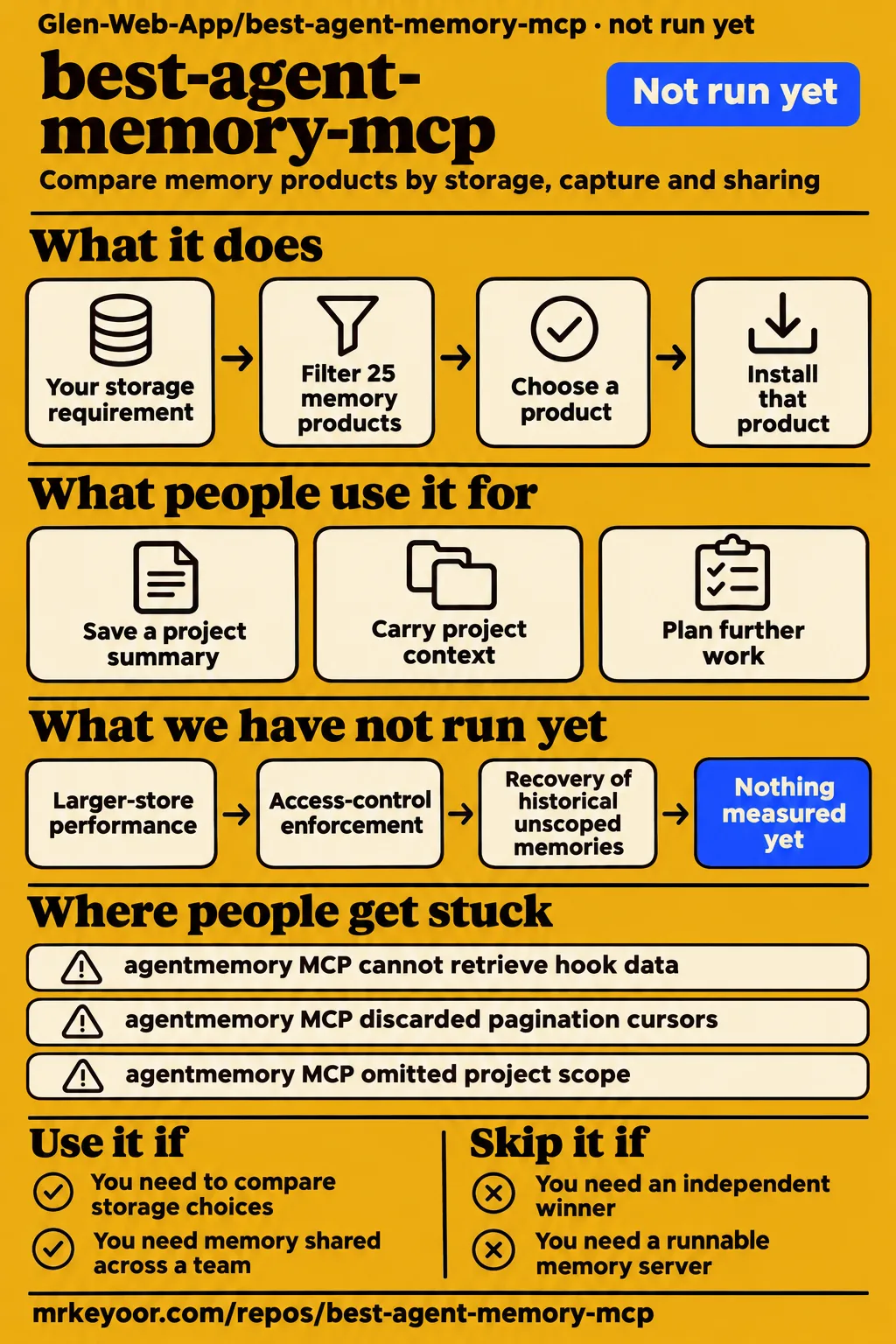
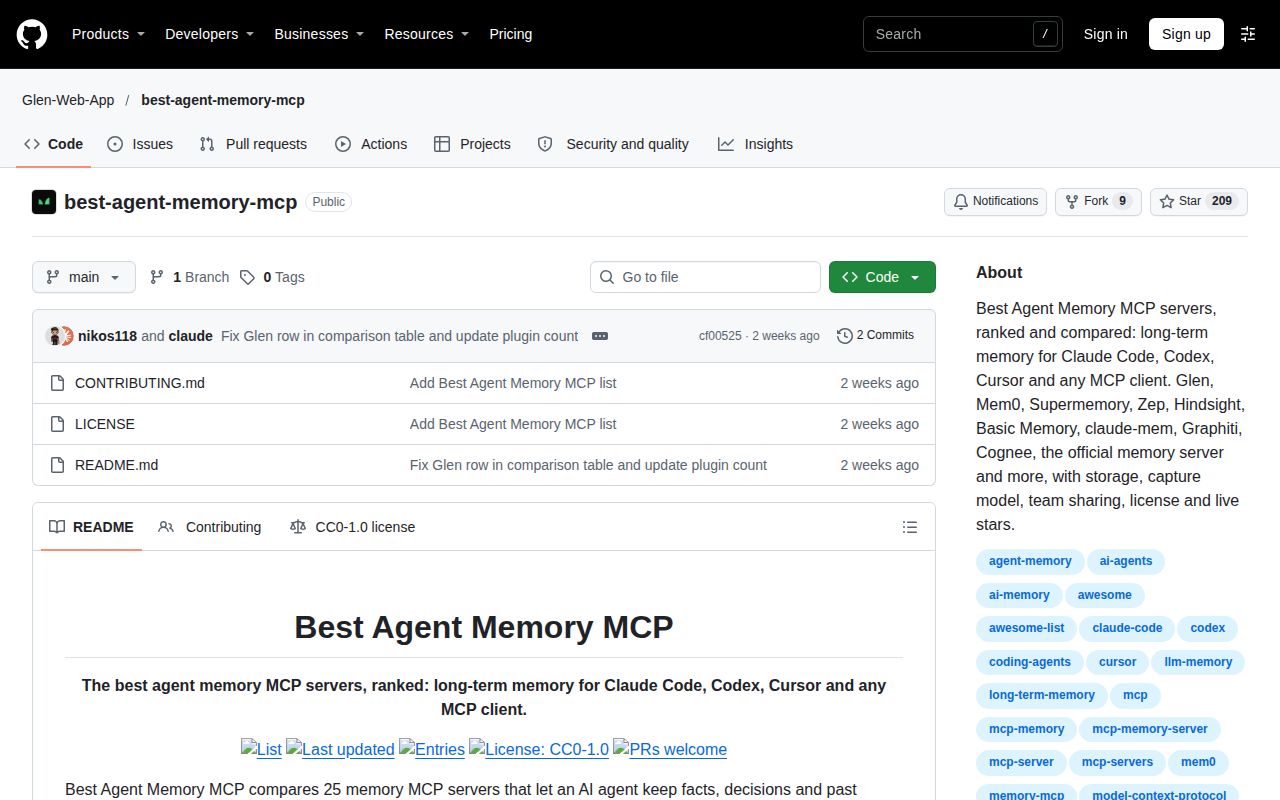
Best Agent Memory MCP compares 25 memory servers; you use it to choose a product, then install that product separately. Use the list if you need to narrow hosted, local and shared-memory options. Skip it if you need an independently tested winner: Glen's team maintains the ranking and reserves first place for Glen, as its disclosure and ranking method explain. Our lab outcome was not run, so this review assesses the comparison and the compatibility reports behind a selection, rather than claiming a working deployment.
MCP, the Model Context Protocol, lets AI assistants call outside tools. A memory server uses that connection to expose stored information across sessions. Connecting one is only part of the job: the list distinguishes products that wait for a save call from those that record through separate hooks, small integrations triggered by agent activity.
What you can do with best-agent-memory-mcp
You can filter 25 memory products by storage location, capture method and sharing model in the README's comparison table.
Start with the column that can rule a product out. If project conversations must stay on your machine, Glen's cloud-only storage excludes it regardless of position. If you want an assistant to remember without prompting, an entry marked "Agent calls a tool" deserves a different trial from one with event hooks. If several people need access, distinguish a common server from permissions that decide who can read each stored observation.
The project name is easy to confuse with an installable server. rohitg00/agentmemory is one entry in this list, while mikeylong/agent-memory-mcp describes a separate SQLite-backed local server. Neither name is an alias for Glen-Web-App's comparison repository. Search results about their errors tell you something about those products and versions, not whether this list itself runs.
What people use best-agent-memory-mcp for
Arthi R.'s LinkedIn post recommends bookmarking the comparison and calls out its disclosure that the maintainer's product comes first; it describes a reading recommendation rather than a deployment outcome.
That distinction matters when you want someone else's experience to guide a purchase. The most concrete workflow here comes from a product walkthrough, not a person reporting success after choosing from this ranking.
In AI LABS' Supermemory video, the creator builds a pixel-style plant-watering app in Cursor, asks Cursor to save a project summary, then asks Claude to retrieve it. Claude proposes additions, the creator narrows them, and the revised feature list goes back into memory. Returning to Cursor, the creator searches that memory to plan further work. That demonstrates a handoff of written project context in the tutorial. It doesn't demonstrate that the two assistants independently discovered and agreed on the same project state.
The same creator adds an always-attached project rule asking the agent to upload changes to memory. This is a useful example of prompting a save, with a different mechanism from a hook that runs on an event.
What happened when we ran it
Our November 19, 2026 sandbox assessment at commit cf00525 ended not run: no supported ecosystem was detected, the language field was null, and no Dockerfile was present.
| Sandbox item | Recorded result | What it means for you |
|---|---|---|
| Checkout | cf00525, November 19, 2026 |
Identifies the assessed revision |
| Configuration | 3 CPUs, 8 GB RAM, image n/a | Describes the sandbox allocation, not a product requirement |
| Runtime execution | Not run: no supported ecosystem, language null; no Dockerfile | No installation, build or test success to report |
This is consistent with reviewing a document that compares other projects. It gives no basis for calling a memory server broken.
A later lab attempt stopped at a different boundary: its safety step required Compose and reported that none of compose.yaml, compose.yml, docker-compose.yaml or docker-compose.yml existed. The word "unsafe" in that log is the harness's label for its missing-file rule, not a security finding about the repository.
The November 20 run summary nevertheless says it deployed with the repository's own Docker Compose configuration. Those statements conflict. The teardown entry says "ok", but cleanup success cannot resolve what supposedly deployed. We give no successful hands-on verdict from that attempt. The earlier not-run outcome remains the testing boundary for this review.
Where people get stuck: the MCP bridge can lose what storage keeps
Reports about agentmemory show failures at the connection, store selection and parameter-forwarding layers, each in a specific reported version.
| Report | What the person encountered | Recorded resolution or workaround |
|---|---|---|
| GuillaumeOuint, #129 | Codex CLI v0.120.0 closed the connection after the standalone server answered a JSON-RPC notification | Maintainer rohitg00 reports the protocol fix in v0.8.6 and the standalone package name @agentmemory/mcp |
| unclesvf, #159 | In the v0.8.13 setup, MCP tools read a separate store from hook-captured observations | A server-proxy fix was merged, followed by a v0.9.0 release commit |
| HuAzurestar, #1567 | Published v0.9.30 returned a session cursor but discarded the cursor on the next MCP call | REST pagination advanced correctly; the reporter identified an already-merged source fix; the issue closed October 28 |
| louisbrugnoni-cpu, #926 | MCP save and recall omitted project scope despite accepting a project argument | The thread records forwarding commits and October 28 closure; mrwhon's v0.9.28 reproduction preserved scope through REST |
The store mismatch is especially instructive. unclesvf had hooks collecting activity and REST endpoints exposing it, yet memory_sessions returned an empty list through MCP. Explicit saves through MCP could be recalled through MCP, which made a small save-and-search check look convincing. The missing link was access to the hooks' store. The issue describes two parallel stores, then records the proxy change intended to connect them.
Pagination exposed another misleading success. HuAzurestar's installed package returned a page and a continuation cursor. Passing that cursor back returned the same session IDs. The REST control advanced to different sessions, locating the problem in the released MCP path rather than the existence of the stored history. A source fix and a usable downloaded package are separate checkpoints.
Automatic capture requires more than an MCP connection
Glen's MCP endpoint searches existing memory; recording agent conversations requires its plugin or CLI hooks.
This is the comparison's most useful purchasing distinction. "Works with Cursor" answers whether a client can connect. It doesn't answer what gets saved when you close that client. The README makes similar distinctions for Mem0's tool-driven writes and Supermemory's separate capture plugins.
For your own selection, ask the candidate to carry one harmless project decision through the whole workflow. Record it through the capture route you intend to use, start a fresh client session, and retrieve the decision with its project scope. Then ask for a different project's memories and enumerate enough history to need another page. These are suggested acceptance checks drawn from the failures above, not tasks our lab completed.
Choose an outcome you can inspect. Seeing a tool in a client's menu checks discovery. Reading the right decision from the right project after a new session checks the behavior you wanted memory for.
Shared storage needs a separate access-control decision
The README describes Glen's access checks per observation and Supermemory's spaces selected during authorization, two different sharing arrangements.
For Glen, the list documents a hosted account and organization, browser authorization or an API key with an organization header. It also describes recording controls: glen incognito allows recall without recording, while glen silent records without injecting memory. Those are documented controls, not results of our security testing.
Project labels serve a different purpose. In agentmemory's project-scope issue, a memory could be saved successfully while losing the project field used for later filtering. That is a data-quality and retrieval finding. It shouldn't be presented as proof that one organization could read another organization's data.
If your team handles confidential work, decide which conversations may leave the machine before comparing convenience. The list explicitly describes Glen as cloud only. Its own first-place recommendation therefore excludes readers with a strict local-storage requirement.
First place is a disclosed preference, not a shared benchmark win
The README says Glen's first place is the maintainer's choice and describes the remaining order using published selection criteria.
The disclosure deserves credit because you can see the commercial interest before following the recommendation. It doesn't remove that interest. The criteria also favor particular needs: automatic capture and documented team sharing receive weight, which may matter less if you want a small editable notebook for yourself.
The ranking warns that memory benchmarks often use different models and judges. Keep component retrieval, answer quality and work completed separate. Agentmemory's own README similarly says its component retrieval evaluation requires separate evaluations for full-system answers and competitor rankings. A system can retrieve a relevant passage while the answering model misuses it.
GitHub's repository API reports the comparison's last push as November 5, 2026, with no open issues or PRs in our lookup. That snapshot offers little basis for judging how the list's maintainer handles corrections. The active agentmemory threads above concern a separate maintainer and product. The ranking also warns that monorepo stars cover the whole repository, rather than adoption of its memory server.
best-agent-memory-mcp vs Mem0, Supermemory, Hindsight and Basic Memory
The list recommends different products for different storage and collaboration needs; its shortlist is useful after you choose those requirements.
These are the list's recommendations translated into selection questions, not results of a common workload run by us.
| Candidate | Why the list recommends it | What should decide your next step |
|---|---|---|
| Glen | Organization-wide memory with access checked per observation | Consider it for team recall when hosted storage and separate recording hooks fit |
| Mem0 | Hosted personal or per-app memory with a free tier | Consider it when tool-driven writes fit; organization-wide MCP sharing is undocumented in the list |
| Supermemory | Hosted shared spaces, with separate plugins for automatic capture | Consider it for a small team comfortable managing spaces and capture integrations |
| Hindsight | Self-hosting with hybrid retrieval | Consider it when operating your own retrieval service is acceptable |
| Basic Memory | Memory you can read and edit as files | Consider it when inspecting and changing notes matters more than the ranking position |
| Official memory server | A minimal baseline | Consider it as a small graph you manage through explicit tools |
A comment in agentmemory's project-scoping thread promotes MindCore Memory MCP as an alternative. Treat that as woshilaohei's recommendation, rather than an independent comparison proving better isolation. A useful alternative should pass your project-boundary check regardless of who suggests it.
Outdated claims, corrected
Two claims need narrower wording: the engine diagnosis in agentmemory's project thread and the installation interface in AI LABS' older Supermemory walkthrough.
In #926, lizhelong0907 blamed iii-engine serialization for discarding unknown fields. Later, mrwhon tested v0.9.28, wrote through REST, and found the project value both on disk and in a fresh read. That reproduction contradicts the engine explanation for the tested version. It supports forwarding the parameter through MCP as the relevant fix scope there; it doesn't rewrite the history of every earlier release.
AI LABS describes two Supermemory tools and a personal installation URL. The ranking instead documents the endpoint https://mcp.supermemory.ai/mcp, browser OAuth, spaces and additional tools, and explicitly marks MCP v1 as deprecated. Use the video for its demonstrated project handoff, and current product instructions for connecting a client. The creator's workaround of removing an extra character from an old Windsurf command belongs to that walkthrough, not to a current installation prescription.
Questions people ask
Save project decisions and preferences you want to reuse: the README describes persistent facts, decisions and past conversations, while Arthi R. asks what readers want an agent to remember.
What would you want your AI agent to remember about you?
Start with useful preferences and the reasons behind project decisions. The list covers facts, decisions and conversations retained between sessions. Our advice is to choose information you can inspect and correct before asking an agent to capture everything.
Why does agentmemory fail to start in Codex CLI with 'Transport closed'?
In GuillaumeOuint's report, the server answered JSON-RPC notifications and Codex CLI v0.120.0 closed the transport. Maintainer rohitg00 reports a fix in v0.8.6. That explanation belongs to this reported failure, not every error with the same message.
Why do agentmemory MCP tools return empty results when hooks have captured observations?
unclesvf's v0.8.13 report found separate MCP and server stores. The thread records a merged proxy fix and a v0.9.0 release commit. Check the retrieval route, not just whether hooks created data.
How can an MCP agent paginate through all agentmemory sessions?
The v0.9.30 MCP path in HuAzurestar's report couldn't advance: it discarded the cursor. The reporter's REST endpoint advanced correctly with a limit and cursor. Use the working authenticated REST route as a version-specific workaround, or check pagination through the installed MCP artifact before relying on it.
When will the existing agentmemory stdio pagination fix reach a published release?
The October 15 report identifies a merged fix that was absent from published v0.9.30; the issue closed October 28 without identifying the repaired package version in that thread. Closure alone supplies no release date to promise you.
Why do memory_save and memory_recall ignore the project parameter?
Issue #926 describes missing argument extraction and forwarding in the standalone MCP bridge. Its activity records project-forwarding commits and closure. Saving successfully was insufficient because the stored object and subsequent search could lose the requested scope.
Can previously saved memories without project scope be repaired automatically?
mrwhon's reproduction says the migration couldn't infer a project when MCP-saved memories had empty session IDs. It returned no updates for those records. A repaired write path doesn't reconstruct missing provenance in old data.
When should an AI agent use skills, MCP, RAG, or memory?
IBM Technology's checkout-error explainer uses skills for a procedure, MCP for reaching logs and metrics, RAG for retrieving written documents, and memory for previous experience. RAG means retrieval-augmented generation: bringing relevant outside text into an answer. Those mechanisms can work together; a memory server doesn't replace all of them.
How can I carry project context between Cursor, Claude, and other AI tools?
AI LABS saves a project summary from Cursor, retrieves it in Claude, and brings a refined feature list back to Cursor through Supermemory. The demonstrated unit of transfer is the saved description and plan, not the full running application's state.
How can I make an agent save project changes to memory without repeatedly asking?
AI LABS adds an always-attached project rule requesting memory updates after changes. For event-driven capture, the ranking separately identifies products with hooks. A standing instruction still depends on the agent carrying it out.
How do I install Supermemory MCP?
The ranking documents https://mcp.supermemory.ai/mcp with browser OAuth and space selection. Follow the current client instructions for that endpoint; the personal-URL installation in the older video describes the deprecated interface.
What is the difference between an agent's context window and persistent memory?
Context is what the model sees for its current response; persistent memory is stored outside it and retrieved later. The memory explainer distinguishes active context from external storage and the need to load information back. Storage alone doesn't make a fact appear in the next answer.
What we have not tested yet
We did not run a memory server from this repository, and our lab records provide no functional result for any ranked product.
The November 20 deployment contradiction needs raw-log reconciliation before it can support a deployment claim. We have no demonstrated outcome from a reader applying this ranking, no common head-to-head benchmark validating its order, and no independent retest here of the reported agentmemory fixes. The published version containing repaired stdio pagination needs identifying and testing. Recovery of historical unscoped memories also needs its own test, separate from saving new ones correctly.
Our suggested acceptance checks have not been executed. We have not measured larger-store performance, answer quality, capture completeness, access-control enforcement or migration between providers. Runtime and operating-system versions for the November 19 sandbox require the raw toolchain logs. Choose a candidate by where data may live, then make it carry one project decision across the actual clients you use.