Short answer: audit the cases before trusting the gain
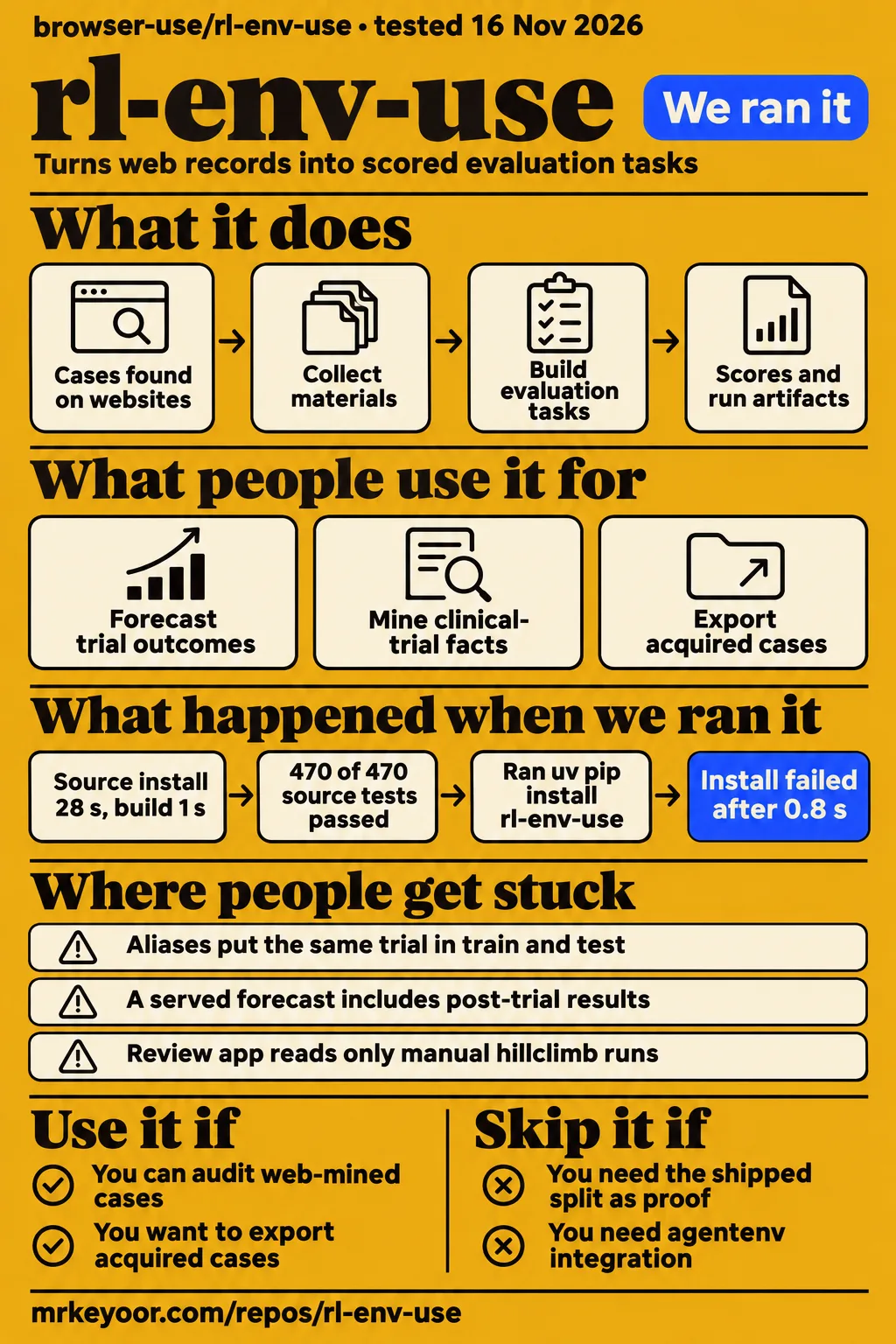
Our sandbox passed all 470 tests at commit 92fe423, but the reported Qwen improvement needs a separate audit of trial identity and observation dates. Use rl-env-use if you can inspect the cases and want web records turned into a scored evaluation. Skip it if you need the shipped clinical-trial fixture to justify a model purchase without checking its inputs. Passing software tests and a valid experiment answer different questions.
Browser Use's rl-env-use builds evaluation environments from web-mined cases and can optimize a model's system prompt. In the reported experiment, model weights stayed fixed. AlphaSignal reports a $72 environment build and an $8 prompt climb, so the cheaper number covers one later stage. The useful decision is whether its case-acquisition workflow saves you work while leaving enough evidence to inspect the result.
What people use rl-env-use for
Browser Use used the shipped example to forecast clinical-trial outcomes and used its mining agents to collect trial and genetic-variant evidence. These are attributed vendor experiments, rather than customer deployments or our own model runs.
| Who used it and for what | Reported outcome | What the outcome tells you |
|---|---|---|
| Browser Use built the shipped clinical-trial forecasting environment and optimized Qwen's prompt. | 35 forecasts from 29 trials; Qwen rose from 0.53 to 0.78 across 16 held-out tasks. | A worked example of acquiring cases and changing a prompt while keeping weights fixed. Experiment account |
| Browser Use mined clinical-trial facts and genetic-variant evidence from websites in internal comparisons with Claude Code. | 17 trial facts and four complete cases across eight missions versus zero verified facts; 40 genetic-variant facts versus six. | A narrow comparison of evidence acquisition under the vendor's configuration. Mining comparison |
The distinction between mining and solving matters. The project skill documentation says browser agents collect materials and their outcomes, while the model under test reads the materials without a browser. For a forecast, the earlier protocol belongs in the observation and the later result belongs in the answer key. Keeping those two roles apart is the central engineering job here.
You can also export the dataset for an external RL trainer or serve tasks through Python's Env interface, according to the same documentation. That gives a team a way to reuse acquired cases without adopting prompt hillclimbing as its training method. The showcased prompt result is a reason to inspect the workflow, not a demonstration of weight training.
What happened when we ran it
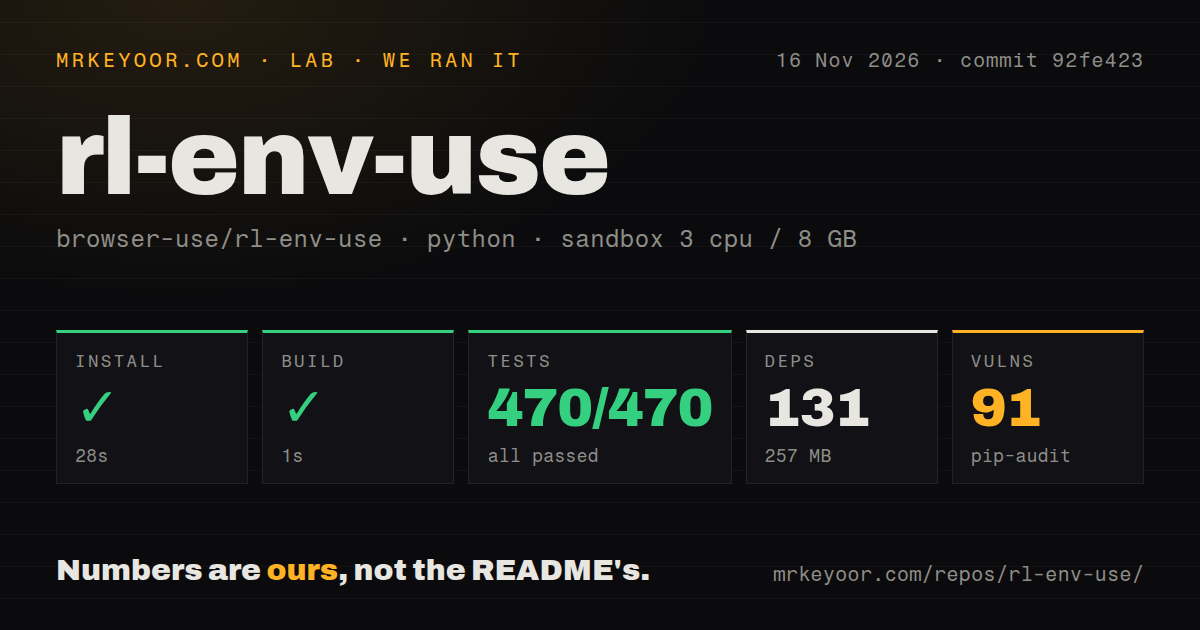
Our source install succeeded in 28 seconds, the build succeeded in 1 second, and pytest passed 470 of 470 tests in 16 seconds. We ran commit 92fe423 on 2026-11-16 in a sandbox configured with 3 CPUs, 8 GB RAM and image label ghcr.io/astral-sh/uv:python3.12-bookworm. Those are repository checks. They give a developer concrete evidence that this checkout can be installed and exercised in that sandbox.
| Check in our sandbox | Recorded result | Consequence for a reader |
|---|---|---|
| Install | Succeeded in 28 seconds; 131 dependencies; 257 MB on disk | The tested source setup completed. |
| Build | Succeeded in 1 second | The build succeeded in 1 second. |
| Tests | Succeeded in 16 seconds; 470 passed, zero failed | All 470 pytest tests passed in 16 seconds. |
| pip-audit | 91 known vulnerabilities | Dependency review belongs before deployment. |
| Repository scan | 308 files, about 9,647 source lines, 29.5 MB checked out | A Python repository with a tests directory. |
| Automation and packaging scan | Zero CI workflow files; no Dockerfile detected | The scan found neither of those repository artifacts. |
A separate quickstart recipe in the pack attempted a registry install and stopped with "rl-env-use was not found in the package registry." Its summary nevertheless says it installed from PyPI, which conflicts with the step and finding records. We use the failure record for that attempt, and the supplied source-run measurements for the successful install above. Failed registry step and install-failed finding describe a failed route, rather than a broken forecasting engine.
The separate recipe recorded its clone step in 2 seconds, then its registry-install failure in 0.8 seconds with exit 1. Its install log identified Python 3.12.12 at /work/venv. Its run summary describes commit 92fe423137c0 and an unprivileged container with 2 CPUs, 4 GB RAM, no published ports and no secrets; that configuration belongs to the failed recipe. Clone step, install log and run summary preserve those records.
The practical response is to follow the project's source-clone instructions. The README reproduced in the pack and the upstream installation guide point readers at a repository checkout. A passing suite is useful when deciding whether to inspect or extend the code. It cannot decide whether two aliases refer to the same underlying trial or whether a protocol observation contains information from after the forecast date.
Where people get stuck: identity, inputs and missing traces
Issue authors report distinct failures in case splitting, forecasting inputs, trace selection and comparison handling. The following checks are our recommended response to those reports, rather than descriptions of an upstream patch.
| Report | What the issue author says happens | What to inspect or change |
|---|---|---|
| Issue #1: case aliases | Different case strings can identify the same clinical trial across train and test. | Normalize trial identifiers before splitting; compare canonical identifier sets across both partitions. |
| Issue #2: protocol-only inputs | A served forecast includes post-trial participant-flow results. | Inspect the actual served context and source dates; exclude post-trial material from the forecast observation. |
| Issue #3: annotation traces | The review server reads manual hillclimb runs, leaving automatic-climb and model-comparison traces inaccessible there. | Track the run directory and identity explicitly; the issue requests flow selection. |
| Issue #4: solving comparison | The Claude Code control discards supplied context and asks for web use. | Give both solving arms equivalent materials before interpreting their relative scores. |
| Issue #5: missing executable | Missing Claude becomes a zero-yield terminal summary despite a saved infrastructure error. | Check executable availability and inspect the saved comparison JSON. |
| Issue #7: probability parsing | An extremely long fraction raises ValueError instead of receiving zero reward. | Bound numeric parsing or catch conversion errors at the grading boundary. |
The split report concerns distinct literal case strings that identify the same trial. A useful acceptance check therefore compares the entities represented by the rows, alongside the row IDs. Normalize ClinicalTrials.gov identifiers before creating partitions, then compare the resulting identifier sets. That addresses the reported defect more directly than checking that two files have different row identifiers. Issue #1 describes the case-alias defect.
The forecast-input report is similarly concrete. The author reports participant-flow results inside the observation returned for a protocol-only endpoint forecast. Checking only whether the endpoint answer appears would miss the timing problem: a table can contain information published after the forecast date without stating that endpoint answer. Inspecting the served observation, including its tables, is therefore part of checking the task contract. Issue #2 documents the served observation.
The reported 0.78 score is not 78% accuracy
A constant 50% forecast scores 0.75 under the reported benchmark's probabilistic scoring rule. That reference point belongs beside Qwen's reported 0.78, because a reader otherwise has no way to interpret the number. AlphaSignal explains the scoring baseline and reports that Browser Use attributed most of the gain to calibration, including discouraging predictions of exactly zero or one.
The reported climb considered 12 prompt changes and retained one, introducing base-rate priors by question type. Its paired 95% confidence interval for improvement was +0.07 to +0.45. That is a result on a small forecasting task set, with uncertainty visible in the interval. It is more useful to a prompt engineer studying confidence calibration than to someone looking for a general league table of model intelligence.
Read the cost the same way. The $17 browser-mining spend was included in the $72 environment build, while the $8 prompt search followed it. Those vendor figures describe the example's stages. Before approving spend, inspect the acquired cases and use the documented dry-run pricing step on the environment you intend to evaluate. The installation guide describes that pricing command.
Security and scale: inspect dependencies and preserve provenance
Our pip-audit result reported 91 known vulnerabilities, which makes dependency review a deployment task even though the repository checks passed. The upstream installation guide also asks for Browser Use and OpenRouter credentials, and recommends a private permissions setting for the local credentials file. Mining and model evaluation depend on those external services. Keep the credentials outside exported datasets and inspect artifacts before sharing them.
The project workflow stores mined materials and outcome facts in kb.json, drafted tasks with gold answers and checks in tasks.jsonl, and the latest audit in audit.json. Its saved review verdicts and model-comparison directories give readers specific artifacts to inspect. Preserve those records with an exported dataset so later reviewers can trace a task back to its materials and distinguish a grading decision from the model's answer.
rl-env-use vs Claude Code and other evaluation workflows
The clearest comparison is how cases enter the evaluation: rl-env-use mines paired web records, while the Anthropic workflow it adopts can start with production or synthetic cases. AlphaSignal describes that difference. If you already possess suitable cases and answer keys, acquiring new ones from the web may solve a problem you do not have.
| Alternative or comparison | Why consider it | How to read the evidence |
|---|---|---|
| Claude Code with WebSearch and WebFetch | Investigate it when you want a general coding agent to search and retrieve sources. | Browser Use reports higher verified-fact yield in its narrow mining comparison. That is a vendor result. Reported comparison |
| Anthropic's eval-design and hillclimbing workflow | Start with it when production examples or synthetic cases already supply your evaluation. | rl-env-use changes case acquisition, rather than proving the entire optimization method superior. Workflow lineage |
| Claude Opus 5.5 and GPT-6 Astra on the shipped forecast task | Use them as reference models for this particular evaluation. | The reported scores are 0.77 and 0.81, alongside climbed Qwen at 0.78. Score comparison |
Two actual projects deserve separate consideration. Claude Code's README describes a terminal coding tool that handles routine tasks, code explanations and git workflows. AgentEnv Framework is an SDK and CLI for building and running agentic environments and their graded tasks, according to its upstream README. Consider it when execution infrastructure is your main need. Its proposed rl-env-use adapter is discussed in issue #6.
What the other reviews get wrong
The promise that frontier models do not saturate these environments is broader than the project's own operating guidance. The supplied synthesis quotes the skill documentation describing frontier saturation on derived SEC-filing computations and recommending forecasts or a panel from the intended smaller-policy family. Difficulty depends on the task and the evaluated policy, rather than on a blanket property of every generated environment.
The MindPattern listing repeats rejection of leaked or memorized tasks. That describes intended filtering. Issue #2 reports a concrete protocol-only input containing later results, so a reader should inspect served observations rather than convert the filter description into a guarantee. Likewise, the split-by-case wording needs the canonical-identity check in issue #1 before it can mean trial-level separation.
The annotation instructions also need a qualification: the documented automatic climb writes into a different directory from the one the review server reads, according to issue #3. A completed climb and an empty Traces tab can coexist. Finally, AlphaSignal's account says weights remained fixed. Calling the $8 prompt search a full RL training run would give a buyer the wrong cost expectation.
Questions people ask
Issue #1 reports that aliases can put the same clinical trial in train and test despite distinct case strings. That is the first question to resolve when interpreting the shipped forecast example. The other questions below address served inputs, trace selection, comparison failures, installation and grading, using the project documentation and the supplied issue reports.
Can aliases for the same clinical trial leak shared cases into both train and test?
Issue #1 reports overlap between trials represented by otherwise separate case strings. Normalize ClinicalTrials.gov identifiers and check their intersection before treating a split as trial-disjoint. The issue describes shared input materials as well as shared trial identity, so comparing task IDs alone misses the reported problem. Case-split report
Does the protocol-only forecasting environment exclude results published after the trial?
Issue #2 reports post-trial participant-flow results inside a served protocol-only forecasting observation. A protocol-only contract therefore needs a date audit of the actual context, including tables. Read the material supplied to the model, rather than checking only links or the presence of the endpoint answer. Observation report
How can I select and annotate traces from an automatic climb or model-comparison run?
The reported review server reads only the manual hillclimb directory and offers no flow selector. Issue #3 requests selection of automatic-climb and model-comparison runs with their identities preserved in annotations. Keep the selected run's directory attached to your review work rather than assuming the Traces tab represents the last command. Trace-selection report
Does the Claude Code solving comparison receive the same case materials as the normal solver?
Issue #4 says the control receives the question, drops context and asks for web use, while the normal solver gets materials and question. Its offline fixture replaces the Claude adapter and final report rendering while using the real loader, solving control, grader and result writer. Check input equivalence before interpreting this comparison. Solving-input report
How can I tell whether a zero-yield Claude mining result means no facts were found or the executable failed?
Inspect the saved comparison JSON for an infrastructure error such as FileNotFoundError. Issue #5 reports that a missing claude executable can still produce a zero-fact terminal summary and successful exit. Check that the executable is available before starting the optional comparison, and exclude failed arms from yield comparisons. Missing-executable report
Can I run Browser Use, Claude Code, pi or another agent harness against rl-env-use through agentenv?
Issue #6 proposes that integration, including agent adapters and exports carrying the grader. The documented current routes are the CLI, dataset export and Python Env interface. Use the integration proposal to understand the requested workflow, and the project documentation for the existing workflow.
Why does an extremely long probability fraction crash Env.reward instead of scoring zero?
Issue #7 reports unbounded digit matching followed by int conversion. Its reproduction uses 4301 digits on each side of a fraction; the reported Python conversion limit is 4300 digits. The suggested repair is bounded parsing or handling the conversion exception so malformed output receives the documented zero reward. Reward-boundary reproduction
How do I install the rl-env-use skill and its required dependencies?
The upstream guide requires Python 3.11 or later, a stable repository clone and its own virtual environment, plus Browser Use and OpenRouter API keys. It documents an editable source install and linking the repository into your agent's skills directory. Node.js 18 or later is optional for HTML reports. Follow install.md, rather than a directory listing's incomplete copy instructions.
What are RL environments, and what can beginners use them for?
In rl-env-use, an environment contains cases, tasks and gold answers that the project uses to evaluate answers and optimize a model's prompt. Browser agents acquire materials and outcomes; the model under test answers from the materials without a browser. Beginners can start by inspecting those roles in the shipped example. Project workflow
What we have not tested yet
Our source checks do not reproduce Browser Use's mining yields, paid environment creation, prompt climb, or the published model scores. The effect of the reported split and temporal-contamination defects on those scores is unquantified. Issue #2 does not establish direct exposure of the QoR-40 endpoint answer. The comparison fixtures do not prove that the published mining results suffered from the executable or solving-input failures, and the deliberately wrong answer in issue #4 is not a model-accuracy measurement.
The issue authors identify source commit 92fe423137c01178692bf0a26c769b20438f9c5f and package version 0.1.0. Their runtime details belong to their reproductions, not our sandbox. Our container image label does not establish the actual interpreter or operating-system version. We have not inspected raw toolchain logs, advisory severity or exploitability, sustained concurrency, authentication boundaries, or network behavior. The sampled issues are open and supply no completed fixes; issue #6's example commands describe a proposed integration.
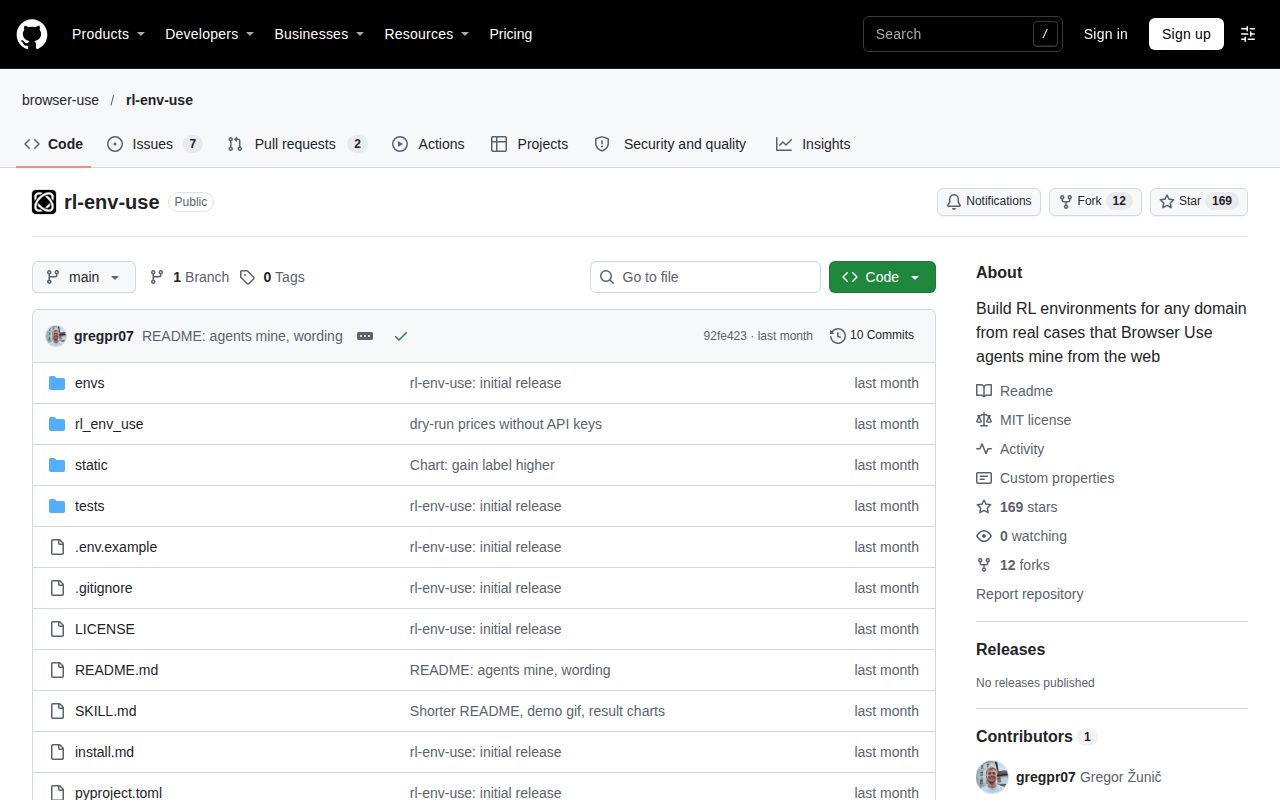
Independent replication and broader adoption remain unestablished in this evidence. The supplied video introductions support no independent rl-env-use deployment result or substantive explanation of environment optimization. The vendor's task scores do not demonstrate general model equivalence, and its costs do not price future sources or retries. The supplied GitHub metadata records 169 stars on 2026-11-16; a null latest-release lookup does not prove the absence of releases. The next useful experiment is a fresh model run after canonicalizing trial identity and excluding later material from protocol-only inputs, with the resulting cases and scores saved together.