One file can pin several language toolchains
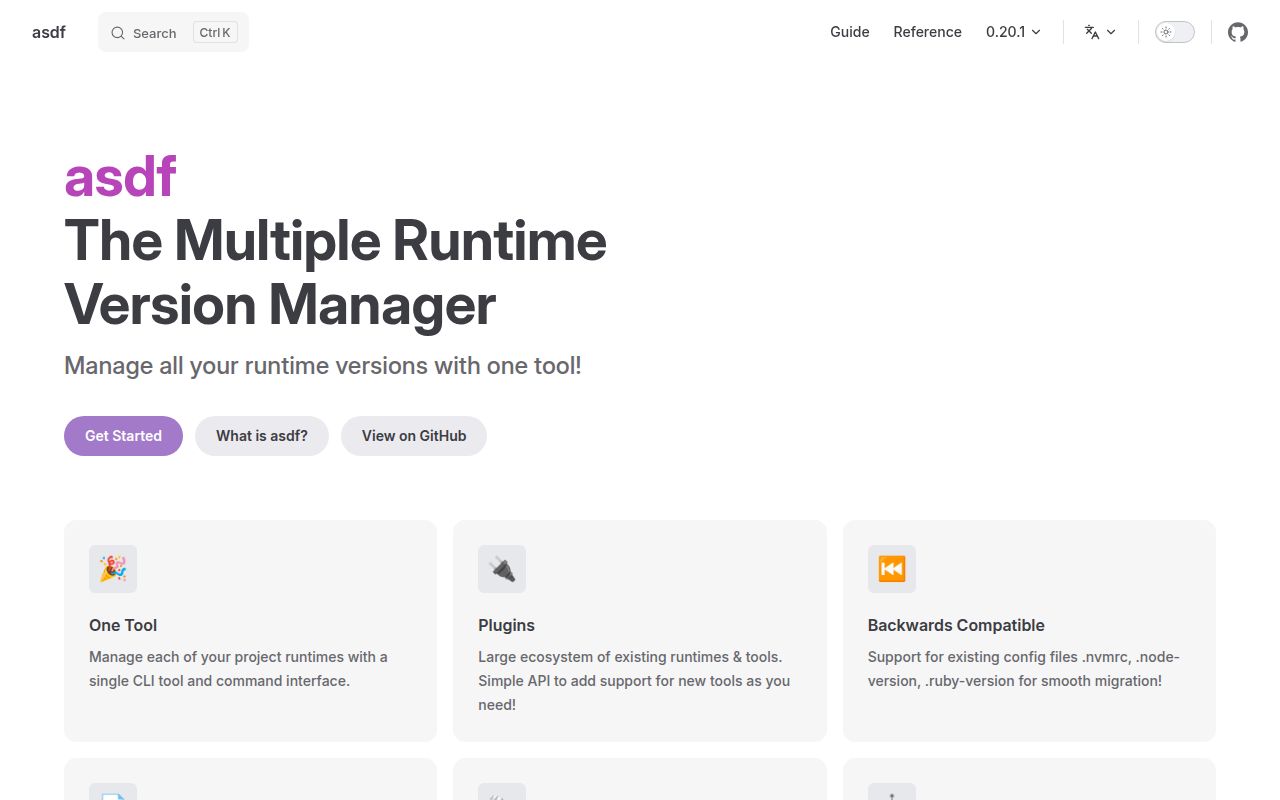
asdf gives a polyglot repository one place to declare tool versions. A .tool-versions file can select Node.js, Python, Ruby, Erlang, or any other tool for which you have installed a plugin. The core walks from the working directory toward your home directory to find that file, then its shims resolve the requested executable just before it runs. Environment variables such as ASDF_PYTHON_VERSION can override the file for one shell or command.
That shared vocabulary is the reason to choose asdf. A developer learns plugin add, install, set, and current once instead of memorizing a different interface for each language manager. The tradeoff is equally direct: the core does not know how to install Python or Node.js by itself. Each plugin supplies that behavior, its dependency list, and any hooks it needs.
The Go rewrite simplified the core and broke old commands
asdf 0.16 replaced the old sourced Bash implementation with a compiled Go binary. The current setup is straightforward for a new user: install the binary, put $ASDF_DATA_DIR/shims at the front of PATH, add a plugin, and install an exact tool version. Core itself still requires Bash 3.2.48 and Git 1.7.7.2, while the selected plugin may require more system packages.
Existing users have a migration, not an ordinary update. The upgrade guide tells them to preserve plugin and installation data, remove the old asdf.sh line from shell startup, and run asdf reshim. Commands also changed: asdf global and asdf local became asdf set, hyphenated forms disappeared, and self-update is gone. Teams with shell setup copied across laptops, CI images, and dev containers should schedule that work instead of changing the binary without a rehearsal.
What happened when we ran it
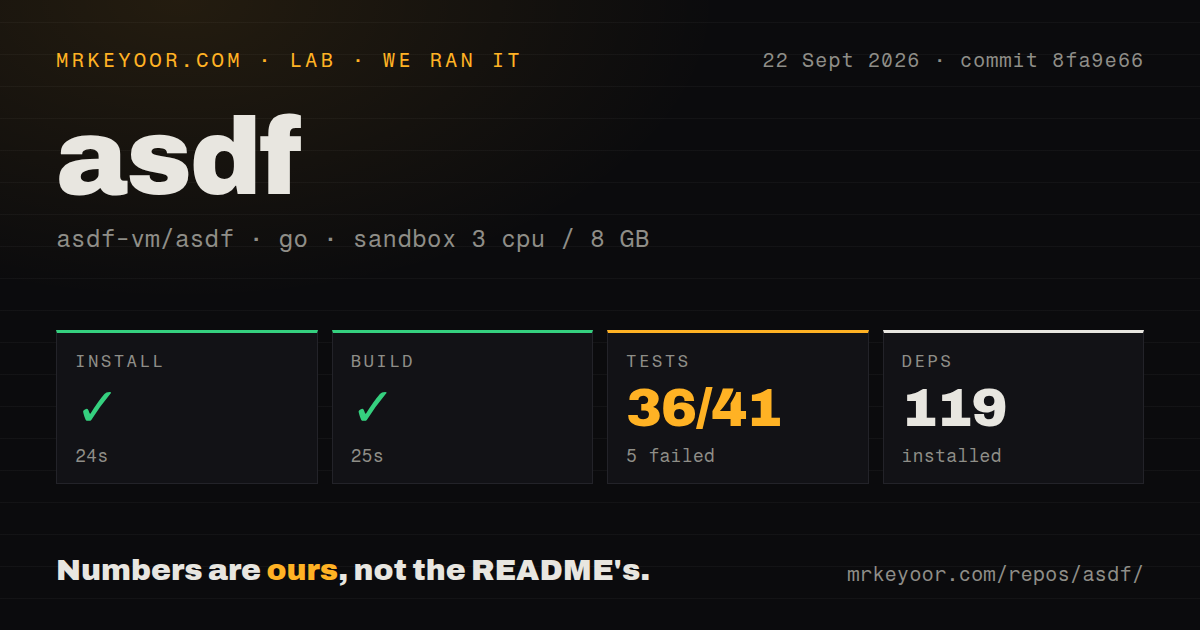
Our sandbox installed the commit 8fa9e66 checkout in 24 seconds, adding 119 packages. The build completed in 25 seconds. The repository itself was compact at 1.4 MB, with 270 files and about 11,013 lines of source. We found 6 CI workflow files, a tests directory, and no Dockerfile. Those are measurements from a fresh unprivileged Debian container with 3 CPUs and 8 GB of RAM.
The test command failed with exit code 1 after 11 seconds. Go test reported 36 passed and 5 failed out of 41. The tail of the log names TestWrite_WithEnvironmentWarnings in internal/info, shows that package failing, and then lists successful packages including installs, paths, plugins, resolve, shims, tool versions, and versions. The supplied tail does not include the failed assertion text, so it supports no narrower diagnosis. The useful result is simple: this release commit did not pass its full test step in our sandbox.
Plugin breadth moves part of the trust decision to you
The official security policy covers asdf core and explicitly excludes plugins, which remain the responsibility of their creators. That boundary matters because plugins download software, may compile it, and can run hooks around install, update, reshim, or removal. The documentation recommends adding a plugin by its full Git URL rather than relying on the short-name repository. A serious team should pin or review that source instead of treating every catalog entry as if the asdf maintainers shipped it.
Plugin dependencies also decide whether setup is truly quick. The Node.js example asks Debian users for dirmngr, gpg, curl, and gawk before the plugin runs. Other tools bring their own compilers and libraries. The 24-second core install measured on our box says nothing about how long Ruby, Erlang, or Python will take to compile, and we did not measure those downstream installations.
Concurrent reshim work can disrupt unrelated commands
Open issue 2315 describes asdf reshim <tool> removing all shims and rebuilding them in place, including shims owned by other plugins. A concurrent process can reportedly see a missing, empty, or only partly rebuilt wrapper. That is a small concern on one developer's idle laptop and a much sharper one on a shared build host, in parallel worktrees, or during an editor task that overlaps an automatic plugin reshim.
The issue was still open on September 22, 2026 and includes a self-contained reproduction against the Go implementation. We did not reproduce that race in our lab, so it should be read as an active upstream report rather than our own result. If CI jobs share one ASDF_DATA_DIR, isolate it per job or test the failure mode before standardizing on asdf.
v0.20.1 shipped the tag without downloadable binaries
GitHub recorded the last push and v0.20.1 release on September 22, 2026. The repository had 25,596 stars and 148 combined issues and pull requests when fetched, and the release notes list fixes for diverged plugin repositories, incomplete installations, shim naming, and help output. That is current maintenance, not a quiet archive.
The release page had zero attached assets, however. Open issue 2329 shows the upload job receiving HTTP 422 after immutable releases were enabled. Package-manager installation, go install, and source builds remain documented routes, but the README's easy precompiled-binary path was unavailable for that release when we checked. For a tool that sits in every shell, waiting for the published artifact or pinning a verified installation route is the sensible move.
Choose asdf when one shared file removes real tool sprawl
Our 24-second install and 25-second build make asdf cheap to evaluate, while the 5 failed tests prevent a blanket recommendation from this run. It earns a place on a polyglot team when .tool-versions replaces several competing files and everyone accepts responsibility for plugin selection. A Python-only or Node.js-only shop will usually get a smaller trust and maintenance surface from a dedicated manager.
For adoption, start with one representative repository and the exact plugins it needs. Audit their Git URLs and dependencies, migrate shell configuration deliberately, then run the same commands in parallel CI jobs before rolling out the shared shim directory. If that trial survives the failure modes your team can actually create, asdf's single command set is useful. If it does not, the convenience is not worth putting underneath every build.