OpenChoreo asks you to adopt an application model
OpenChoreo defines components, endpoints and deployment environments above Kubernetes resources. That is the adoption decision worth spending time on. If those definitions match how your organization delivers software, a shared platform could save your team from maintaining its own collection of conventions. If they do not, a developer portal alone will not settle the mismatch.
The README describes a Backstage-powered portal alongside a control plane, workload data plane and observability plane. A separate CI plane is optional. Developers describe what they want to run, while platform engineers configure the component types and traits they can use. Those are documented design choices; our sandbox did not demonstrate that they make application delivery easier.
What happened when we ran it
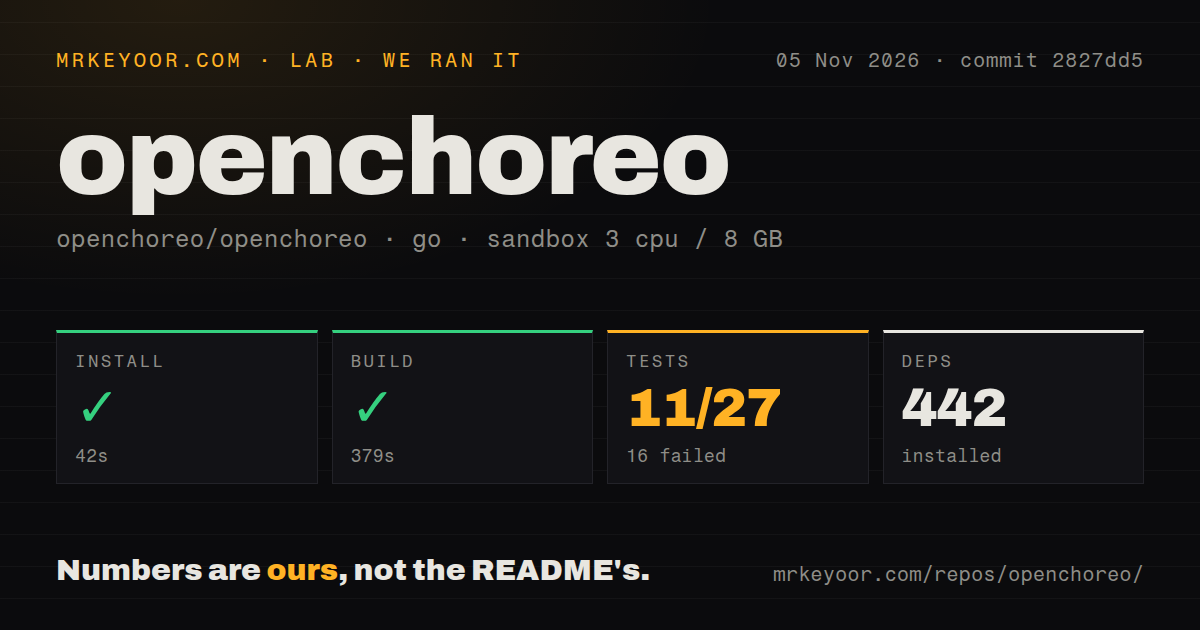
Our sandbox installed OpenChoreo's dependencies in 42 seconds and built commit 2827dd5 in 379 seconds on November 5, 2026. The record lists 442 dependencies. For someone working on the repository, this establishes that the recorded checkout cleared its build step. It says nothing about application rollout time or the operating cost of the platform.
The test command exited 1 after 528 seconds. The supplied summary records 11 passed and 16 failed out of 27 Go test results. These results should not be presented as a count of individual assertions across the project. The tail includes failures under the releaselines, secrets and workloadtypes end-to-end suites. It also shows successful results for Helm, workflow templates and audit-generation tools.
The underlying exceptions are absent from that tail. We cannot conclude that the failures came from missing cluster services, a particular dependency or a product defect. Anyone continuing this evaluation needs the full failing logs before deciding what to repair or rerun. The command failed; its cause remains unresolved in the supplied evidence.
The scan recorded 3,072 files, approximately 680,979 lines of source and a 37.6 MB checkout. It found 19 CI workflow files, a Dockerfile and a tests directory. That is a substantial repository to enter, and the build duration gives contributors a concrete planning reference. Workflow files show that automation is present, without proving its current results.
The recorded sandbox had 3 CPUs and 8 GB RAM, with image label golang:1.24-bookworm. We do not infer the actual Go or operating-system version from that label. No security-audit result or deployed workload measurement accompanies this run.
The quick start creates a cluster beyond the repository build
The current quick-start guide uses a preconfigured Dev Container, creates a local k3d cluster and installs OpenChoreo through Helm charts. Its sample application deployment is a separate action. These are useful distinctions when someone points to our successful build as evidence that the platform is ready to use.
Docker is part of that documented route. The example mounts the host Docker socket and uses host networking, so choose the evaluation machine with that access in mind. The guide also documents cleanup. We did not execute the guide, inspect its installed resources or verify that cleanup restores a particular host state.
The portal uses ThunderID for authentication and user management. Build and observability capabilities require additional flags in the quick-start installation. If your acceptance criteria include building an image from source or following an application's logs, include the relevant optional plane in the trial. A portal login alone would leave those requirements unanswered.
Component types are a platform team's ongoing responsibility
OpenChoreo's Platform API uses Kubernetes custom resource definitions. The README identifies ComponentTypes, Traits and Workflows as programmable abstractions for platform engineers. Application developers can work with services, workers and scheduled jobs while the platform team decides what those types mean underneath.
I would evaluate that contract with an existing service, rather than begin by recreating a large service catalog. Try expressing its endpoint and dependency requirements, then trace the resulting Kubernetes resources. The useful question is whether the supported model preserves the controls your operators need. Our run contains no isolation, access-control or traffic-policy validation, even though the README describes those as platform responsibilities.
A team with no Kubernetes operating practice should budget for learning both Kubernetes and OpenChoreo. Its higher-level resources do not eliminate ownership of the underlying cluster. The optional CI plane uses Buildpacks and Argo Workflows by default, which also matters when deciding how much of an existing delivery system to retain.
A portal framework or delivery tool may cover the actual gap
Backstage is a framework for building developer portals around a software catalog. Its README documents templates and technical documentation as well. Consider it directly when discovery and project creation are the problem, while your deployment conventions already work. OpenChoreo itself uses Backstage, so this is a question of scope rather than incompatible products.
Argo CD is a declarative GitOps continuous delivery tool for Kubernetes. Consider it when delivery from version-controlled definitions is the missing capability. We did not run either alternative or measure comparative effort. Neither comparison establishes that replacing OpenChoreo with a smaller part will be cheaper for your team.
Recent repository activity does not resolve our failed checks
GitHub records OpenChoreo's last push on November 6, 2026. The recent activity feed includes controller-fix and release-backport pull requests updated that day. That supports a finding of current development activity, without establishing that any proposed fix addresses our failures. None of the supplied log entries connects them.
Documentation earns 3/5 under this editorial rubric: 1 means no usable instructions, 3 means concrete instructions with material verification gaps, and 5 means independently checked coverage of documented routes. Setup, support capacity and production maturity remain unassessed. Before adoption, complete an isolated application deployment and recover the missing failure diagnostics. Those results would give a platform team grounds for a decision that the repository build alone cannot provide.