Choose LZ4 when getting data back into use quickly matters enough to justify a dedicated compression format. Before changing a storage pipeline, though, check what its readers understand. A decoder expecting a raw LZ4 block and one expecting an LZ4 frame have different contracts. The algorithm's name alone won't settle compatibility.
LZ4 supplies a C library and a command-line utility for lossless compression. The useful decision is whether its format and controls fit your application. Our repository checks passed, but they don't tell you how much space your records will save or how quickly your service will read them.
What happened when we ran it
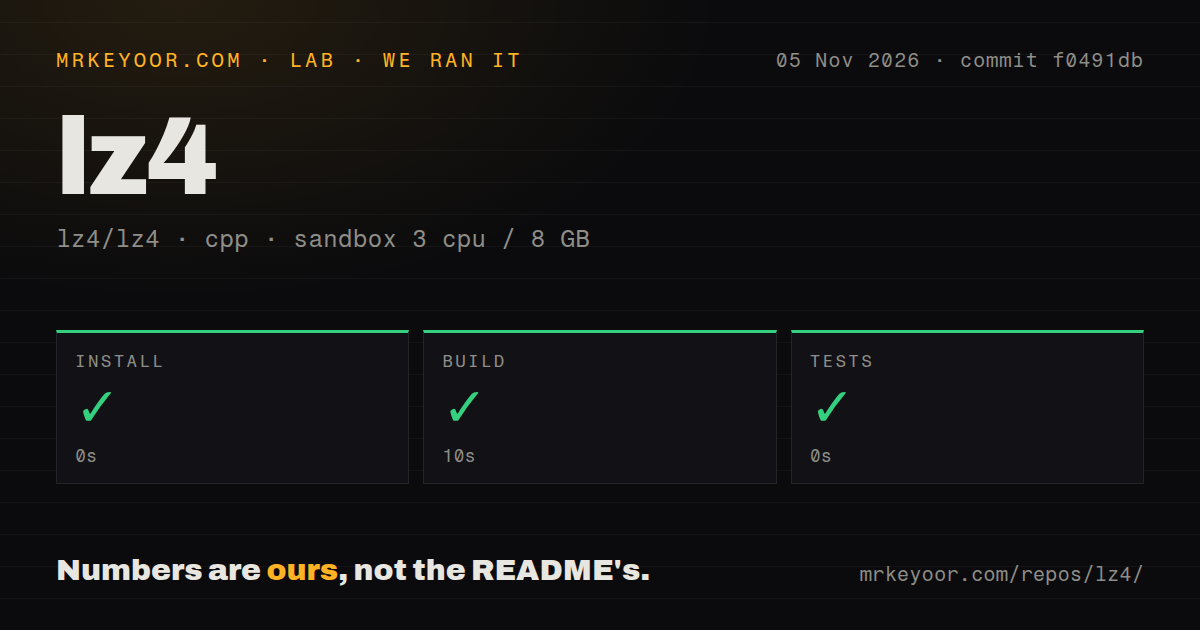
Our sandbox built LZ4 in 10 seconds at commit f0491db on November 5, 2026. The install and test steps both succeeded with recorded durations of 0 seconds. The record supplies no individual test count, test names or coverage breakdown. A zero-second entry is the recorded duration, not proof that a complete suite runs instantaneously.
The configured sandbox had 3 CPUs, 8 GB RAM and image lab-cpp:1. That label establishes neither the compiler version nor the operating-system version. The checkout contained 225 files, approximately 40,830 source lines and 2.3 MB. Although the lab classified the ecosystem as cpp, GitHub identifies the primary language as C.
Our scan found 11 CI workflow files and a tests directory, with no Dockerfile. Those are repository signals. They don't show which upstream checks our command exercised. No dependency count, installed footprint or vulnerability audit accompanies this record, so the successful install step cannot establish a dependency-free or audited deployment.
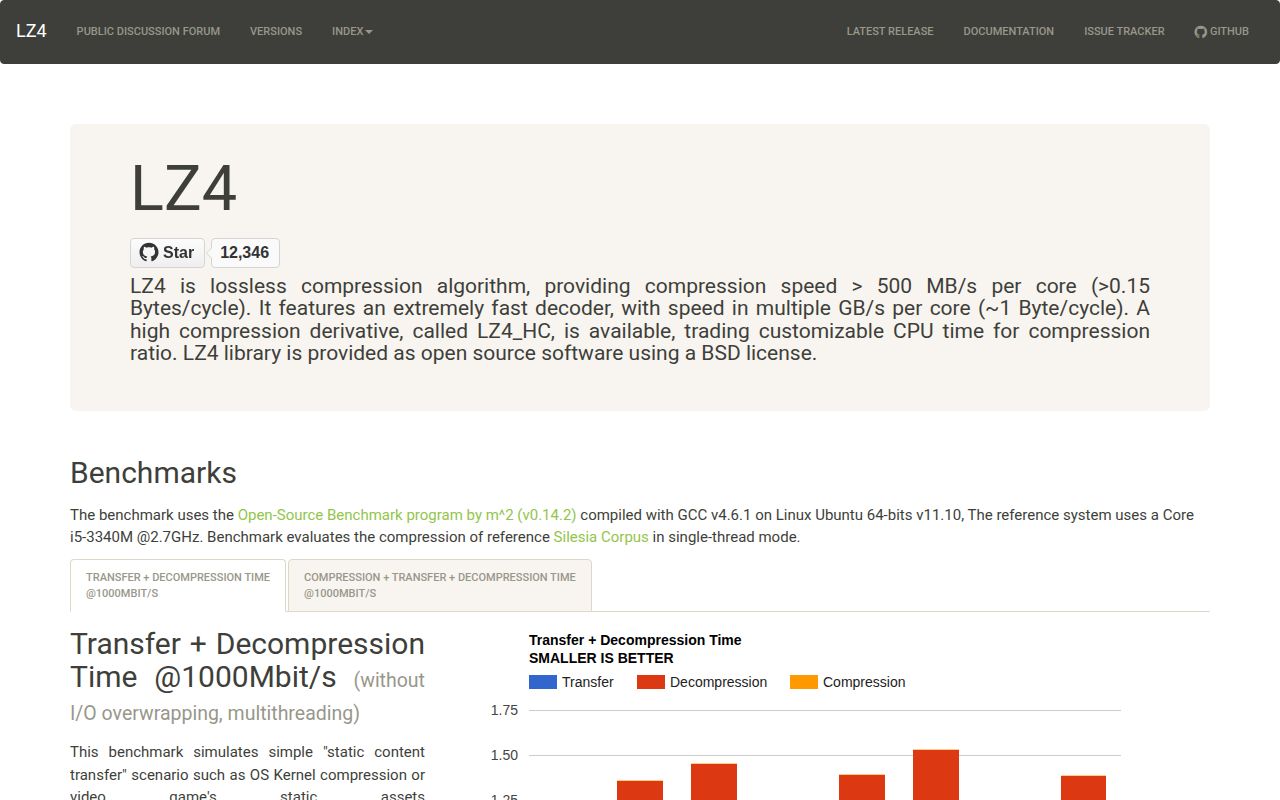
We measured no compression throughput, decompression throughput or compression ratio. The README's benchmark table is upstream evidence from a different workload and machine. Use our result to justify an integration trial, then measure representative data on the hardware that will actually process it.
Block and frame APIs require different integration choices
The README distinguishes raw blocks from frames used for files and streams. Interoperable file and stream implementations must respect the frame format. Pick the intended reader before picking the API, especially when exchanging compressed output across languages or services.
For example, a storage engine that already owns record boundaries has a different integration problem from a program sending a file to another machine. Specify the expected representation in that interface. Calling both payloads LZ4 leaves an avoidable ambiguity for the next developer who has to decode them.
The API references live in the library headers. Read the header for the selected interface alongside its format documentation. A successful repository build cannot confirm that your caller passes valid buffers or handles an incomplete input correctly. Those checks belong in the application trial, using the actual reader as well as the writer.
Library threading depends on how you link it
The v1.11.0 release, published November 4, 2026, introduces multithreaded compression through the frame API. Its worker setting is experimental. Treat the new option as something to qualify in your integration, especially if a stable API commitment is required.
The release says multithreading is enabled by default in the dynamic library. The static library stays single-threaded by default and can accept the worker setting while still using one thread. A configuration field being accepted therefore doesn't prove that your linked application gained parallel compression.
That distinction is enough to change an evaluation plan. Record which library artifact you link and observe the application's behavior with its normal concurrency. We did not exercise this feature in our sandbox. The upstream release's scaling results cannot serve as a prediction for a machine already busy processing other requests.
The library and command-line utility have different licenses
The library uses BSD 2-Clause, while the command-line utility uses GPL-2.0-or-later. Keep that distinction in the dependency record when deciding whether to embed the library or distribute the utility. GitHub's generic license field is less useful here than the README's explicit split.
The documented setup is local and lists no hosted service or API credentials. Your operating work concerns the compiled artifact and its callers. For an embedded application, qualify the library you ship. For file exchange, qualify the receiving tool too. Neither route gains compatibility merely because the producer compiled successfully.
Zstandard and Snappy are separate format decisions
Zstandard targets real-time compression with an emphasis on compression ratio. Evaluate it when that tradeoff deserves a trial against your data. Our LZ4 run provides no comparison between the two, and changing formats also requires checking every reader that will consume the result.
Snappy explicitly prioritizes high speed and reasonable compression over maximum compression. Choose it when Snappy is the format your integration needs, or include it in a workload comparison. Its README does not promise compatibility with other compression libraries.
Recent activity supports a trial, not a reliability guarantee
GitHub records a last push on November 5, 2026, with recent pull requests addressing CLI and library details. Alongside the November release, that establishes ongoing activity. It doesn't establish maintainer response times or reliability in your service.
Our editorial scale uses 1 for a documented major obstacle, 3 for a usable path with material caveats and 5 for broad validation within the assessed scope. Setup earns 3 because the recorded steps passed while application operation remains unverified. Documentation earns 4 for separate format and header references. Maturity earns 3 for the repository result and continuing releases, with coverage unknown. Community support is unassessed.
Take a representative file or record batch, compress it through the interface you intend to ship, and decode it with the actual receiving implementation. Keep the original bytes for comparison. That compatibility result should precede any decision based on a throughput headline.