The Terraform AzureRM provider's source checkout exceeded our 900-second limit for both build and tests. That is a material finding for someone changing the provider. It tells an infrastructure team much less about using a published provider to manage Azure resources.
The adoption decision starts with your chosen resource and workflow. AzureRM connects Terraform configuration to Azure Resource Manager, while AzAPI and Bicep offer different ways to describe Azure changes. Our run did not provision anything in Azure.
AzureRM manages resources through Terraform configuration
The AzureRM README shows a provider declaration followed by a resource group and a virtual network. The network refers to the resource group's name and location. This is a useful introduction for someone who wants related Azure resources described together in Terraform configuration.
The example specifies the provider source and pins a version. Follow that practice when evaluating a resource: record the provider version alongside your configuration so a later change has an identifiable starting point. The current README's example is documentation, not evidence that its version matches our measured commit.
Authentication supports Azure CLI, Managed Identity and Service Principal routes. Choose the identity your intended execution environment can use and verify its permissions in a disposable Azure scope. The provider declaration is only part of that preparation. Our source run establishes neither authenticated access nor permission to create a resource.
What happened when we ran it
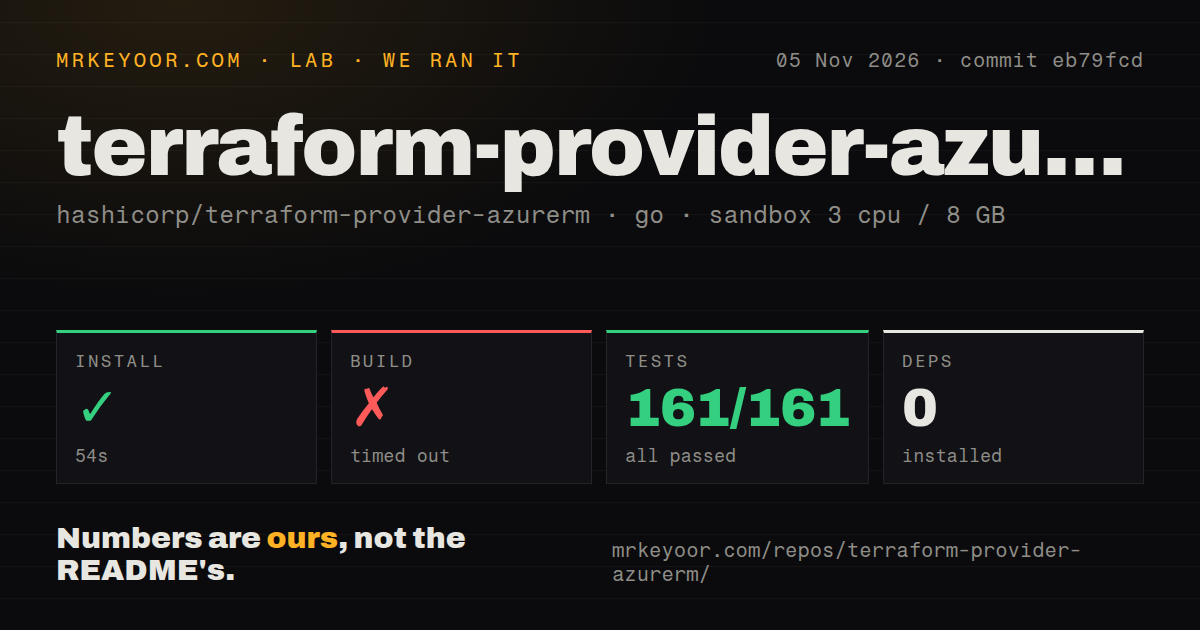
Our November 5, 2026 sandbox run completed AzureRM's install step in 54 seconds, but the build and test steps each timed out at 900 seconds. The measured commit was eb79fcd. The test record reports 161 passes and 0 failures among 161 recorded results. Because the command timed out, those results do not establish a completed suite or its full size.
The retained test tail shows successful package results under CDN, Chaos Studio and Code Signing, followed by Cognitive Services packages. Several entries report no test files. Its last line is a successful cognitive_account package result. There is no failing assertion or explanatory error in that tail, so it cannot tell us why the overall command exceeded its limit.
The dependency recorder reported 0 entries after the successful install step. Treat that as a recording result, without concluding that this Go provider has no dependencies. The checkout contained 11,372 files, approximately 1,528,088 source lines and 64 MB. The scan recorded 48 CI workflow files, no Dockerfile and no tests directory. The package results themselves show why the absence of that directory cannot establish an absence of tests.
The configured sandbox had 3 CPUs, 8 GB RAM and image golang:1.24-bookworm. The image label does not establish the actual Go or operating-system version. No vulnerability-audit result accompanies the run, and neither a working provider binary nor an Azure resource lifecycle was verified.
These limits matter in different ways. A contributor cannot use this run as a completed validation of the checkout. A user cannot turn its timeouts into evidence that a downloaded provider fails to create a virtual network. We have no log evidence that attributes either timeout to a particular package, toolchain mismatch or Azure service.
A source contributor needs the documented toolchain
The contributor guide points to the repository's .go-version for Go and expects Terraform on the machine. It also documents Python and npm for non-Go tooling. Check those requirements against the selected checkout before treating a generic Go container as a supported development environment.
Windows contributors have extra requirements: the guide calls for Git Bash and Make, and describes line-ending and long-filename pitfalls. These are documented cautions, without evidence that they caused our sandbox timeouts. Source development therefore deserves its own evaluation rather than inheriting an ease-of-use claim from the short resource-group example.
Setup ease remains unassessed because the recorded install step was followed by incomplete build and test commands, and the record does not establish a supported toolchain. Operational maturity is also unassessed: successful local package results tell us nothing about an Azure deployment's behavior when a resource changes or disappears.
AzAPI covers ARM gaps, while Bicep uses a different language
AzAPI describes itself as a thin layer over Azure Resource Manager REST APIs. Its README explicitly positions it as a complement for resources and features that AzureRM does not yet, or may never, support. Consider it when a specific required API is missing from AzureRM's resource interface. Check that exact gap before choosing it, rather than assuming every preview feature requires a different provider.
Azure Bicep is a declarative language for deploying Azure resources. Its README says state is stored in Azure, with no state files to manage. Evaluate it when an Azure deployment language fits your team better than a Terraform provider workflow. This is a choice of operating model, without a measured speed or reliability advantage for either alternative.
For AzureRM, begin with the resource you actually intend to manage. In a disposable scope, review the proposed change, create the resource and check what a subsequent configuration change would do. Verify cleanup too. These are proposed acceptance checks; the source run completed none of them. Keep the provider version and execution identity in the record so any unexpected behavior can be investigated against the same configuration.