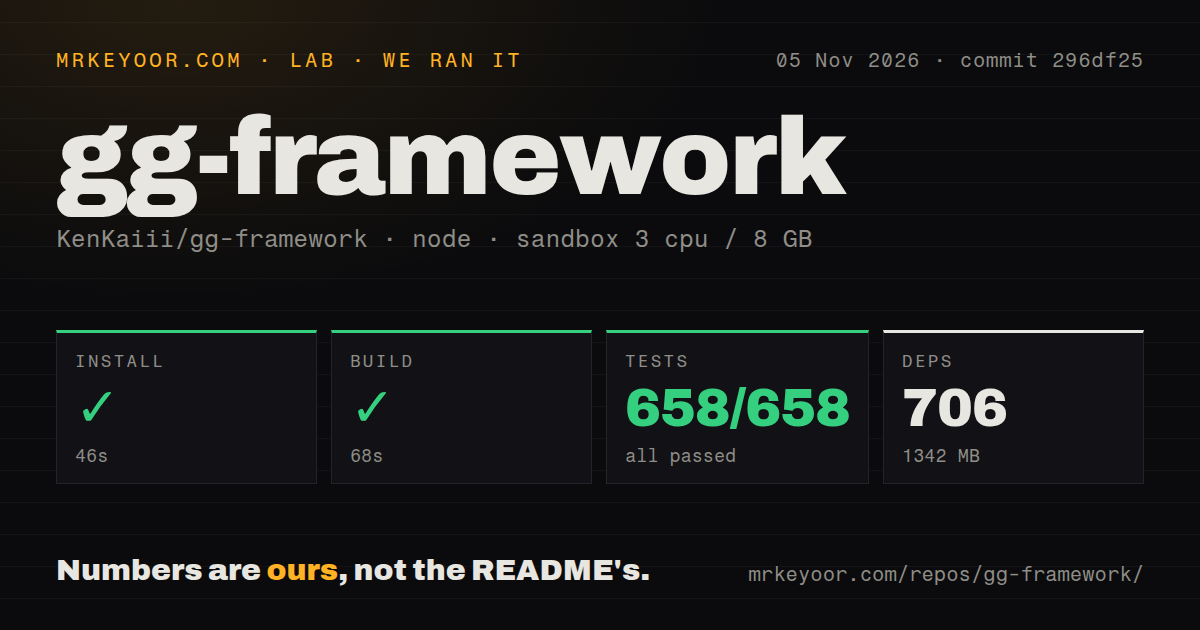

GG Framework's source build passed in our sandbox, but its test command failed. Developers considering its reusable agent packages need to investigate that result. GG Coder's desktop installers require a separate evaluation.
The framework and desktop app serve different readers
The README presents GG Coder as a desktop coding agent with connected AI providers, Chat, Motion and goal-based work. GG Framework exposes packages for provider responses, tool-using agents, authentication and the coding engine. The README explicitly allows developers to use those packages in their own applications without adopting the desktop app.
An application developer may want a particular package. Someone seeking a coding assistant can evaluate the app or CLI instead. Our source-workspace measurements describe the development route; they do not establish minimum requirements for the packaged app.
The project uses AGPL-3.0 licensing. The README says developers who distribute changes or run them as a network service must share their source under the same license. Resolve whether those terms fit your product before building around the packages.
What happened when we ran it
On November 5, 2026, our sandbox installed GG Framework in 46 seconds and built it successfully in 68 seconds at commit 296df25. The releases page identifies v0.102.2 with commit 296df25. The test command exited 1 after 742 seconds. The run recorded 706 dependencies occupying 1,342 MB on disk and a 57.8 MB checkout.
The summaries require care. The parser records 658 passed and 0 failed. The packages/ggcoder log tail reports 46 failed, 4,854 passed and 18 skipped. These entries do not establish an exhaustive workspace total. The unsuccessful command exit and explicit failure summary mean this run cannot be described as a passing suite.
The tail names failures in motion-music-fit, motion-reference-study and motion-review-frames, plus session-storage-fd-leak. It does not expose the underlying assertions or exceptions, so it cannot establish their causes. A filename mentioning file descriptors is not proof of a live leak.
The recorded configuration was 3 CPUs, 8 GB RAM and image lab-node:22. Actual runtime and operating-system versions are not established by that label. The scan found monorepo workspaces, two CI workflow files, no Dockerfile and no tests directory. The inline .test.ts paths in the log show why the directory observation does not mean the repository lacks tests.
The supplied run contains no generated-code quality assessment, completed desktop or provider session, measured provider-cost comparison, or vulnerability-audit result.
Source setup requires Tauri and a provider choice
The development instructions require Node.js, pnpm and Tauri prerequisites. The README separately lists desktop downloads for Apple Silicon macOS, Windows and x86_64 Linux. Those download routes were not verified in the supplied run.
The coding-engine documentation describes provider login through OAuth or API keys, depending on the service, and local models behind an OpenAI-compatible server. Authentication is stored in ~/.gg/auth.json and shared with the desktop app. Choose your intended provider route before evaluating generated work or usage costs.
The documentation also describes custom MCP connections, tool schemas loaded on demand and an optional Playwright dependency for screenshots. The supplied source run does not establish that provider login, MCP connections or browser screenshots work in a representative session. These are documented capabilities, not results from our sandbox evaluation.
Rewind excludes shell-made changes
The coding-engine README says checkpoints capture prior content before write/edit tool operations. Changes made through bash are not captured. That leaves shell commands such as code generators and bulk file edits outside the documented checkpoint coverage.
Trial GG Coder in a repository with ordinary Git recovery, and inspect the resulting diff before continuing. Its documented tools can write files and execute shell commands. Checkpoint coverage therefore matters when deciding how much work to delegate.
Activity and alternatives do not resolve the failed checks
The README publishes its own coding-agent efficiency comparison. Our workspace build measures a different activity and provides no evidence of cheaper prompts, faster edits or better answers than another coding assistant.
The releases page lists v0.103.1 on November 5, 2026. Supplied repository metadata, observed on November 6, records the last push as November 5, 2026 at 20:27:11 UTC. The supplied open-issue view returned no matching issues. These observations show dated repository activity and the result of that issue filter; they do not establish support responsiveness or show that the failures at v0.102.2 were fixed.
Aider documents automatic Git commits and using familiar Git tools to review and undo AI changes. Consider it when that recovery workflow is central to your choice. Goose documents desktop, CLI and API routes with MCP extensions. Consider it when a general-purpose local automation agent fits your needs. Neither alternative was measured against GG Framework in our sandbox.
The numerical ratings below assess documentation and source-verification readiness, not coding quality. On this five-point scale, 1 means severe documented barriers, 3 means a documented evaluation path with material limits, and 5 requires independently demonstrated coverage of the intended workflow; 2 and 4 fall between those anchors. Documentation earns 3 for specific development, authentication and checkpoint guidance. Maturity earns 2 because the source test command failed and the supplied tail does not explain the failures. Complete setup and support responsiveness remain unassessed.
Before adopting the framework, reproduce the failed checks at your chosen revision and verify one representative agent task through your intended provider.