Installation stops before the host changes begin
A six-second dependency install leaves the main question about dsh-purge unanswered: does it correctly change the DeepSeek Harness version you actually run? The plugin works on an existing local host, and its README separates fetching the package from applying its patches. Our sandbox covered the dependency step. It did not exercise that host-modification path.
That boundary matters if you are evaluating model behavior. DeepSeek Harness can alter the request and its execution environment before the model's answer appears. dsh-purge describes changes to prompts, approval policy and tool limits so a researcher can investigate the host's contribution. Treating every refusal as a model-level result would miss the distinction this plugin is intended to expose.
What happened when we ran it
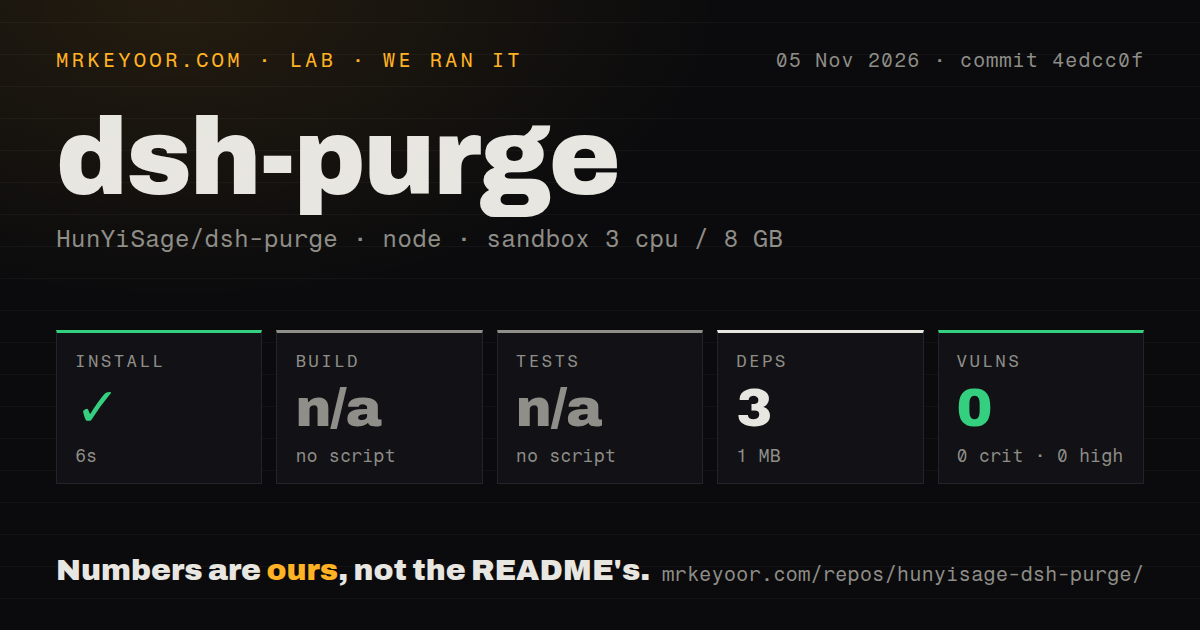
Our sandbox installed dsh-purge in 6 seconds, recording 3 dependencies and 1 MB on disk. The run used commit 4edcc0f on November 5, 2026. There was no build script or target and no test script or target, so both steps were skipped. A skipped check supplies no passing result.
npm audit reported 0 known vulnerabilities, with none in any severity category. That is a dated dependency-audit observation. It does not verify the plugin's local file changes, restoration behavior or handling of a supported Harness host. No measured red-team outcome accompanies this run.
The configured sandbox had 3 CPUs, 8 GB RAM and image label lab-node:22. The image label establishes neither the actual Node runtime nor the operating-system version. The scan found one CI workflow file, no Dockerfile and no tests directory. Those are repository-scan findings, not evidence that every upstream verification method is absent.
The selected profile determines which host is changed
The README supports official Web and desktop hosts and says to install and apply them separately. It describes package installation adding the plugin to a profile's bundles and inserting a configuration entry. A package present on disk is therefore only part of the documented loading path.
After the host loads the plugin, Apply in its Clean panel writes the changes. Web controls affect Web, and desktop controls affect desktop. The troubleshooting instructions spend considerable space on selecting the right home and profile because a machine can have multiple homes. That is useful documentation, but our run does not establish that profile discovery works on your installation.
The guide also documents Restore and Uninstall, including reverting applied patches. Those are claims to verify in a disposable copy before depending on them. For an evaluation record, save the exact host artifact, plugin revision and patch status alongside the prompt and response. Otherwise a later change in host policy can make two model results difficult to compare.
The README and release notes disagree about RC support
The current English README identifies version 1.1.90 and targets DSH 0.2.1-rc.2. It explicitly says rc.3 and newer RCs are unsupported. The latest-release endpoint instead returns v1.1.92, published November 5, 2026, whose included 1.1.91 notes say the host target now includes rc.5 alongside rc.2.
That mismatch prevents a simple compatibility recommendation. The release notes provide evidence that the maintainer changed the declared target. They do not establish that our sandbox validated either host version. Choose a specific release artifact and check its matching host guidance before applying anything to an installation you need to keep using.
The same release describes bundled skills and explains that the knowledge base is a local database generated at runtime from local templates and manual entries. Do not assume that a checked-out repository contains a populated database ready for an evaluation. Nor should the README's broad jailbreak language be treated as evidence that every model will behave as claimed.
The Apache label needs to be read beside the README
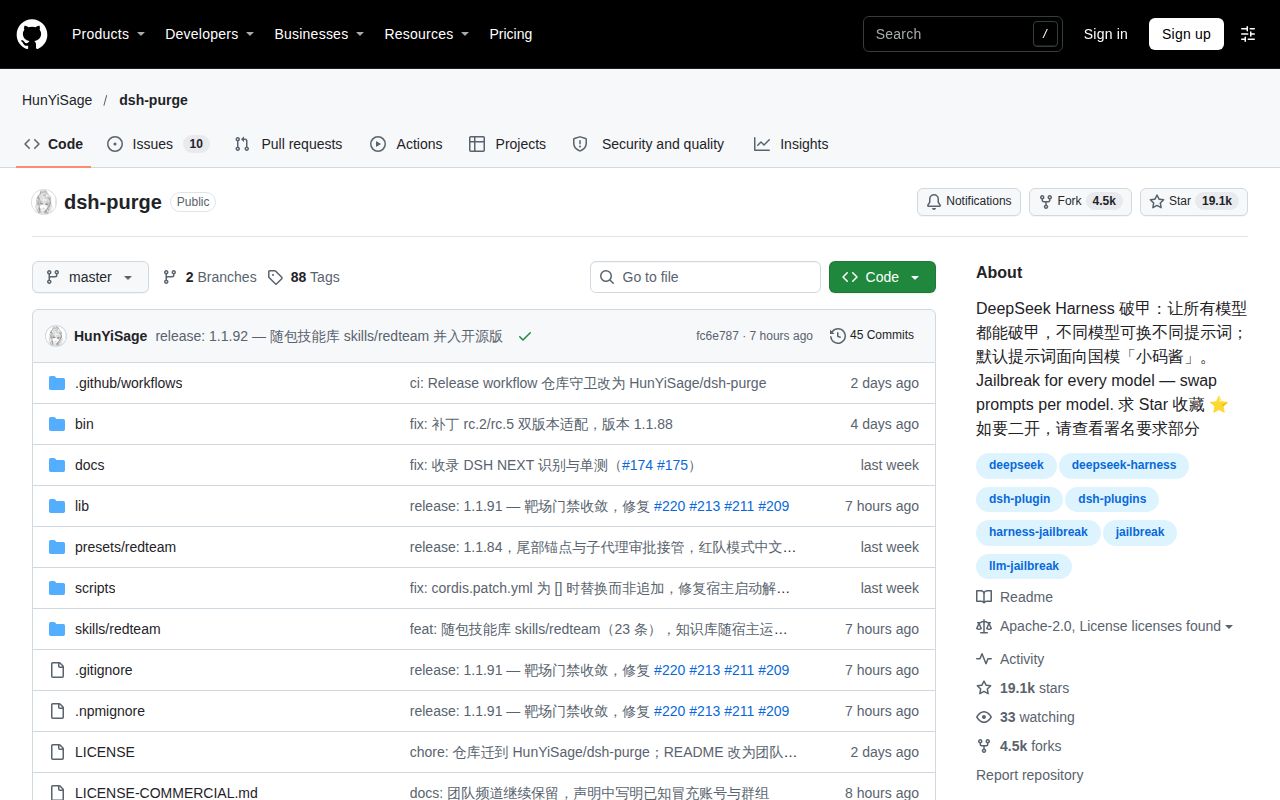
GitHub identifies Apache-2.0, and the LICENSE file contains the Apache License. The README also prohibits resale of the original build and lists restrictions on targets and use. These statements coexist in the current project documentation. The badge alone does not explain how the maintainers intend them to fit together.
For internal evaluation, read the stated boundaries before selecting a use case. For redistribution or a commercial dependency, obtain clarification about the terms you intend to rely on. This review records the conflicting signals rather than resolving their legal effect. The current README identifies a maintainer team and links English, Chinese and Japanese documentation, so describing today's project as having only Chinese instructions would also be misleading.
GitHub records a last push on November 5, 2026, and recent issues concern host-version declarations and compatibility. Together with the new release, that establishes current activity. It does not establish a support commitment. Older descriptions of a GitHub release cutoff do not describe the release endpoint retrieved for this review.
Promptfoo and Garak answer different evaluation questions
Promptfoo is a CLI and library for evaluating and red-teaming LLM-based applications. Consider it when you want to assess application behavior through an evaluation runner, without making local Harness patching the subject of the exercise.
Garak is an LLM vulnerability scanner. Its README describes probes for unwanted behavior in LLM-backed applications. It is relevant when the question concerns what an application will produce under probing. Neither alternative is presented here as a measured winner or as a drop-in replacement for Harness host modifications.
All four rating dimensions remain unassessed: our successful dependency step does not establish supported setup, and the documentation conflict blocks a confident compatibility judgment. Before choosing dsh-purge, make one disposable host your acceptance case: confirm the intended profile, inspect what Apply reports, and verify restoration against the saved original.