mise replaces three development setup layers
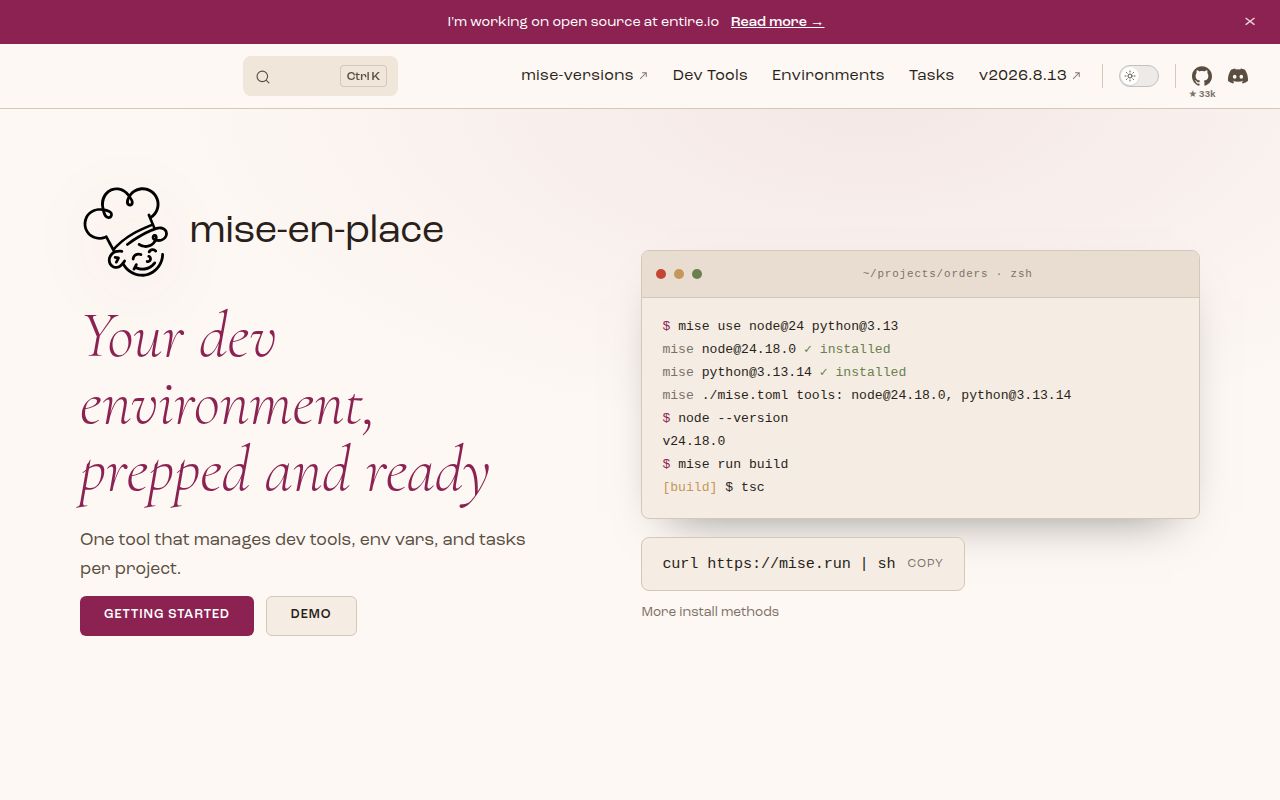
mise manages tool versions, project environment variables, and tasks from one CLI. A mise.toml can select Node, Python, Terraform, or hundreds of other tools, set project-specific values, and define commands such as build or deploy. Shell activation updates the environment when a developer enters a directory, while mise exec provides an on-demand route that does not permanently modify the current shell.
Our checkout at commit 87ed638 contained 3,354 files, about 313,833 source lines, and occupied 27.7 MB. The main implementation is Rust, but the repository also includes documentation and web tooling that our harness detected as a Bun workspace. Twenty-three GitHub Actions workflow files, a Dockerfile, and a tests directory show a mature contributor surface. Users normally install a release binary.
One file can align local shells and CI
The practical gain is reducing setup drift. A project can declare tool versions, required environment names, and canonical tasks beside its code. New contributors run mise install, while CI resolves the same configuration. Compatibility with asdf's .tool-versions and common files such as .node-version lowers migration work. Teams can move gradually instead of rewriting every repository before the first user adopts mise.
The README's combined example pins Terraform 1 and AWS CLI 2, sets workspace and region variables, then defines validation, planning, and deployment tasks. That is convenient, but it also gives one configuration file authority over tool downloads, environment, and commands. Ownership should be clear. Code review for mise.toml, task files, hooks, backends, and lockfile changes deserves the same attention as a CI workflow change.
What happened when we ran it
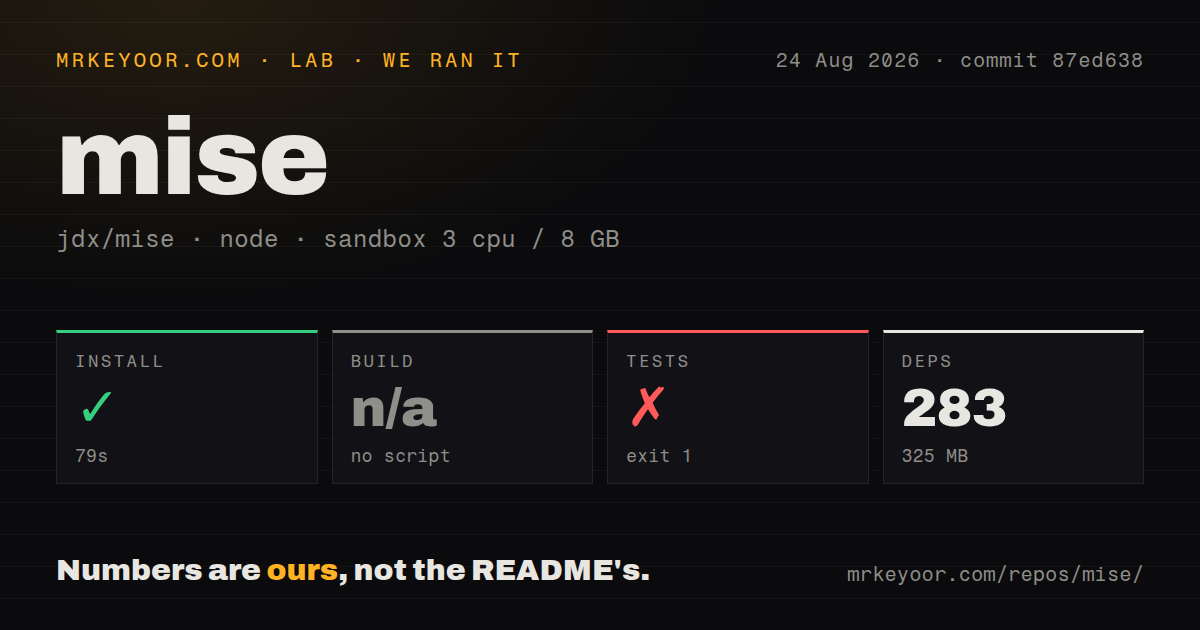
Our Bun install succeeded in 79 seconds in a fresh Debian sandbox with 3 CPUs and 8 GB of RAM. It installed 283 packages and used 325 MB on disk. The root exposed no build script or target, so the harness skipped build. This measured path belongs to repository support tooling, not compilation of the primary Rust binary.
The root test command failed after 6 seconds. Its entire behavior was to print Error: no test specified and exit with code 1. The lab therefore has no passing test count, and the failure does not say that mise's Rust tests failed. It says the generic package-script probe found a placeholder. Contributors should follow the repository's native Rust workflow instead of using the root package manifest as the quality gate.
That distinction prevents an unfair conclusion in either direction. The 79-second install and 325 MB footprint matter to people working on the detected Bun workspace. They do not measure installing the normal mise binary through mise.run, a package manager, or a GitHub release. Likewise, 23 CI workflow files do not replace a local result for the actual component being changed.
Trust controls matter because config can execute code
The security guide says project configuration can run templates, hooks, tasks, plugin scripts, and post-install actions. It can also inject environment variables, alter PATH, and set options that affect resolution. mise has a trust system for normal use and a separate safe mode for configurations the operator does not control. The distinction is useful: trust decides which configs load, while safe mode makes loaded project config inert.
With MISE_SAFE=1, mise refuses code-bearing templates, tasks, plugin installation, hooks, and tool post-install actions. It ignores project environment, shell aliases, PATH directives, and project settings while still allowing version resolution through supported HTTP-based backends. The docs specifically position this mode for automation that inspects pull-request branches. A scheduled lockfile update should use it rather than granting an unknown branch ambient shell authority.
Supply-chain checks vary by backend
For aqua-backed tools, mise can verify Cosign or Minisign signatures, SLSA provenance, and GitHub artifact attestations. Node.js and Swift downloads have built-in OpenPGP checks. A minimum-release-age setting can delay newly published tool versions, and lockfiles can record checksums and provenance. These controls are valuable because the CLI connects to many registries and installers; they do not mean every backend supplies identical metadata.
The docs give 7d as a minimum-age example and explain that explicit pins such as Node 22.5.0 bypass fuzzy-version filtering. Transitive age filtering is limited to npm and pipx, while versions without timestamps are included by default. Teams should document which backends they allow and what verification each one supplies. A single mise install command may still cross several independent upstream trust systems.
Environment redaction has a raw-output exception
mise can load .env files, require variables without assigning them, and mark names or patterns for redaction. The environment guide also warns that task redaction works by intercepting output line by line. Tasks using raw = true bypass that interception, so sensitive values can reach terminal or CI logs. CI systems may need their own masking in addition to mise's declarations.
This matters because the same mise.toml may define a deployment task and its required credentials. Redaction is useful, but it is not secret storage and does not repair a command that prints a credential deliberately. Keep secret values in the chosen secret provider or CI store, review task output modes, and test log behavior with disposable values before a 325 MB tool workspace or a production deployment depends on the configuration.
Release activity is current, with support in Discussions
Version v2026.8.12 was published on 2026-08-24. It added plugin-package pruning and fixed configuration parsing, comment preservation, interrupted task handling, PATH behavior, terminal restoration, Go environment leakage, diagnostics, and package-manager ownership checks. The repository was pushed again on 2026-08-25. The README's quick-start transcript already displays 2026.8.13 from main, so users should distinguish current documentation from the latest GitHub release object.
GitHub reported 64 open issues and pull requests, but the issue-only search returned no items. The README explains why: troubleshooting and bug reports moved to GitHub Discussions after issue volume became difficult to manage. That policy makes the latest release and same-day push better health evidence than the empty issue search. mise is actively maintained; adopters still need a process for following Discussions and frequent dated releases.